
Important Cultural Property of Nara
奈 良 県 の 重 要 文 化 財Nara’s Important Cultural Properties — designated for their value to the nation’s cultural history.
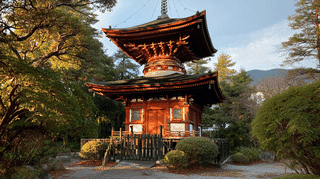
An early Edo-period Buddhist pagoda in Kashihara, Nara Prefecture, Japan. It stands on the great foundations there that are some 1000 years older still.
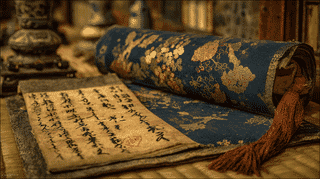
A Nanbokucho-period manuscript held at Tenri in Nara Prefecture. Its own category field there spans three headings, with others appended after them all.

A single handscroll recording a waka poetry contest at the court of Emperor Daigo, hosted by a consort, preserving the verses and verdicts of a Heian gathering.
At Hannya-ji in Nara stand two granite kasa-tōba, stone memorial pillars raised in 1261 by I no Yukiyoshi for his late father and his still-living mother.
The Kachomon Kei is a Heian bronze ritual gong from Nara, decorated with flowers and birds and struck during Buddhist services as a signal. Designated in 1953.
Beneath the central pillar of a vanished Gango-ji pagoda lay gold, beads and eighth-century coins, unearthed in 1927 and now kept at the Nara National Museum.
Privately held in Nara, the Ki Clan Genealogy is a fourteenth-century scroll of one of Japan's oldest noble families. Its reverse hides a rare 1351 kana calendar.
Forty-one landscape panels by Sakaki Hyakusen, a pioneer of Japan's Nanga school, painted in 1751 near Nara and now on deposit at the Nara National Museum.
An Important Cultural Property in Nara: a bronze Buddhist chime cast in 1208 with paired peacocks, linked by hand to a National Treasure kei made the next year.
An Important Cultural Property in Nara, this Kamakura-period mandala on silk anchored the secret Ichiji Kinrin rite. Privately held, it is not on public display.
A twelfth-century Heian lacquer box for a court cap, worked in hyomon with silver and gold set flush into black lacquer. A Kasuga Taisha treasure that lost its lid.
An Important Cultural Property by Ogata Kenzan: a half-cylinder tea bowl with an iron-brown waterfall on one side and a poem on the other, both from his own brush.
The Sanzon Senbutsu is a fired-clay plaque of a seated Buddha and two standing attendants, designated in 1901 among the earliest protected objects in Japan.
An Important Cultural Property tachi forged in 1319 by Kyoto's Rai Kunitoshi, its slender form and quiet straight temper marking the smith's late style.
Kept above ground rather than buried, the two iron shields of Isonokami Jingu in Nara are rare, near-complete Kofun-period pieces and an Important Cultural Property.
The Tennin-mon Sen from Asuka's Okadera is a square clay tile carved with a celestial being lifting a scarf, a rare survival now held at the Kyoto National Museum.
The Wooden Ichiman-setsutō with lotus base at Hōryū-ji in Ikaruga, Nara, is a unique seven-tiered miniature pagoda created in the 8th century as a special marker for every 10,000 of the one million pagodas commissioned by Empress Shōtoku. Designated an Important Cultural Property and the only surviving example in the world, it stands at the origin of printed dharani, among the world's oldest dated printed materials. It is preserved in the Daihōzōin treasure hall at Hōryū-ji, a UNESCO World Heritage Site.
Preserved at Hōryū-ji in Ikaruga, Nara, the Wooden Jūmanzettō (with Remnant Lotus Pedestal) is the sole known surviving example of the thirteen-storied pagodas crowning Empress Shōtoku's eighth-century million-pagoda project. Originally one of just ten distributed to ten major temples after the Fujiwara no Nakamaro Rebellion, it embodies the imperial vow for state protection and the era that produced some of the world's oldest dated printed materials.
Held in the Daihōzōin of Hōryū-ji in Ikaruga, Nara, the Wooden Million Small Pagodas were commissioned by Empress Shōtoku in the 8th century after the Emi no Oshikatsu Rebellion. Each palm-sized three-tiered pagoda contains a printed dharani scroll regarded as the world's oldest dated printed text. Designated an Important Cultural Property, they are a remarkable testament to Nara-period devotion and the dawn of printing in Japan.
A National Important Cultural Property held privately in Nara Prefecture, this set of six color-on-paper fusuma panels was painted in 1751 by Sakaki Hyakusen (1697–1752), one of the four founding figures of Japanese Nanga literati painting, just one year before his death. Depicting Mount Tiantai's legendary stone bridge and its abode of five hundred arhats, the work is part of the 41-panel cycle known as the Former Jimon-in Wall Paintings — the largest surviving program of architectural painting by Hyakusen and a milestone in the adaptation of Chinese Southern School painting to Japanese fusuma format.
More from Nara
Nara’s registered properties across designations, with featured heritage and travel notes.
The complete kokuhō catalogue — browse by prefecture, period, and category.
Nationwide jūyō bunkazai — architecture, sculpture, painting, crafts, and documents.