
Edo
Niigata · 江戸Browse Niigata’s cultural heritage from the Edo period (1603 – 1868). Filter by type and keyword, with concise stories, maps, and travel tips.
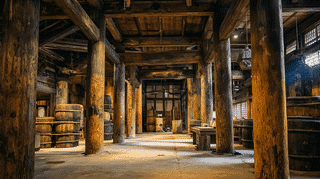
Explore the Yoshikawa Family Residence Storehouse, a Registered Tangible Cultural Property built in 1841. This authentic Edo-period dozo storehouse in Murakami City reveals the fascinating history of sake brewing and salmon culture in northern Niigata. Plan your visit to this off-the-beaten-path destination.

The Three-story Pagoda of Oppoji Temple in Tainai City, Niigata Prefecture, is a nationally designated Important Cultural Property built in 1620 through the patronage of the lord of Murakami Castle. Standing approximately 24.2 meters tall, this pure Japanese-style pagoda is celebrated for its unadorned elegance and perfectly balanced proportions. Set within one of Niigata's most ancient temples founded in 736, the grounds are steeped in legend — from the sacred relic of the Buddha's left eye to the legendary spring water Dokkon-sui associated with the great monk Kūkai.
The Tohashira Shrine Hall, a nationally designated Important Cultural Property standing within the sacred precincts of Yahiko Shrine in Niigata Prefecture, was built in 1694 by the feudal lord of Nagaoka Domain. This thatched-roof shrine preserves late Momoyama-period carvings and holds a surprising historical connection to one of Japan's greatest civil engineering projects.
The Yamaguchi Family Residence, located in the mountainous village of Shimode in Itoigawa City, Niigata Prefecture, is a late Edo-period farmhouse built in 1779. Designated as an Important Cultural Property of Japan, it exemplifies snow-country architecture with its robust structure, elevated floors, and distinctive adze-hewn beam framework unique to the Kubiki region.
The Haiden and Heiden of Arakawa Shrine, standing on a hilltop in Momozaki-hama, Tainai City, Niigata Prefecture, is a Registered Tangible Cultural Property built in 1841. Reflecting the prosperity of this former Kitamaebune trading port, the building features an irimoya-style copper-clad roof, richly carved entrance porch, and an imposing interior with four rainbow beams and bottle-shaped struts.
Discover the Arakawa Shrine Main Hall in Tainai City, Niigata — a Registered Tangible Cultural Property built in 1841. Its elaborate wave carvings and ornate details reflect the wealth brought by Kitamae-bune trade ships along the Sea of Japan coast.
Ikinariya's rear gate, a late-Edo service gate on the hill behind the buildings, has a single lattice leaf with a sliding wicket and carefully chamfered posts.
Ikinariya's main building, in a Niigata ryotei founded around 1700, is a late-Edo two-story wooden hall with an L-shaped doma, one of ten structures registered in 2000.
Registered in 2025, the Main Building of the Enami Family Residence in Niigata City is a late Edo farmhouse whose thatched roof covers a twenty-one mat Ochanoma.
The Shed of the Enami Family Residence in Niigata City, registered in 2025, is a late Edo outbuilding split into a bedding room, a book store and a charcoal store.
A late Edo farmhouse at Hossue in Nagaoka, Niigata, registered in 2011: a hipped thatch roof 13m, an earth-floored niwa, a four-room plan and an attached stable.
Built in 1867 in the mountain hamlet of Wakatochi in Ojiya City, Niigata, this chūmon-zukuri farmhouse exemplifies the architectural wisdom of Japan's snow country. Featuring elegant reception rooms with tokonoma alcoves and shoin-style details, it was registered as a national Tangible Cultural Property in 2016. Now operating as a farmhouse inn, it offers authentic country cuisine, seasonal farm experiences, and a moving story of community revival after the 2004 Chuetsu Earthquake.
Kappo Tochu Honkan in Ojiya, Niigata, is a late-Edo three-storey wooden restaurant listed in 2015. Kawai Tsugunosuke reportedly lunched in its Plum Room in 1868.
Discover the Former Iida Family Residence in Jōetsu, Niigata — an 1853 Edo-period thatched-roof farmhouse registered as a Tangible Cultural Property. Featuring the distinctive chūmon-zukuri style of the Echigo region and massive timber framing built to endure heavy snowfall, this architectural treasure offers a rare glimpse into rural life in Japan's snow country.
Saieiji Kyozo in Tokamachi, Niigata, is a mud-walled sutra repository of about 1848. Just 13 square metres, it holds an altar and scripture shelves. Registered 2000.
Saieiji Kuri and Corridor in Tokamachi, Niigata, is a two-storey temple residence of about 1848, joined to the main hall. Its shoin rooms survive. Registered 2000.
Saieiji Shoro in Tokamachi, Niigata, is a 9.2 square metre belfry of about 1848 on a high platform. Its bell still sounds daily at eleven. Registered 2000.
Saieiji Hondo in Tokamachi, Niigata, is a Shinshu main hall rebuilt in 1848 after fire. It is 19 metres wide, with a deeply carved porch. Registered in 2000.
A late Edo storehouse said to have been moved to Sekiya around 1845. Its placed roof sits free above plastered walls, a fire defence. Registered in 2000. Not open.
Nine years older than the main hall it adjoins, this 1785 priests' wing in Tainai, Niigata, was registered in 2018 for its sequence of shoin reception rooms.