
Shōwa
Niigata · 昭和Browse Niigata’s cultural heritage from the Shōwa period (1926 – 1989). Filter by type and keyword, with concise stories, maps, and travel tips.
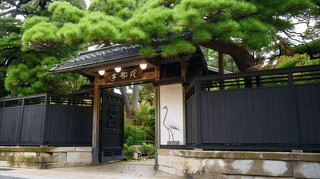
Explore the Ikinariya Storehouse (Dozou), a Registered Tangible Cultural Property of Japan built in 1928. Located in Niigata's historic Nishiohata district, this traditional Japanese storehouse features a stunning crane relief plaster art and represents the elegance of a legendary ryotei with over 300 years of history.

The Former Hirasawa Residence (Shoraikaku) in Nagaoka, Niigata Prefecture was completed by 1934 by Hirasawa Yonosuke, founder of the Asahi Shuzo sake brewery, and was designated an Important Cultural Property in 2018. Blending a traditional Japanese house with Art Deco stained-glass round windows and parquet floors, the residence showcases early Shōwa craftsmanship at its finest and is open to the public.
Ikinariya's middle gate and wall of 1928 form an inner boundary: a light gate with a natural-timber ridge, shingle roof and woven door, beside a wall by the storehouse.
Ikinariya's detached room, a 1928 wing and its largest registered structure, sets Western lamps and a natural-wood rail within a Japanese hall, cranes throughout.
A 1942 reinforced-concrete underpass links the building and island platform at Nihongi. Trains reverse across the main line here, so passengers cross safely below ground.
A 1937 steel roof shelters the island platform at Nihongi. Its columns reuse old rails, American ones from 1923 and Yawata Works rails from 1929, welded head to head.
A 1935 wooden waiting room stands on the Nihongi platform, glass on all sides and a timber face where red walls meet white posts. Built for snow country, registered 2019.
Completed in 1935 and registered in 2003, this three-storey timber ryotei on Niigata's Honcho-dori pairs arched windows with woven copper walls and tiered roofs.
Kappo Tochu Bekkan in Ojiya, Niigata, is a prewar Showa annex linked to the main restaurant at an angle by a skip-floor passage. It was registered in 2015.
Raised in 1928 at the back of the Ariake plot in Niigata, this L-shaped wing turns board cladding, latticed windows and log rafters toward a narrow lane.
Villagers in the Niigata hills built this wooden gymnasium themselves in 1952. Its timber truss is open to view, and a mezzanine etiquette room juts over the hall.
Standing alone at the north, this single-storey rice storehouse shows a king-post truss inside and reopened in 2020 as a fermentation museum and cafe.
Attached at the rear of the main house, this two-storey timber parlor greets guests through a cusped-gable porch and opens two garden-facing sides in glass.
The Former Kobayashi Kokei Residence in Takada Castle Site Park, Joetsu, Niigata, is a nationally Registered Tangible Cultural Property designed by Yoshida Isoya, the pioneer of modern sukiya architecture, for the celebrated Japanese painter Kobayashi Kokei. Originally built in Tokyo in 1934 and relocated to Kokei's hometown in 2001, it showcases innovative techniques that modernized traditional Japanese residential architecture while preserving exceptional Kyoto-trained craftsmanship.
The Former Daishi Bank Sumiyoshi-cho Branch, relocated to the Niigata City History Museum Minatopia grounds, is a Registered Tangible Cultural Property completed in 1927. Its granite facade, Ionic columns, and magnificent interior with marble and white plaster showcase the grandeur of one of Japan's oldest banks. Free admission.
Located in the historic castle town of Murakami, Niigata Prefecture, the Former Daishi Bank Murakami Branch Manager's Residence is a National Registered Tangible Cultural Property built in 1936 as the home of the Murakami Credit Union president. It features a stately irimoya-style roof, elegant sasarako clapboard siding, and exquisite interior woodwork using precious kuro-gaki (black persimmon) timber.
Built around 1947, two years after the Nagaoka air raid, this merchant house keeps a gangi snow arcade and a sukiya alcove of bamboo and polished logs. Listed 2018.
A 1938 timber house in Niigata City combining corridor circulation with upstairs reception rooms, registered in 2006. Privately owned; exterior viewing only.
Completed in 1951 at Iwamuro Onsen near Yahiko, this timber inn was registered in 2016 with three sister wings. Still open, with every bath fed by raw spring water.
The Sakata residence main house in Gosen, Niigata, once home to village headmen. Its 20-metre frontage and hipped-and-gabled roof mark a wealthy farming family's rank.