
Historic Sites, Places of Scenic Beauty, and Natural Monuments of Oita
大 分 県 の 史 跡 名 勝 天 然 記 念 物Oita · Historic Sites, Places of Scenic Beauty, and Natural Monuments
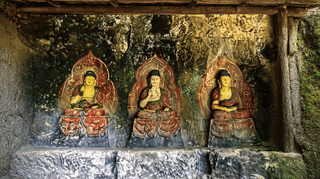
Discover the Ogata Miyasako Nishi Sekibutsu, a National Historic Site in Oita Prefecture featuring three equally-arranged Buddha statues carved into volcanic rock during the Heian period. Located near the famous Harajiri Falls, this hidden treasure offers a unique glimpse into ancient Buddhist devotion in rural Japan.
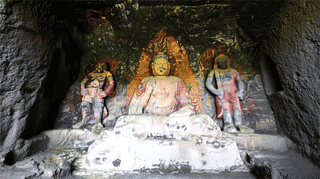
Explore the Ogata Miyasako Higashi Stone Buddhas, a National Historic Site in Bungo-Ono City, Oita Prefecture. These remarkable late Heian period cliff carvings feature five Buddhist deities with preserved polychrome coloring. Learn about their connection to the legendary samurai Ogata Koreyoshi and plan your visit to this hidden gem of Japanese Buddhist art.
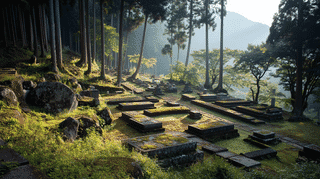
Discover Shimofuji Christian Cemetery in Usuki, a nationally designated historic site and Japan's first complete Christian burial ground from the 16th century. Explore the hidden history of Kirishitan faith, European burial traditions, and the remarkable legacy of early Japanese Christians.
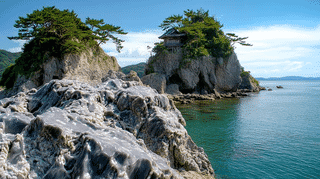
Explore Himeshima's rare milky-white obsidian cliffs, a National Natural Monument where prehistoric trade networks flourished across western Japan for over 20,000 years. Plan your visit to this off-the-beaten-path geopark destination in Oita Prefecture.

Ana Kannon Kofun in Hita City, Oita Prefecture, is a decorated tumulus dating from the late 6th to early 7th century and designated a National Historic Site of Japan in 1933. Inside its multi-room horizontal stone chamber, the walls are adorned with red and green paintings of concentric circles, continuous triangles, ships, birds, and human figures — a celebrated example of the Chikugo River decorated-tomb tradition.
The Ankokuji Settlement Ruins in Kunisaki City, Oita, is a Yayoi-to-early-Kofun-period wetland village designated a National Historic Site in 1992. Famous as the 'Toro of the West' for its remarkably preserved wooden artifacts and carbonized rice, the site is also the type-site for Ankokuji-type pottery. Today it is a public park with reconstructed pit dwellings, raised-floor storehouses, and an adjacent learning hall offering hands-on experiences of ancient Japanese life.
Designated a National Historic Site in 1934, the Inukai Stone Buddhas in Bungo-Ono City, Oita Prefecture, comprise a magnificent Acala Triad carved in deep relief into a welded tuff cliff formed by the Aso pyroclastic flow. The seated central Fudō Myōō, about 3.76 meters tall, is flanked by his two boy attendants and dates to the late Heian to Kamakura period. Its rare features — no flame halo, both eyes wide open, and visible soles in a full lotus pose — preserve older iconographic traditions, making this one of the most distinctive magaibutsu of the Ono River basin.
Located in Kiyokawa-machi, Bungo-ono City, Oita Prefecture, the Iwato Site is a Late Paleolithic National Historic Site dating back approximately 20,000 to 24,000 years. It yielded the kokeshi-shaped stone figurine—widely regarded as Japan's oldest human-form artifact—along with numerous stone tools and a possible stone-piled tomb, offering a rare glimpse into the lives and spiritual world of Ice Age people in the Japanese archipelago.
Designated a National Natural Monument in 1934, the Great Cedar of Ōgosha Shrine stands in a quiet grove just south of Yufuin Station. Over 1,000 years old, 38 m tall, and roughly 14 m in girth at its base, this Cryptomeria japonica giant divides into two trunks at three meters and harbors a sacred image inside a vast hollow.
Explore the Nakagawa Clan Cemetery, a National Historic Site in Taketa City, Oita Prefecture. Three distinct burial grounds reveal the diverse funerary philosophies of Edo-period feudal lords — from elegant Buddhist mausoleums with garden ponds to Confucian graves atop remote mountains in the Kuju Range.
This Natural Monument on a Hita riverbed in Oita preserves a forest swept up by Aso's greatest eruption 90,000 years ago, holding 13 tree species in its layers.
In Saiki, Oita, a four-hectare shrine grove harbors the endangered Hanagagashi oak (Quercus hondae) in near old-growth condition, found only in Kyushu and Shikoku.
Six keyhole tombs and 100+ smaller burials trace three centuries of Usa chieftains, from third-century Akatsuka's bronze mirrors to sixth-century Tsurumi's chamber.
Three gardens laid out in 1829 by the eighth Mori lord Kurushima Michihiro on Mt. Suehiro in Kusu, Oita. Designated a Place of Scenic Beauty in January 2012.
Kumano Magaibutsu in Oita holds two of Japan's largest cliff Buddhas: an 8-meter Fudo Myo-o and a 7-meter Dainichi Nyorai, reached by a legendary stone stairway.
Kobe Site in Usa, Oita preserves a 3rd to 4th century moated settlement that evolved into a chief's residence, yielding pottery from Kinai and Kibi trade routes.
On a plateau in eastern Oita, the Sato Kanga Site preserves a 7th-century district office where large timber buildings stood in a U-shape around a central hall.
A National Natural Monument at Shōoku-ji temple in Hiji, Ōita: a female sago palm about six meters tall, aged 600 to 700 years, long called Japan's finest cycad.
The Nanatsu-mori Kofun Group in Taketa City, Oita Prefecture, is a nationally designated historic site featuring ancient burial mounds from the early Kofun period (4th century). With two keyhole-shaped and two round tumuli still intact, the site yielded remarkable artifacts including bronze mirrors and jasper bracelets that evidence cultural ties to the Kinai heartland. Each September, approximately 200,000 red spider lilies blanket the grounds, creating a breathtaking fusion of ancient history and natural splendor.
Standing within the precincts of Yusuhara Hachimangu Shrine in Oita City, the Great Camphor of Yusuhara Hachimangu is a National Natural Monument believed to be more than 3,000 years old. With a trunk circumference of about 19 meters, a height of roughly 30 meters, and a vast hollow inside its trunk, it is one of Japan's largest trees, ranked seventh nationwide in the 1989 Environment Agency survey. Discover this living monument, sheltered for over a millennium by the primeval forest of one of Bungo Province's oldest shrines.
More from Oita
Oita’s registered properties across designations, with featured heritage and travel notes.
The complete kokuhō catalogue — browse by prefecture, period, and category.
Nationwide jūyō bunkazai — architecture, sculpture, painting, crafts, and documents.