
Kamakura
Shiga · 鎌倉Browse Shiga’s cultural heritage from the Kamakura period (1185 – 1333). Filter by type and keyword, with concise stories, maps, and travel tips.
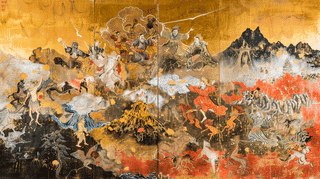
A Kamakura-period painting in several scrolls at Shojuraigoji in Otsu, Shiga. A copy of the work itself carries a prefectural listing entirely of its own.

A Tang-period text owned by Enryakuji in Shiga Prefecture. Its own country field reads China, while its own period field gives the Tang dynasty of it.

Discover the Ichiji Kinrin Image, a Kamakura-period silk painting designated an Important Cultural Property in 1940 and privately preserved in Ichinobe, Higashiomi, Shiga. Explore the mystical iconography of this supreme esoteric Buddhist deity and the rich cultural heritage of eastern Ōmi.
Discover the Anyoji Thirteen-Story Stone Pagoda, a nationally designated Important Cultural Property from the late Kamakura period, standing within the grounds of Tohozan Anyoji Temple in Ritto City, Shiga Prefecture. This 334 cm granite pagoda features exquisite relief carvings of four Buddhas and elegant eave curvature.
The subsidiary Kasuga Shrine Main Hall within Ikuwa Shrine in Yasu City, Shiga Prefecture, is an Important Cultural Property dating to the late Kamakura period. Built in the nagare-zukuri style with cypress bark roofing, this compact shrine hall preserves older architectural techniques than the adjacent main Ikuwa Shrine hall, making it a rare and valuable example of medieval Japanese sacred architecture.
Built in 1194 through the patronage of Minamoto no Yoritomo, the Tahōtō of Ishiyama-dera in Ōtsu is the oldest two-storied pagoda in Japan whose date of construction can be firmly confirmed. Its perfectly balanced form — a square lower story and a circular upper story — has earned it a place among Japan's Three Famous Pagodas, and it is a designated National Treasure. Inside are a seated statue of Dainichi Nyorai by the great sculptor Kaikei and early Kamakura pillar paintings.
Enkoji Kujunoto in Yasu, Shiga, is a granite nine-storey pagoda of about 1256, now 3.94 m without its finial. Its lowest tier bears the four Diamond Realm Buddhas.
Enkoji Hondo in Yasu, Shiga, built in 1257, is dated by ink writing on its ridgepole. Its gabled roof, rare on a Buddhist hall, was restored in a 1956 repair.
Ono Shrine's tower gate in Ritto, Shiga is the oldest surviving romon at any shrine or temple in the prefecture, an early-Kamakura building in late Heian style.
Standing in the grounds of Zenryū-ji and Inshū-ji temples in Moriyama City, Shiga Prefecture, the Kakesho Hōtō is a 3.83-metre stone pagoda carved in the late Kamakura period (1275–1332) and designated an Important Cultural Property of Japan in 1925. With its base, cylindrical body, square roof and tall finial all beautifully preserved, and with striking peacock reliefs carved on the sides of its base, it is consistently ranked among the finest stone hōtō of the Ōmi region. The site also marks the ground where the Kanamori Gassen of 1466—the first ikkō-ikki in Japanese history—took place, making the pagoda both an artistic masterpiece and a silent witness to a pivotal moment in medieval Japanese religion.
A granite five-storied pagoda of 1246 stands unattended beside Route 477 in Omihachiman, Shiga. Its dated inscription anchors the chronology of Omi stone carving.
A small stone pagoda in the precinct of Saimyoji in Moriyama, Shiga, credited by tradition to regent Hojo Tokiyori. Now leaning, it is viewed from a few paces back.
Discover the Saimyoji Three-Story Pagoda, a National Treasure in Shiga Prefecture's Koto Sanzan temple complex. This Kamakura-period masterpiece features exquisite cypress-bark roofing and rare polychrome Buddhist murals that have survived over 700 years.
Explore the Saimyoji Main Hall, a Kamakura-period masterpiece and one of Japan's first National Treasures. Nestled in Shiga's Koto Sanzan mountains, this nail-free cypress temple offers ancient Buddhist art, stunning gardens, and spectacular autumn foliage.
Shina Shrine's main hall in Kusatsu, built in 1298, keeps a ridgepole inscription naming its carpenter. A wind-god hall with Kamakura brackets and white plaster.
An unsigned granite hokyointo at Jakushoji in Hino, Shiga, dated to the late Kamakura period by its upright corner ornaments, carved Buddhas and lotus base.
Two granite five-ring pagodas at Ishidō-ji in Shiga, dated 1304 and 1349. The carved year-marks make this Important Cultural Property a rare dating anchor.
Discover the Important Cultural Property seven-story stone pagoda at Sekininji Temple in Higashiomi, Shiga. Built in 1318, this Kamakura-period monument is tied to the legendary Man'yōshū poet Yamabe no Akahito. Explore its history, significance, and visitor tips.
The Ōki Shrine main hall inside Daihō Shrine in Rittō was built in 1283 and designated an Important Cultural Property in 1906, the oldest hall of its type.
Discover Chojuji Temple's National Treasure Main Hall in Konan, Shiga. This early Kamakura-period masterpiece of pure Japanese (wayo) architecture features a rare dual-hall structure and cypress bark roof. One of the Konan Sanzan temple trio, it offers serene beauty amid stunning seasonal foliage.