
Meiji
Shiga · 明治Browse Shiga’s cultural heritage from the Meiji period (1868 – 1912). Filter by type and keyword, with concise stories, maps, and travel tips.
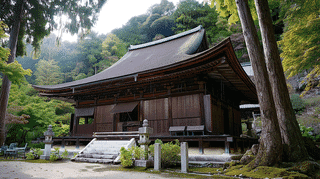
Discover Kannon-shoji Jizo-do, a registered cultural property from 1881, nestled within the ancient pilgrimage temple founded by Prince Shotoku on Mt. Kinugasa in Shiga Prefecture. Experience authentic Japanese Buddhist architecture and the legendary mermaid tale.

A bronze spire on a hilltop behind Enryaku-ji's West Pagoda hall, traced to Saichō in 820 and recast in bronze around 1895. Inside are copied sutras, not relics.
Tucked away in Shiga Prefecture's historic Omi merchant town of Gokasho-Kondo, Shojukan Garden is a Nationally Registered Monument designed by the celebrated late-Edo to Meiji garden master Katsumoto Donketsu. This stroll-style dry landscape garden, opened to the public in 2023 alongside a 200-year-old merchant residence, features a famous heart-shaped Inome window and a rare chance to experience authentic Omi merchant heritage.
The 1890 carriage porch of the Otsu courthouse, moved to Omi Jingu in 1971 to shelter car purification rites. Its gable pendant still bears a chrysanthemum crest.
The Ohmi Railway Echigawa Bridge, spanning the Echi River in Shiga Prefecture, is a 239-meter steel railway bridge built in 1898. Featuring a British-made pony Warren truss by Andrew Handyside & Company, this Registered Tangible Cultural Property has served as an active railroad crossing for over 125 years.
The Omihachiman Youth Hostel in Shiga Prefecture is a nationally registered tangible cultural property originally built in 1909 as the Gamo-gun Industrial Promotion Hall. Featuring a distinctive cusped-gable entrance and grand interior staircase, this Meiji-era wooden public building offers guests the rare opportunity to stay overnight inside a cultural landmark.
Discover Okkin Mukugawa Exchange Hall, a Meiji-era thatched-roof farmhouse registered as a Tangible Cultural Property in Takashima City, Shiga Prefecture. Explore its traditional irori hearth, tatami rooms, and the charming mountain village of Mukugawa near Lake Biwa.
Discover Kagi-rou, a Registered Tangible Cultural Property in Taga, Shiga Prefecture. This Edo-period ryokan founded in 1689 features exquisite sukiya-style architecture and stands as an iconic landmark of the Taga Taisha shrine town.
Gariban Denshōkan in Higashiōmi is the 1909 annex of the home of Horii Shinjirō, inventor of the Japanese mimeograph. Registered in 1998; open weekends, free.
The largest building at Kawaraya-ji, this 1871 priests' quarters greets guests with a cusped karahafu entrance and bold beam framing over its earthen-floored kitchen.
The Former Tada Family Residence Main House in Otsu, Shiga is a mid-Meiji townhouse facing a lane in the old post town, keeping its lattice bay and guard rail.
The oldest of the five buildings, this 1892 plaster storehouse carries scrolling motifs and a family crest at its west door and a wave-formed eave on the east gable.
The Kurokabe Glass Hall in Nagahama, Shiga Prefecture, is a nationally registered tangible cultural property originally built in 1900 as the Nagahama Branch of Japan's 130th National Bank. Known locally as the 'Black Wall Bank' for its distinctive black-lacquered plaster exterior, this Japanese-Western eclectic wooden building was reborn as a glass art gallery in 1989 and now serves as the symbol of Kurokabe Square, a cultural district attracting approximately two million visitors annually.
A compact two-story storehouse at the former Fujii estate, its white plaster skirt faced with horizontal planks reused from old wooden river boats.
Rebuilt here in 1932, the plain main house of the former Fujii estate anchors the Gokasho folk museum and shows how thrifty Omi merchants once lived and worked.
The Kanran-tei at Saikyō-ji is a late-Meiji sukiya room behind the guest hall, its vermilion walls framing a carved wave transom that echoes its name.
The Sōso Daishi-den at Saikyō-ji in Ōtsu honors Shinsei, founder of the Tendai-Shinsei school. Built in 1894 in a formal residential style, it faces the temple approach.
A 64-square-metre reception room in Aisho Town, Shiga, built in 1878 for the Meiji Emperor's rest stop and moved by hikiya in 1911. Registered in December 2000.
An 1911 timber banquet hall of 183 square metres in Aisho Town, Shiga, with six ten-mat rooms, boat-bottom ceilings and flanking corridors. Registered in 2000.
Standing along the historic Happu Highway in Higashiomi City, Shiga Prefecture, the Ichi-no-Torii of Tarobogu Aga Shrine is a stone Myojin-style gateway built in 1894 (Meiji 27). With a span of 5.4 metres, this great torii frames a long northward approach toward the sacred Mt. Akagami, marking the traditional starting point of the pilgrimage to the 1,400-year-old shrine. Designated a Registered Tangible Cultural Property in 2019, it preserves the devotional spirit and stone craftsmanship of the Meiji era for visitors today.