
Registered Tangible Cultural Properties of Shimane
島 根 県 の 登 録 有 形 文 化 財Shimane · Registered Tangible Cultural Properties
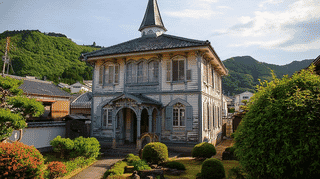
The priest's house at Tsuwano Catholic Church in Shimane is a timber building of 1917 in 2 storeys, slate-roofed and clad differently on each floor. Registered 2010.

This late Edo four-legged gate at Ikoji in Masuda carries hexagonal relief along its tie-beam and stepped brackets under the eaves. It was registered in 2017.
The late-Edo main house of the Ishibashi Residence in Izumo, Shimane, covers 262 square metres, its frontage widened by pent roofs, with checkerboard namako tiling.
The Meiji tea room of the Ishibashi Residence in Izumo, Shimane, is a thirteen-square-metre three-mat space with a round bamboo-lattice window and a level alcove.
The late-Meiji reception wing of the Ishibashi Residence in Izumo, Shimane, rises two storeys over coursed stone, white plaster above boarding, holding the street.
The Izumo Taisha Ukabashi Otorii, a 23-metre reinforced-concrete gate of 1915 over the road at the south end of Shinmon-dori, Izumo City, was registered in 2015.
Built in 1914 in the northwest corner of the Izumo Taisha precinct, this two-storey cedar treasure hall was registered as a Tangible Cultural Property in 2015.
Built in 1927 to electrify the line to Matsue, Nunosaki Substation still feeds Ichibata's trains. Its symmetrical front carries a giant order of pilasters.
Built in 1930, registered in 1996: Ichibata's Izumo Taisha-mae station wears a Secession-style roof, and coloured glass patterns the floor of a working terminus.
The ceremonial gate of the Itohara ironmaster house, a late-Edo timber gate roofed in tile with flanking walls, opened only for the lord of Matsue's formal visits.
The 1896 Kanayago shrine of the Itohara house, barely 0.9 square metres, enshrining the deity of ironmaking revered by tatara smelters. Its smallest registered building.
The late-Edo rice storehouse of the Itohara house, oldest of the family's stores. Registered farmers who held samurai rank, they built wealth on rice as well as iron.
The 1924 main house of the Itohara ironmasters of Okuizumo: some forty rooms over about 350 tsubo. It once lodged the lord of Matsue as its guest.
The late-Meiji enclosure wall of the Itohara house, a timber wall with tiled coping about 36 metres long, tying the ceremonial gate and stone pillars into one frontage.
The late-Meiji reception rooms of the Itohara house, remodelled in 1936, where the lord of Matsue was received. The family kept tea utensils of the tea-master lord Fumai.
The early-Showa tea-garden arbor of the Itohara house, barely three square metres under a cedar-bark roof, where guests paused before a tea gathering.
The 1876 south storehouse of the Itohara house, earliest dated of its buildings. A two-storey white-plastered dozo of about 193 square metres, largest of its stores.
The late-Meiji stone gate pillars of the Itohara house, framing an opening about 3.7 metres wide, the everyday counterpart to its timber ceremonial gate.
Standing on the grounds of Shimane Prefectural Taisha High School near Izumo Taisha Grand Shrine, Inasa Kaikan is the former 1902 auditorium of Shimane Prefectural Third Middle School. A nationally Registered Tangible Cultural Property, it showcases pseudo-Western Meiji school architecture with clapboard siding, sash windows, and a distinctive octagonal entrance porch preserved from the original main building.
This timber house of about 1920 at Kohama, a fishing village in Masuda, has a low attic storey and lime plaster to the eaves. Registered in 2022; interior private.
More from Shimane
Shimane’s registered properties across designations, with featured heritage and travel notes.
The complete kokuhō catalogue — browse by prefecture, period, and category.
Nationwide jūyō bunkazai — architecture, sculpture, painting, crafts, and documents.