
Kamakura
Ehime · 鎌倉Browse Ehime’s cultural heritage from the Kamakura period (1185 – 1333). Filter by type and keyword, with concise stories, maps, and travel tips.
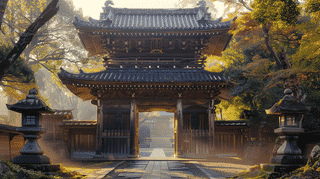
A two-storeyed gate at Ishiteji in Matsuyama, Ehime, said to date from 1318. Its frog-leg struts are held masterpieces carrying the Kamakura character.
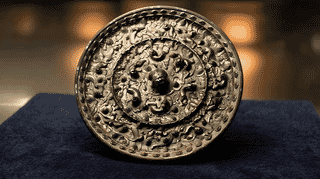
A Tang bronze mirror at Oyamazumi Shrine in Ehime, 26.8 centimetres across. A grapevine forms the ground beneath birds and beasts. National Treasure since 1953.
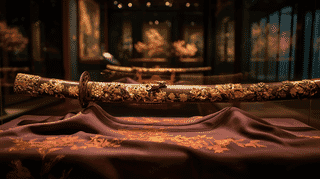
A Kamakura sword mounting at Oyamazumi Shrine in Ehime, 96.3 centimetres long. Its peony arabesque is cut differently on each part. National Treasure since 1955.

Tucked away behind the three-story pagoda of Ishiteji Temple in Matsuyama, the Karitei-mo-ten-do is a small but exquisite shrine designated as an Important Cultural Property of Japan. Built in the late Kamakura period (1275-1332) in the rare ikkensha nagare-misedana style with a cypress bark roof, it is among the oldest shrine structures in Ehime Prefecture. Discover its enduring tradition of safe-childbirth prayers and architectural details that mirror the National Treasure Niomon Gate.
A granite gorinto at Ishiteji in Matsuyama, just over 273 centimetres tall and designated in 1952. Bearing no carved date, it is dated by its form alone.
A 24.1-metre pagoda at Ishiteji in Matsuyama, designated an Important Cultural Property in 1907. Its central mast stops on a beam above the first storey.
The Main Hall of Ishiteji Temple in Matsuyama, Ehime is a National Important Cultural Property dating from the late Kamakura period. As the 51st temple of the Shikoku 88-Temple Pilgrimage and only a short walk from Dōgo Onsen, it offers a rare combination of living pilgrimage culture and outstanding medieval Wayō-style architecture, alongside the National Treasure Niōmon Gate and other heritage buildings.
Three late Kamakura granite pagodas stand in a row at this Omishima shrine. The tallest rises past 394 cm, and one carries the name of a mason from Onomichi.
A granite Hōkyōintō stone pagoda from the late Kamakura period stands within the grounds of Kamei Hachiman Shrine on Uoshima, a remote fishing island in the Seto Inland Sea, Ehime Prefecture. Designated as an Important Cultural Property of Japan, this medieval stone tower exemplifies the artistry of Kamakura-era stone craft and carries a local legend connecting it to the Nanbokuchō warrior Shinozuka Iganokami. On this tiny island of about 110 residents, the pagoda has quietly watched over 700 years of history.
A pair of uninscribed granite stupas of the late Kamakura period standing on one platform in a Noma rice field, Imabari. Designated in 1954, freely visitable.
Eleven granite pagodas behind Jozenji's main hall in Imabari: 4 gorinto, 5 hokyointo and 2 hoto, three of them dated 1326 or 1357, regathered here in 1704.
Taisanji Temple Niomon Gate stands midway up the approach in Matsuyama. Dated 1275 to 1332, it mixes Japanese and Zen-derived carpentry and once had two storeys.
Discover the National Treasure main hall of Taisan-ji Temple, a magnificent Kamakura-period Buddhist building in Matsuyama. Temple 52 on the Shikoku pilgrimage, it houses rare secret Buddha statues and features a legendary origin story.
Discover Taihoji Main Hall, a National Treasure in Matsuyama, Ehime. This early Kamakura-period temple preserves rare late-Heian Amida hall architecture and houses Important Cultural Property Buddhist statues. Open annually on March 28.
Standing in the wooded grounds behind Noma Shrine in Imabari City, Ehime Prefecture, this 211 cm granite stone pagoda was created in 1322 by a man named Ki no Aruharu and his wife as a prayer for healing and longevity. Designated a National Important Cultural Property in 1954, it represents the distinctive regional Ochi-style and offers travelers a profound encounter with late Kamakura-period Buddhist art and devotion.
Discover the Kawazutsumi-no-tachi—a rare Important Cultural Property at Ōyamazumi Shrine on Ōmishima Island. This treasure pairs an ancient signed blade by the Ko-Hōki-school smith Aritsuna with a battle-ready leather-wrapped mounting in yamagane fittings. Learn about its history, what to look for in person, and how to plan your visit to Japan's unparalleled storehouse of samurai arms.
This article introduces the Kuro-urushi Tachi, an unsigned slim tachi mounting designated as an Important Cultural Property and preserved at Ōyamazumi Shrine on Ōmishima Island, Ehime Prefecture. With an overall length of 99.8 cm, the Kamakura-period mounting features hemp-cloth wrapping coated in deep black lacquer, gilt-bronze fittings, and a distinctive balance-weight (fundō) shaped guard. It served for centuries as the symbolic sword bestowed at the succession ceremony of the Ōhafuri, the hereditary chief priestly family of one of Japan's most ancient and revered shrines. Designated in 1901, the sword embodies a rare, unbroken link between a cultural object and a living ritual tradition. The article covers the sword's craftsmanship, the reasons for its designation, its sacred role within the shrine, highlights of the treasure halls where it is preserved, and practical guidance for visitors traveling to Ōmishima via the famed Shimanami Kaidō.
Discover the Murasaki Aya Odoshi Yoroi, a rare National Treasure armor from the early Kamakura period, housed at Oyamazumi Shrine on Omishima Island, Ehime. Learn about its history, craftsmanship, and how to visit.
Tucked away in the rice fields of Saijo City, Ehime, the Wooden Seated Statue of Zen Master Buttsū at Hokoku-ji Temple is a designated Important Cultural Property of Japan. This 78.3 cm portrait sculpture of the Kamakura-period Zen master Chikotsu Daie, lovingly nicknamed Kurobotoke-san for its glossy black surface, even traveled to the Museum of Fine Arts, Boston, in 1970. Discover its history, artistic value, viewing tips, and nearby attractions.