
Registered Tangible Cultural Properties of Miyagi
宮 城 県 の 登 録 有 形 文 化 財Miyagi · Registered Tangible Cultural Properties
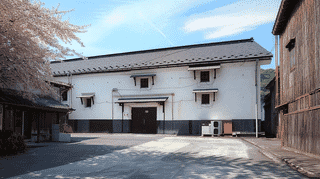
A large Taisho-period storehouse in Tome, Miyagi, fifteen bays long. Its roof frame imitates a Western truss, bolted and strapped together with iron straps.

Three-story cedar inn at Kamasaki Onsen, rebuilt 1941 after flood damage. Cedar through-pillars run from basement to top floor. National Cultural Property, 2016.
The Ebiki Miso and Soy Sauce Brewing Storehouse in Toyoma, Tome City, Miyagi, is part of the historic compound of Ebiki Shoten, founded in 1833 and registered as a national Tangible Cultural Property in 2018. Located in the heart of "Miyagi's Meiji Village," the complex preserves eight buildings spanning the late Edo to Taisho eras, where traditional miso and soy sauce fermentation continues to this day.
Discover the Enmei-ji Temple Sanmon Gate in Shiroishi, Miyagi — a Registered Tangible Cultural Property originally built as the Umayaguchi-mon of Shiroishi Castle during the late Edo period. Explore its samurai heritage and unique turret-gate architecture.
The Oimatsu Nagata Brewery Inari Shrine Sayado is a Taisho-era protective shrine shelter in Watari, Miyagi Prefecture, registered as a national Tangible Cultural Property. Despite its compact size of just 4.8 square meters, this wooden structure features magnificent woodcarvings attributed to the legendary Kesen carpenters of Tohoku, including bamboo-and-sparrow and dragon-and-cloud motifs. Discover the artistry and history behind this hidden gem on the grounds of a brewery with over 300 years of tradition.
Discover Otakamori Yakushido, a nationally registered tangible cultural property on Miyato Island in Higashimatsushima, Miyagi. Built in 1915 with revivalist architectural style and tiles from the same kiln as National Treasure Zuiganji, this Buddhist hall stands on the slopes of Otakamori—one of the Four Great Views of Matsushima.
Discover the Shoin and Kuri of Daigakusan Kōfuku-ji, a Registered Tangible Cultural Property in Tome City, Miyagi. This Meiji-era Tendai Buddhist temple features a unique blend of traditional Japanese architecture with pioneering colored glass accents, set atop a scenic hilltop alongside the vibrant Kannon-dō and the remarkable Western-style Rokkaku-dō.
Discover the Kakuboshi Store, a nationally registered tangible cultural property in Kesennuma, Miyagi. This early Showa-era kura-style building survived the 2011 tsunami and was painstakingly rebuilt, standing today as a symbol of resilience and traditional craftsmanship.
Discover the Kato Family Residence in Tome City, Miyagi Prefecture—a nationally registered tangible cultural property built in the early Meiji era. Learn about its architectural heritage, rural farmhouse charm, and the historic Toyoma castle town known as "Miyagi's Meiji Village."
The Former Second Higher School Main Gate on Tohoku University's Katahira Campus in Sendai is an ornamental brick gate designed in 1889 by Ministry of Education architects Yamaguchi Hanroku and Kuru Masamichi. Having survived multiple relocations and earthquake damage, the gate was lovingly restored by alumni to its original location and registered as a National Tangible Cultural Property in 2021.
Completed in 1930 on Tohoku University's Katahira campus, this scratch-tiled block served as the school gate: a vaulted passage runs through it under the SKK crest.
Built in 1910 among the timber halls of Sendai's Second Higher School, this three-storey brick stack kept books safe from fire. Its English-bond walls still stand.
This 1934 stable in Kurihara, Miyagi, is eleven metres long, with an earth floor, doorways widened for horses and deep segai-zukuri eaves beneath a thatched roof.
Built between 1830 and 1868 in Kurihara, Miyagi, this thatched farmhouse keeps a regular four-room plan, with an alcove and sao-buchi ceiling in its formal room.
Located in the quiet mountains of Kesennuma, Miyagi Prefecture, the Former Tsukidate Elementary School Building is a two-story wooden schoolhouse built in 1922 and registered as a National Tangible Cultural Property in 2007. With its Stick Style exterior, Western-style truss roof, and rotating transom windows, it offers a rare and atmospheric glimpse into Taishō-era educational architecture.
Completed in 1930, this L-shaped classroom building gathers its arch, stone cladding, and rooftop tower at the center of a rare symmetrical facade.
This 1929 laboratory pairs brick tile and arched windows with a plainer upper floor, its central entrance crowned by stained glass, in Sendai's Katahira Campus.
Built in 1926, this granite-clad gate with pen-nib capitals spans 6.3 meters; its doors were lost to wartime requisition, yet the pillars still stand.
Built in 1926 by Tsuyoshi Ogura, this Romanesque former library reading room now houses the Tohoku University Archives, open free on weekdays in Sendai.
Completed in 1927, this concrete building with herringbone brick tilework survived the 1945 air raids as the last Faculty of Law and Letters building.
More from Miyagi
Miyagi’s registered properties across designations, with featured heritage and travel notes.
The complete kokuhō catalogue — browse by prefecture, period, and category.
Nationwide jūyō bunkazai — architecture, sculpture, painting, crafts, and documents.