
Registered Tangible Cultural Properties of Miyagi
宮 城 県 の 登 録 有 形 文 化 財Miyagi · Registered Tangible Cultural Properties
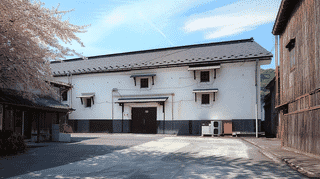
A large Taisho-period storehouse in Tome, Miyagi, fifteen bays long. Its roof frame imitates a Western truss, bolted and strapped together with iron straps.

The 1933 portal of a 696-metre water conduit below Aoshita No. 1 Dam in Sendai. Pilasters and a machicolated cornice frame the arch of this registered entrance.
Completed in 1934 on the Aoshita River near Sendai, this working waterworks dam stands 13.4 metres high, and its cobblestone spillway is seen from the crest bridge.
A reinforced concrete cylinder of 1933 rising from a reservoir near Sendai, 15.5 metres tall. Three intake mouths at differing depths draw the cleanest layer.
The uppermost of three Sendai waterworks dams, finished in 1934 with the longest crest at 60.4 metres. A sediment outlet below its subsidiary weir keeps silt down.
The middle dam of three on the Aoshita River near Sendai, completed in 1934 and standing about 10 metres above the reservoir below. A forest path reaches a view.
Erected in 1934 beside Aoshita No. 1 Dam near Sendai, this broad stone monument carries a goat-head spout in front and a plate naming the engineers on its reverse.
Built in 1933 as the water source office above the first Aoshita reservoir near Sendai, this small concrete building curves its stair tower out and has portholes.
A small cobblestone weir of 1933 standing 518 metres above Aoshita No. 3 Dam near Sendai. A notch in its crest lets the flow of the river be read as a number.
The small protective hall before the Aoba Shrine worship hall in Sendai, dated 1931, is a gable-entry hall of 6 square metres carved to match the main hall.
The offering preparation hall of Aoba Shrine in Sendai, built in about 1929, is a hip-and-gable hall joined to the worship hall by a corridor for carrying offerings.
The 1927 openwork fence of Aoba Shrine in Sendai runs 87 metres around the main hall, with a cut-stone base, battened panels, lattice above and two wicket gates.
At Aoba Shrine in Sendai, a 1927 four-legged middle gate in the fence is joined to an open prayer recitation hall, both sharing the carved details of the main hall.
The 1927 worship hall of Aoba Shrine in Sendai, a five-by-three-bay hall with a copper hip-and-gable roof and coffered ceiling, closes the end of the approach.
The 1924 main hall of Aoba Shrine in Sendai, dedicated to Date Masamune, is a three-bay nagare-style hall pairing geometric beam ends with medieval-style struts.
Three-story cedar inn at Kamasaki Onsen, rebuilt 1941 after flood damage. Cedar through-pillars run from basement to top floor. National Cultural Property, 2016.
The front storehouse of Ebiki in Toyoma, Tome, Miyagi, a Taisho store for goods and grain, faces Mikkamachi street beside the former shop and shapes the old street.
The former sake brewery of Ebiki in Toyoma, Tome, Miyagi, a long late Edo store used for sake until 1908, has triple tie-beam frames and a shelf for the sake god.
The former soy-sauce store of Ebiki in Toyoma, Tome, Miyagi, built in 1892, is a long storehouse whose orderly beams show the skill of carpenter Sato Asakichi.
The former shop of Ebiki in Toyoma, Tome, Miyagi, a late Taisho building, has patterned namako walls and stands on a corner at the entrance to the old town.
More from Miyagi
Miyagi’s registered properties across designations, with featured heritage and travel notes.
The complete kokuhō catalogue — browse by prefecture, period, and category.
Nationwide jūyō bunkazai — architecture, sculpture, painting, crafts, and documents.