
Taishō
Okayama · 大正Browse Okayama’s cultural heritage from the Taishō period (1912 – 1926). Filter by type and keyword, with concise stories, maps, and travel tips.
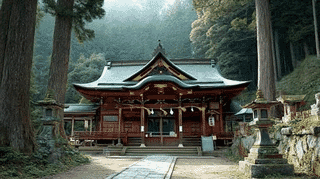
A shrine hall of 1919 in Maniwa, Okayama, just 12 square metres. Its walls are laid in two layers, with round posts outside and square ones set within.

Discover the Iri Power Station Water Tank, a reinforced concrete structure from 1920, registered as a Tangible Cultural Property in Kagamino, Okayama. Explore the oldest surviving hydroelectric facility on the Yoshii River.
Discover the Iri Power Station Penstock Retaining Wall and Main Building Retaining Wall, a Registered Tangible Cultural Property in Kagamino Town, Okayama. Built in 1920, these cobblestone retaining walls support Okayama's oldest surviving hydroelectric power station along the Yoshii River.
The Iri Power Station Main Building, nestled in the mountains of Kagamino Town, Okayama Prefecture, is a wooden hydroelectric plant building constructed in 1920 during the Taisho era. As the oldest surviving power station on the Yoshii River system, it has operated continuously for over a century and was registered as a national Registered Tangible Cultural Property in 2006. With its king post truss roof structure and copper-clad gabled roof, it preserves the distinctive character of Taisho-era industrial architecture.
Okayama Former Bank of Japan Hall, built in 1922 by Nagano Uheiji, carries a Corinthian portico in granite. It survived the 1945 air raid and is now a concert hall.
Okayama Temperance Hall was built in 1923 as the base of a movement against drink. The timber building survived the 1945 raid and still houses a ground floor cafe.
A 1919 timber judo hall at Okayama Asahi High School, built for the elite Sixth Higher School. Springs in the floor gave it bounce, and it survived the 1945 raid.
Built in 1922 at Okayama University's Shikata Campus, this gate raises four red brick piers on granite bases, crowned with Secession-style capitals and copper lamps.
A 22-square-metre timber lodge of 1922 beside the main gate of Okayama University's Shikata Campus, roofed in scalloped natural slate on an irregular hexagonal plan.
Okina Bridge in Tsuyama City, Okayama Prefecture, is a 1926 reinforced concrete bridge featuring Art Deco-style balustrade pillars. Its fully preserved original brick pavement, rediscovered beneath modern asphalt, earned it recognition as both a Registered Tangible Cultural Property and a JSCE Heritage of Civil Engineering.
Standing in the verdant hills of Maniwa City in Okayama Prefecture, the Worship Hall of Kiyama Shrine is an elegant single-story wooden building designed in 1919 by architect Egawa Saburohachi. With its hip-and-gable copper roof, ornate karahafu front porch, and a Western-style truss roof structure, the hall masterfully blends tradition with modern innovation. Designated a Registered Tangible Cultural Property of Japan in 2017, it remains the heart of a shrine with over twelve hundred years of history.
The Connecting Corridor of Kiyama Shrine in Maniwa City, Okayama, is a small but exquisite covered walkway designed in 1919 by the prefectural architect Egawa Saburohachi. Linking the worship hall and the shrine office in a gentle arc, it showcases carved rainbow beams, paired rafters, a softly curved floor, and a weathered copper roof. Registered as a Tangible Cultural Property in 2017, it stands within a shrine whose history reaches back more than 1,200 years.
Rising 21 meters above the embankment of the Asahi River in Kyobashi-cho, Okayama, this steel-framed warning tower was built in 1924 and designated a National Registered Tangible Cultural Property in 2006. Its four legs of angle steel, braced by distinctive ring-type turnbuckles and crowned by a small watchtower with an iron pyramidal roof, form one of Japan's rare surviving Taisho-era urban warning towers. Together with the nearby Kyobashi water pipe bridge and Kyobashi road bridge, it anchors a remarkable cluster of early-modern engineering heritage close to Okayama Castle, Korakuen Garden, and the much-loved monthly Kyobashi Morning Market.
Built in 1926 as the heart of Japan's first privately funded public observatory, this observation room features an ingenious sliding roof mechanism. It is the very place where legendary amateur astronomer Minoru Honda discovered 12 comets and 11 novae. Registered as a National Tangible Cultural Property and designated as a Japanese Astronomical Heritage, it holds exceptional significance in the history of science.
The Former Chugoku Bank Ushimado Branch is a charming red brick building in the historic port town of Ushimado, Setouchi City, Okayama Prefecture. Built in 1915 as the Ushimado Bank headquarters, this registered Tangible Cultural Property features German-imported brick walls, granite foundations, and a fascinating blend of Western and Japanese architectural styles. Now open free of charge as the Machikado Musée Ushimado Cultural Hall, it is a must-see highlight along the atmospheric Shiomachi Karakoto Street.
The northernmost of five registered buildings on a Kurashiki estate, this 1914 storehouse matches its neighbor in black plaster and tile but is larger, at 69 m².
Built around 1914 for businessman Nakayama Setsutaro, this Kurashiki house has a granite-floored formal entrance and a 15-mat reception room with a large alcove.
A 1914 two-story storehouse on a tall stone base at the rear of a Kurashiki estate, its black plaster walls edged with white namako tile cladding and a tiled drip.
A 27-meter gatehouse of around 1915 guarding a Kurashiki estate, with double doors of solid zelkova, plastered eaves and servants' rooms built into its wings.
A 1914 annex in Kurashiki joining an airy guest pavilion to a black-plastered storehouse; its upstairs room looks south to Mizushima and the sea beyond.