
Meiji
Osaka · 明治Browse Osaka’s cultural heritage from the Meiji period (1868 – 1912). Filter by type and keyword, with concise stories, maps, and travel tips.

A Southern Song Jian bowl at the Museum of Oriental Ceramics in Osaka, silver spots packed tightly across both surfaces. Once owned by the regent Hidetsugu.

A Southern Song tenmoku bowl at the Fujita Museum in Osaka, its black glaze scattered with haloed spots. Alone among yohen bowls, it is mottled inside and out.
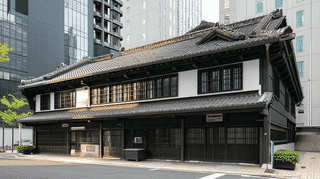
Three Meiji-period townhouse buildings in Osaka Prefecture. Its own name says former while its own reading field there leaves that word out completely.
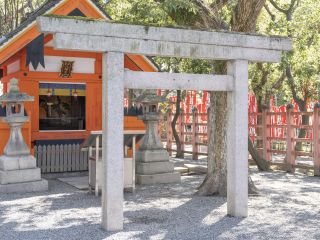
The Sumiyoshi Taisha Wakamiya Hachimangu Torii Gate is a small 1907 stone torii in Osaka with square pillars and straight lintels, a rare form in the grounds.

The Senpukan in Osaka, built in 1871 as the government mint's reception house and designed by Thomas Waters, is a veranda-wrapped brick building open each March.
The stone portico of the Osaka Mint foundry, built in 1871 and moved in 1934 to front a memorial hall beside the Senpukan, is an Important Cultural Property.
On Osaka's Okawa River stand the remains of Japan's first modern mint, founded in 1871. Senpukan, the old main gate, a guard house and early gas lamps survive here.
Built in 1881 in Chihayaakasaka, Osaka's only village, this farmhouse sets six slatted mushiko windows into black lime plaster. Registered 2007. Closed to visitors.
The former main hall of Abe Oji Shrine in Osaka, built in 1908 and moved in 1968, is a small nagare-style hall whose side middle posts rise to the ridge.
A small storehouse of about 1889 in Fukae, Osaka, set on a tall dressed-stone base after flood damage in 1885, with curved sangi-zumi corners. Registered 2023.
A gatehouse of about 1889 in Fukae, Osaka: one tiled roof over gate and wing rooms, a heavy timber door and a lattice window facing the street. Registered 2023.
An earthen wall of about 1889 in Fukae, Osaka, running 41 metres along two sides of an old compound, with a moulded cornice, a pebbled base and a stone-framed door.
A timber wall of about 1889 in Fukae, Osaka, running 29 metres along two sides of an old compound, 2.1 metres high on the north and 1.7 on the east. Registered 2023.
A late-Taisho storehouse closing a lane in Tezukayama, Osaka: plaster to the eaves, an armoured window hood, iron doors with a family crest, and a flamenco studio.
A 476-square-meter Meiji sake brewing hall in Tondabayashi, Osaka, with a steep gable roof, a brick koji room and a red-brick chimney. Registered in 2008.
A Meiji-era wall on the old Kishu Kaido in Kaizuka, Osaka, linking a townhouse to its storehouse: 7.3 meters in 6 bays, with a doorway behind removable boards.
A Meiji-era 2-storey storehouse in Kaizuka, Osaka, where the Uno family kept its clothing. Unlike the east storehouse, its ridgepole rests on horizontal beams.
The Osaka Tenmangu Shrine Kagura Hall of 1904, linked to the worship hall by a corridor, keeps old forms: boat brackets, sparse double rafters and lattice shutters.
The Osaka Tenmangu Shrine Assembly Hall of 1911 holds 5 rooms between the main hall and Baikaden. Once a waiting room, it now hosts receptions and plum exhibitions.
Meiji-era detached reception wing of the Okamoto family in Kaizuka, Osaka. Though altered, it keeps a fine 8-mat tea room. Registered in 2003; closed to visitors.