
Momoyama
Osaka · 安土桃山Browse Osaka’s cultural heritage from the Momoyama period (1573 – 1603). Filter by type and keyword, with concise stories, maps, and travel tips.
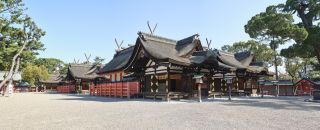
The Important Cultural Property Sumiyoshi Taisha in Osaka covers thirteen buildings, from Hideyori's 1607 South Gate and stone stage to the offering halls of 1810.

A wakizashi dated 1586 by Horikawa Kunihiro, the smith later called the founder of Japan's new sword era. An early work, now an Important Cultural Property in Osaka.
In an Osaka museum, this pair of Momoyama folding screens paints Europeans arriving by ship and Christian worship on gold leaf. It opens only in May and November.
The Izumianashi Shrine Auxiliary Kasuga Shrine Main Hall is a small kasuga-zukuri hall dated to about 1602, though older details hint it may predate that era.
Rebuilt by Toyotomi Hideyori in 1602, the Izumianashi Shrine Main Hall joins two small sanctuaries for a married pair of deities, each with its own gable and steps.
The main hall of Katano Shrine in Hirakata, Osaka, is a three-bay nagare-style hall of 1602 roofed in cypress bark, with Momoyama gates protected by the prefecture.
22 buildings dating from 1606 to the mid-Edo period at Amanosan Kongoji in Kawachinagano, Osaka, from the Gobutsudo to the guardian shrine, designated in 2019.
A 1606 hall at Amanosan Kongoji in Kawachinagano, Osaka, enshrining a portrait of Kobo Daishi, with a pyramidal bark roof and an attached moon-viewing pavilion.
The pagoda of Shoman-in, the Aizen Hall in Tennoji, Osaka, a tahoto of 1597 said to be a gift of Hideyoshi, holds a three-dimensional mandala; entry is free.
The guardian Tenmangu shrine of Sofukuji in Izumisano, Osaka, built about 1576, is a small kasuga-style hall, a forerunner of early modern shrine architecture.
Toyotomi Hideyori had this three-bay shrine hall in Kishiwada rebuilt in 1603. Protected since 1914, it stands in a precinct open to all without charge.
Nagano Jinja Honden in Kawachi-Nagano, Osaka, listed in 1941, packs a dormer gable and a curved bargeboard onto a one-bay cypress bark roof. Free to enter.
Minase Shrine Guest Hall in Shimamoto, Osaka, is the oldest building on its grounds: a Momoyama shoin with a 30-mat room, designated in 1926, opened on special days.
The main hall of Yasaka Shrine in Ikeda, Osaka, built in 1610, is a one-bay nagare-style hall whose decorated struts and beam ends show the Momoyama style.
Discover the Shino Tea Bowl, Named "Hirosawa," an Important Cultural Property of Japan housed at the Yuki Museum of Art in Osaka. A Momoyama-period masterpiece from the Mino kilns, this half-cylindrical chawan features creamy white feldspar glaze, soft fire-color flush, and faintly emerging iron-pigment designs. Ranked among the finest Shino tea bowls alongside the National Treasure "Unohana-gaki" and "Hagoromo," it embodies the very spirit of wabi tea aesthetics.
Discover the Important Cultural Property held at Osaka Castle Museum: Toyotomi Hideyoshi's autograph death poem ('Like dew I fall, like dew I vanish — all the affairs of Naniwa are but a dream within a dream'), ten blood-oath pledges in which Maeda Toshiie and other senior retainers swore loyalty to the young heir Hideyori on sacred Kumano talismans, and the vermilion-sealed orders that launched the second invasion of Korea in 1597. Designated in 2020, these thirteen documents offer an intimate window into the final years of the Toyotomi regime — with full historical background and visitor information for the Osaka Castle donjon.