
Edo
Osaka · 江戸Browse Osaka’s cultural heritage from the Edo period (1603 – 1868). Filter by type and keyword, with concise stories, maps, and travel tips.

A Southern Song Jian bowl at the Museum of Oriental Ceramics in Osaka, silver spots packed tightly across both surfaces. Once owned by the regent Hidetsugu.

A Southern Song tenmoku bowl at the Fujita Museum in Osaka, its black glaze scattered with haloed spots. Alone among yohen bowls, it is mottled inside and out.
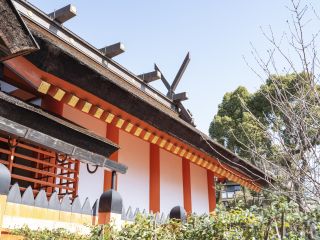
Built in 1708, the main hall of Daikai Shrine at Sumiyoshi Taisha is the oldest surviving Sumiyoshi-zukuri sanctuary, predating the National Treasure halls.
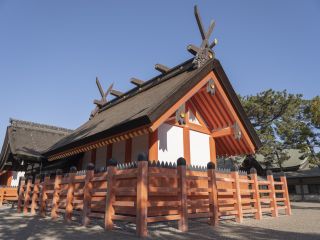
The Sumiyoshi Taisha Main Hall in Osaka is four National Treasure sanctuaries rebuilt in 1810 in the archaic Sumiyoshi style, all facing west like a fleet.
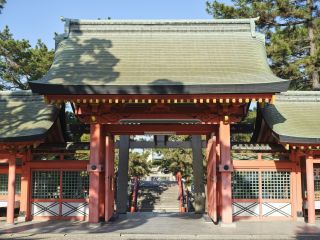
The Sumiyoshi Taisha Kojumon Gate is the early Edo four-legged gate fronting the main sanctuary in Osaka, with an unusual stack of beams and struts above its doors.
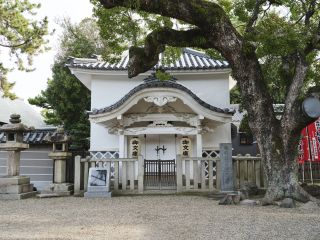
The Sumiyoshi Taisha Obunko Library is a storehouse built around 1723 by booksellers of Osaka, Kyoto and Edo to hold books, called the oldest library in Osaka.
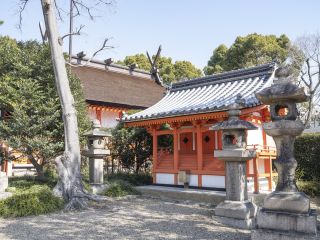
The Sumiyoshi Taisha Shiga Shrine Main Hall in Osaka is a late 17th-century three-bay shrine for the three sea gods, among the oldest buildings in the grounds.
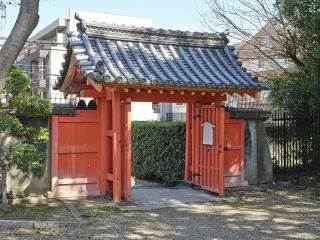
The Sumiyoshi Taisha Daikai Shrine North Small Gate is a late Edo munamon gate in Osaka, paired with a south twin to frame the front of the Daikai subsidiary shrine.
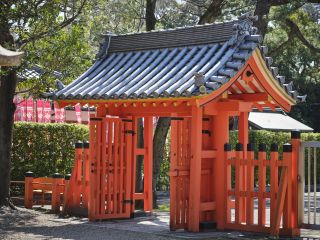
The Sumiyoshi Taisha Daikai Shrine South Small Gate is a late Edo munamon gate in Osaka, moved around 1881, paired with a north twin at the front of Daikai Shrine.
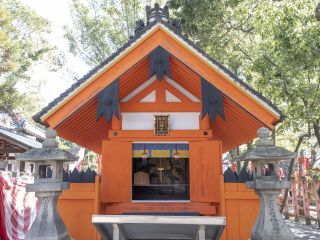
The Sumiyoshi Taisha Wakamiya Hachimangu Main Hall in Osaka is a one-bay shrine of about 1810, the main halls in miniature, with pine and doves on its doors.
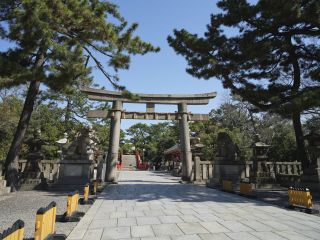
The Sumiyoshi Taisha West Great Torii Gate is the stone Myojin torii at the shrine's main entrance, 6.1 m wide and 6.4 m high, facing the Sumiyoshi Toriimae tram.
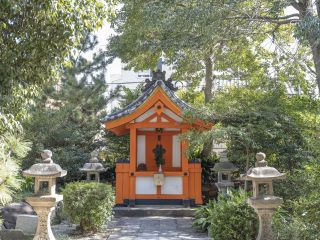
The Sumiyoshi Taisha Godosha Main Hall is a late Edo one-bay shrine deep in the garden in Osaka, dedicated to the god of the land, in small-scale Sumiyoshi style.
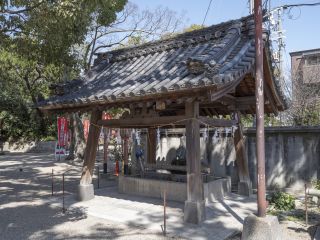
The Sumiyoshi Taisha South Temizuya Pavilion is a late Edo water pavilion in Osaka with fan rafters, projecting brackets and a coffered ceiling, ornate for its size.

An Important Cultural Property of Japan, this Edo-period sword guard (tsuba) by Nara Toshinaga (1667–1737) is among the supreme achievements of Japanese metalwork. Its high-relief carving and luxurious mixed-metal inlay depict the warrior Omori Hikoshichi carrying a demon woman — the vengeful spirit of Kusunoki Masashige — in a wraparound composition drawn from the Taiheiki chronicle. This guide introduces the work, its master craftsman, and where to encounter comparable tsuba masterpieces in Japan.
Called the Masamune of Osaka for his steel's clarity, Inoue Shinkai forged this Important Cultural Property in 1676, its tang bearing the imperial chrysanthemum.
Discover the Important Cultural Property katana inscribed 'Yamashiro Daijō Fujiwara Kunikane / An Auspicious Day in the Eighth Month of Kan'ei 5' (1628), held privately in Osaka. Forged by the first-generation Sendai Kunikane—official swordsmith of Date Masamune—just one year after he received his court title, this masterpiece revived the ancient Yamato Hōshō tradition of straight-grain forging.
Designated as an Important Art Object, this katana was forged in 1614 by the first-generation Echizen Yasutsugu, official swordsmith to the Tokugawa shogunate, using imported nanban iron in Edo. A pioneering example of foreign iron in Japanese swordsmithing and a historically significant blade created in the year of the Siege of Osaka Castle.
Seventy-six fusuma panels by Kano school artists from the early 17th century adorn four rooms of Daian-ji Temple's Main Hall in Sakai City, Osaka. Designated as an Important Cultural Property, these gold-ground polychrome and ink paintings are the sole surviving barrier paintings from Sakai — once one of Japan's wealthiest trading cities. The collection includes the legendary 'Pine with Added Branch' featured in prewar Japanese textbooks.
Osaka Castle's 13 designated buildings, from the 1620 Sengan and Inui turrets to the granite gunpowder magazine and Tamon Turret, with 2026 opening dates and prices.
Osaka's Former Ogata Kōan Residence, known as Tekijuku, is Japan's only surviving Dutch studies academy. Designated in 1964, it is open daily except Mondays.