
Historic Sites, Places of Scenic Beauty, and Natural Monuments of Japan
史 跡 名 勝 天 然 記 念 物Browse Japan’s Historic Sites, Places of Scenic Beauty, and Natural Monuments nationwide. Filter by prefecture, period, and category, with concise stories, maps, and practical travel tips.
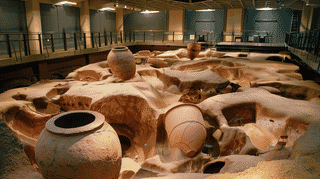
A Yayoi-period cemetery at Fukuoka, Japan. Pit, jar and stone-cist burials appear in turn, and a hall built over the dig shows jars and bones as they were found.
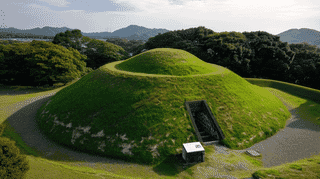
A tomb group in Yame, Fukuoka Prefecture, Japan. Five quite separate designations over there became just one there even now, with three more tombs added.
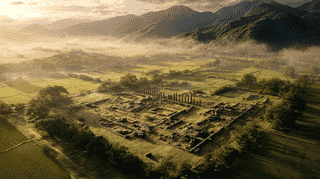
An ancient government office site at Minamisoma, Fukushima Prefecture, Japan. Once taken for a temple, it proved on excavation to be the office of a district.
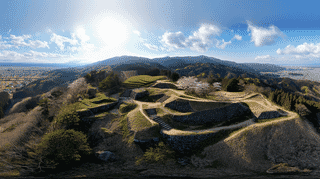
The seat of the Date family at Koori, Fukushima Prefecture, Japan. Named in the family's own law code, it was demolished as a condition of peace after an inner war.
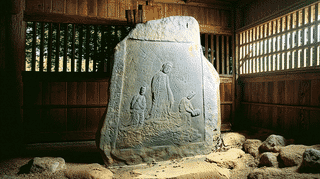
A memorial stone at Fukushima City, Fukushima Prefecture, Japan. Carved with Amida descending in welcome, it says a woman of the Taira raised it for her mother.
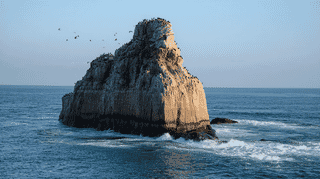
A tuff islet about 250 metres off Izumicho in Iwaki, Fukushima, where Japanese cormorants winter. Designated a Natural Monument in 1945, and eroding steadily.
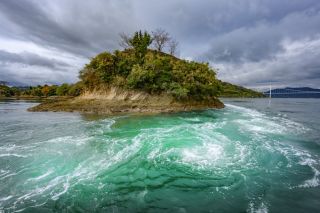
Noshima Castle Ruins, set on two uninhabited islands in the Miyakubo Strait off Imabari City in Ehime, is the only sea castle of the medieval Murakami pirates designated as a National Historic Site of Japan. Guarded by tidal currents reaching 10 knots and preserving its main bailey, second and third baileys, outworks, and more than 400 pier postholes, this rare medieval fortress can now be visited via a landing cruise from the Murakami Kaizoku Museum on Oshima.

Three Shinto shrines and two temples on the southern Kii Peninsula, bound by a thousand-year pilgrimage tradition and protected as a UNESCO World Heritage site.
Below the Shimokubo Dam, 1.5 km of the Kanna River winds among 48 green-schist boulders — the Sanbaseki, prized since the Edo era and protected since 1957.
Three flat-topped volcanic buttes east of sacred Hikosan in Kyushu. A 1941 Natural Monument, Takanosuyama offers an exposed rope-aided climb across three summits.
A 4.2-km Edo-period mountain road across the Ōu range, where Bashō was held at the Shitomae barrier in 1689 and wrote his flea-and-horse haiku nearby.
Where Wakayama, Mie and Nara meet, the Kitayama River cuts a one-kilometre gorge of 50-metre hornfels cliffs and emerald pools — a Special Place of Scenic Beauty.
A 330-meter-deep caldera lake on the Aomori-Akita border. The 14-kilometer Oirase Stream descends from its eastern shore through mossy forest, waterfalls and rapids.
Edo Tōkaidō over the 846 m Hakone Pass: 1680 stone pavement, 1618 cedars, and restored milestone mounds form a National Historic Site between Odawara and Mishima.
Aozuka Kofun in Inuyama City, Aichi Prefecture, is a magnificent keyhole-shaped tumulus measuring approximately 123 meters in length, built in the mid-fourth century. As the second-largest ancient tomb in Aichi, it was designated a National Historic Site in 1983 and now anchors the Aozuka Kofun Historic Park, where reconstructed pottery cylinders, lush bamboo-grass slopes, and an on-site guidance facility immerse visitors in over 1,600 years of layered history—from the powerful chieftains of ancient Owari to a Sengoku-era fortress.
Ano Ichirizuka in Toyoake City, Aichi Prefecture is a pair of milestone mounds built in 1604 by order of Tokugawa Ieyasu, marking the 86th ri from Nihonbashi along the old Tokaido. As one of the very few sites in Japan where both the east and west mounds still survive in their original positions across the road, it was designated a National Historic Site in 1936—a quiet but uniquely vivid window into Edo-period travel.
Kamakura-period tile kilns near the tip of the Atsumi Peninsula, Aichi, a Historic Site since 1967, which fired tiles for the rebuilt Great Buddha Hall of Todaiji.
Uma-no-se-iwa, a National Natural Monument in Aichi, is a 122-metre volcanic dike in the Ure River bed near Yuya Onsen, left standing as softer rock eroded away.
Urigō Site in Toyohashi, Aichi, is a Yayoi wetland village on the lower Toyokawa. Wooden tools, charred rice and shell mounds reveal farming, fishing and hunting.
The Ō-Arako Old Kiln Site fired medieval stoneware on the Atsumi Peninsula. An inscribed jar dates it to a 12th-century governor, rare in early Japanese ceramics.
More across Japan
The complete kokuhō catalogue — browse by prefecture, period, and category.
Nationwide jūyō bunkazai — architecture, sculpture, painting, crafts, and documents.
UNESCO-inscribed cultural and natural sites across the archipelago.