
Edo
Hyogo · 江戸Browse Hyogo’s cultural heritage from the Edo period (1603 – 1868). Filter by type and keyword, with concise stories, maps, and travel tips.
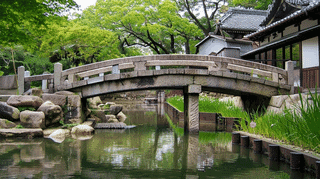
Discover the Kaei Bridge at Nishinomiya Shrine, a registered cultural property built in 1848 by sake brewers leading to Matsuo Shrine. Explore this elegant granite bridge in Nada Gogō, Japan's most renowned sake-producing region.

Raised in 1628 with backing from the lord of Himeji, this nine-bay hall juts from a wooded hillside on timber posts, its ceiling packed with pilgrim slips.
In Itami near Osaka, the Former Okada Residence is a townhouse dated to 1674, rare for its century, fronting Japan's oldest sake brewery with a known build date.
Located in Tanigawa, Sannan-cho, Tamba City, Hyogo Prefecture, the Main Hall of Takakura Shrine was built in 1705 by local craftsmen and designated a national Important Cultural Property in 2018. One of the largest Edo-period shrine main halls in the Tamba region, it features a distinctive layered roof and exquisite polychrome carvings that reward unhurried exploration.
Jōonji, a Nichiren temple in Amagasaki's Teramachi quarter, holds two Important Cultural Properties: a 1623 Main Hall and the city's only tahōtō, a 1607 pagoda.
Rebuilt in 1626, Hiromine Shrine Worship Hall in Himeji stands eaves to eaves with the eleven-bay sanctuary. Its east bay was dropped and its sides left open.
The Funayakata, an Important Cultural Property standing beside the pond at Sorakuen Garden in Kobe, is the preserved upper cabin of a river pleasure boat (kawagozafune) once used by the Honda lords of Himeji Domain in the mid-Edo period. Finished in lacquer and gold leaf, it is the sole surviving example of a river-type gozabune cabin in Japan—an irreplaceable window into an aquatic daimyō culture that has vanished everywhere else.
Built in 1853 at Fukuyoshi in Sayo, Hyogo, this thatched two-storey farmhouse keeps a formal shikidai entrance and an eight-room plan. Registered 2024. Not open.
This late Edo storehouse behind the Inoue main house at Fukuyoshi in Sayo, Hyogo, has earthen walls stopped at the middle coat, a stone plinth and pantiles.
A late-Edo torii of Rokko granite, 5.2 metres high, marks the south edge of Otsuchi Shrine in Kobe, a village enriched by water-mill oil pressing. Listed in 2016.
The main hall of Otsuchi Shrine in Kobe covers 1.5 square metres. Built late in the Edo period for a village of oil-pressing water mills, it was registered in 2016.
A modest wing where the retired head of the Otoshi household lived. Set along the north-east wall, it pairs a six-mat room with a four-mat anteroom. Registered 1999.
This grain store sits where the estate's south-east and south-west faces meet, sharing one roof with the adjoining carpenter's room. Its street face is board-clad.
A relatively large rice store in the south garden, its entrance flanked by namako lattice-plaster walls. A slightly offset ridge hints it may predate the 1835 main house.
Built in 1835 for the great headman of the lower Kakogawa, this 455-square-metre, hip-and-gable-roofed house heads a nine-building compound registered in 1999.
A small tea room off the veranda of the main house, pairing a three-mat tea space with a two-mat preparation area. A copper eave shades its south side. Registered 1999.
This range on the estate's south-east street edge sets a central gate between a storehouse-like block and service rooms; its plaster and boarded walls shape the street.
A small plaster store on the north-west wall by the detached wing. Gable-entered and just 17 square metres, it is the smallest of the nine, holding household utensils.
A closed plaster storehouse at the corner where the estate's north-east and north-west edges meet. Three by two bays, it held household utensils with the west store.
Discover the Uchi-Ōkura, a registered tangible cultural property within the Kajihara estate in Ōshio, Himeji. This Edo-period earthen storehouse reflects the prosperity of salt industry landowners in Hyogo Prefecture.