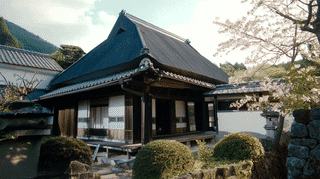
Shigeta Family Residence Tool Store and Privy: Two Eras in One Corner
At the northwest corner of the Shigeta residence in Mannō, Kagawa, two structures of different dates stand as one registered building. The tool store, or dōgugura, was built in Meiji 10 (1877) in the earthen-walled manner. The privy, or setchin, attached to its southwest, came later, added in Taishō 3 (1914) and built with exposed timber framing rather than plastered mass. Read together, they show a farmstead that grew across two generations.
The tool store joins directly to the main house and runs east to west. Along its south face a lean-to reaches out to form a kuramae, a covered working space in front of the store. Its combined floor area is about 59 square metres. The building is one of the elements that define the compound's northwest corner.
Why It Carries a National Registration
The tool store and privy were entered in the national register of tangible cultural properties on 19 September 2003, with notice on 17 October, under registration number 37-0187. The registration recognises the pair's role in the historic character of the Shigeta compound.
The two dates carry the point. The Shigeta line began as farmers, and the oldest part of the main house stands at its southeast corner. In Meiji 10 the family enlarged the residence, and the tool store belongs to that campaign. When the privy was added in Taishō 3, the layout reached the form it holds today. A single registered building that spans 1877 and 1914 records, in plaster and timber, how a working household kept adapting its own walls.
What to Look For
The tool store measures five ken along the ridge and two and a half deep, gabled and roofed in pantile. Look high on the south and north walls: two windows are set near the top of each face. Placed above head height, they let light and air reach the interior while keeping the lower walls solid and secure, the logic a storehouse follows.
The contrast between the two parts is the thing to catch. The Meiji tool store is earthen-walled, its frame hidden. The Taishō privy beside it is shinkabe, its posts and beams left in view. One building thus holds two ways of making a wall, set side by side. The covered kuramae along the south shows where the daily work of moving tools took place. As the residence remains private, this corner is best read from outside its bounds.
Q&A
- Why are a tool store and a privy counted as one property?
- They stand joined at the compound's northwest corner and were registered together as a single building, even though they were built at different times.
- When was each part built?
- The tool store dates from Meiji 10 (1877). The privy was added in Taishō 3 (1914).
- What is a kuramae?
- The covered space in front of a storehouse, here formed by a lean-to along the south face, used as a working area when the store was opened.
- Why are the windows set so high?
- High windows bring light and air while keeping the lower walls unbroken and secure, which suits a building meant for storage.
Basic Information
| Name | Shigeta Family Residence Tool Store and Privy (Shigeta-ke Jūtaku Dōgugura oyobi Setchin) |
|---|---|
| Location | 534 Kamibira, Yamawaki, Mannō-chō, Nakatado-gun, Kagawa Prefecture |
| Category | Registered Tangible Cultural Property (building) |
| Registered | 19 September 2003 (notice 17 October 2003); registration no. 37-0187 |
| Date of construction | Meiji 10 (1877); privy added Taishō 3 (1914) |
| Structure | Single-storey earthen-walled and timber construction, tiled roof, floor area about 59 m²; tool store gabled, five by two and a half ken |
| Count | 1 building |
| Access | Private residence; exterior viewing from the public road |
References
- National Database of Registered Cultural Properties, Agency for Cultural Affairs: Shigeta Family Residence Tool Store and Privy
- https://kunishitei.bunka.go.jp/heritage/detail/101/00003630
- Mannō Town, Cultural Properties: Shigeta Family Residence Main House and five others
- https://www.town.manno.lg.jp/site/bunkazai/4511.html
- Mannō Town, Cultural Properties: nationally designated and registered properties
- https://www.town.manno.lg.jp/site/bunkazai/list83-295.html
Last verified: 2026.07.11