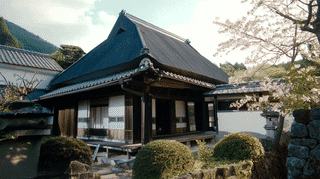
Shigeta Family Residence Komegura: A Rice Store Built Against Fire
On the broad yard between the main house and the gatehouse of the Shigeta residence in Mannō, Kagawa, a thick-walled storehouse faces west. This is the komegura, the rice store, raised in Meiji 10 (1877) in the dozō manner, its timber frame packed and plastered over in earth until the walls read as solid mass. It runs north to south, seven ken along the ridge and two and a half ken deep, under a gabled pantile roof, with a lean-to eave carried along its western face.
The floor area comes to about 84 square metres. For a farming family this was the building that held the year's return in grain, and its heavy earthen walls were a defence against the one thing that could erase that return in an hour, which was fire.
Why It Carries a National Registration
The rice store entered the national register of tangible cultural properties on 19 September 2003, with notice on 17 October, under registration number 37-0188. As with the other Shigeta buildings, the ground for registration was its part in the historic landscape rather than any single celebrated feature.
That landscape was shaped by a particular prosperity. Yamawaki sat on the road between Awa and Sanuki, and until the mid-twentieth century it served as a waypoint in the kariko-ushi trade, the seasonal hiring out of Awa cattle to Sanuki farms. A household that could raise a fireproof store of this size on its own yard was one whose harvests, and whose place in that regional economy, were worth guarding.
What to Look For
The interior was divided for work, not for show. From the south the space runs as three rooms in sequence: the rice store proper, then a naya or barn room, then a room for tools. Each held a different part of the farming year, and the arrangement let the family move grain, equipment, and stored goods without crossing one another.
The detail worth finding stands at the north gable end. Beside the doorway of the tool room, the builders attached a stone water tank of about three by two metres. In a district of timber and thatch, a store of rice was never far from the threat of flame, and this tank held the water kept ready against it. The lean-to eave on the west side sheltered the working face of the building, where doors were opened and loads carried through. Because the residence is privately owned, the store is seen from the yard's edge and the public road.
Q&A
- What is a dozō?
- It is a storehouse whose timber frame is buried under thick earthen plaster, producing heavy walls that resist fire. It was the standard way to protect valued goods such as rice.
- How is the inside arranged?
- In three rooms running from the south: the rice store, a barn room, and a tool room.
- What is the stone tank at the north end?
- A masonry water tank of about three by two metres, set beside the tool-room door. It supplied water for fire defence, a real concern for a rice store.
- Where does the store sit in the compound?
- On the wide yard, called kado, between the main house to the northwest and the gatehouse. It faces west toward that yard.
Basic Information
| Name | Shigeta Family Residence Komegura (Shigeta-ke Jūtaku Komegura) |
|---|---|
| Location | 534 Kamibira, Yamawaki, Mannō-chō, Nakatado-gun, Kagawa Prefecture |
| Category | Registered Tangible Cultural Property (building) |
| Registered | 19 September 2003 (notice 17 October 2003); registration no. 37-0188 |
| Date of construction | Meiji 10 (1877) |
| Structure | Single-storey earthen-walled storehouse, tiled roof, floor area about 84 m², with fire-water tank; gabled, seven by two and a half ken |
| Count | 1 building |
| Access | Private residence; exterior viewing from the public road |
References
- National Database of Registered Cultural Properties, Agency for Cultural Affairs: Shigeta Family Residence Komegura
- https://kunishitei.bunka.go.jp/heritage/detail/101/00003631
- Mannō Town, Cultural Properties: Shigeta Family Residence Main House and five others
- https://www.town.manno.lg.jp/site/bunkazai/4511.html
- Mannō Town, Cultural Properties: nationally designated and registered properties
- https://www.town.manno.lg.jp/site/bunkazai/list83-295.html
Last verified: 2026.07.11