
Muromachi
Okayama · 室町Browse Okayama’s cultural heritage from the Muromachi period (1336 – 1573). Filter by type and keyword, with concise stories, maps, and travel tips.
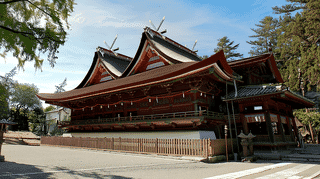
The halls of Kibitsu Shrine in Okayama were rebuilt in 1425 by Ashikaga Yoshimitsu. Two hip-and-gable roofs joined front and back form a shape found nowhere else.

Discover the National Treasure 'Portrait of a Court Lady' (Kyūjo-zu), a Yuan Dynasty masterpiece depicting a woman in male court attire with a flute at her sash. Explore its storied provenance from the Ashikaga Shogunal collection to the legendary collector Ohara Magosaburō, its connection to the ancient flute virtuoso Huan Yi, and how to view this enigmatic painting at the Kyoto National Museum and the 2026 special exhibition at the Ohara Museum of Art in Kurashiki.
Discover the National Treasure "Landscape in Ink and Light Color on Paper" by Sesshū Tōyō, one of Japan's greatest ink painters. This masterpiece from the Muromachi period is believed to be his final work, held in the Ōhara family collection in Kurashiki, Okayama.
Discover the Otakisan Three-Storied Pagoda, an Important Cultural Property dating from 1441, nestled within the ancient Fukushoji Temple complex in Bizen, Okayama. Explore its Muromachi-period architecture, lush hydrangea gardens, and serene mountain trails.
Rebuilt in 1543, the North Zuijinmon at Kibitsu Shrine mirrors its tiled southern twin but wears a cypress-bark roof. It became an Important Cultural Property in 1913.
Built in 1357, the South Zuijinmon is the oldest building at Kibitsu Shrine, a tile-roofed eight-legged gate listed as an Important Cultural Property in 1911.
The Main Halls of Kumano Shrine in Hayashi, Kurashiki City, Okayama, comprise six independent buildings arranged in a single row, deliberately patterned on the layout of Kumano Hongū-taisha in Kii. The central Second Hall, rebuilt in 1492, is a National Important Cultural Property and a rare survivor of mid-Muromachi painted shrine architecture, with vermillion-lacquered timbers and white gofun walls in a refined sumi-ki-iri kasuga-zukuri style. The other five halls were rebuilt in 1647 under the patronage of the Okayama daimyō Ikeda Mitsumasa. The shrine was founded in 701 and has long been one of western Japan's leading centers of Kumano worship and Shugendō.
Discover Shufukuji Hoden, a rare granite treasure hall built in 1338 in Okayama's historic Ashimori district. This Important Cultural Property blends Kasuga-style shrine architecture with medieval stone craftsmanship.
Discover the Three-Storied Pagoda of Shinko-ji Temple in Bizen City, Okayama—a nationally designated Important Cultural Property built in the mid-Muromachi period and relocated in 1613. Standing 18.24 meters tall, this vermillion pagoda features exquisite kaerumata carvings with Sanskrit motifs and enshrines a rare wax-stone Dainichi Nyorai statue.
Shinkoji Main Hall in Bizen, Okayama was built in 1516, a date fixed by its inscribed ridge tag. Five bays square under a tiled roof, the precinct is free to enter.
The Stone Pagoda of Tsuzumi Shrine in Okayama City was carved in 1346 and stands 4.15 metres in granite, the largest of its kind in the prefecture. Entry is free.
Nakayama Shrine in Tsuyama City, Okayama Prefecture, is the ichinomiya (highest-ranking shrine) of the former Mimasaka Province, with a founding tradition dating to 707 CE. Its main hall, rebuilt in 1559 by the warlord Amago Haruhisa, features the unique 'Nakayama-zukuri' architectural style and is designated as a national Important Cultural Property. The shrine is also known for its monkey deity legend from the Konjaku Monogatari and its distinctively designed Nakayama torii gate.
A granite stone pagoda at Honzan-ji in Okayama, dated 1335. About 184 cm tall, it stands beside the temple's three-story pagoda and is the grounds' oldest structure.
Built in 1350 on Iwama-san in Misaki, Okayama, this Tendai hall mixes Japanese and Zen-style carpentry under a cypress-bark hip roof, an Important Cultural Property.
A granite torii at Honjo Hachimangu in Kurashiki, dated by inscription to 1421. This Important Cultural Property is a benchmark for early Muromachi stone gates.
Honren-ji's middle gate in Ushimado, Okayama, is a rare two-pillar munamon, valued for its unusual joinery and named an Important Cultural Property in 1970.
Honrenji Temple Banjindo in Setouchi City, Okayama, shelters three late Muromachi shrines under a single covering hall. Their dates, roof forms and how to visit.
Honrenji Temple Main Hall at Ushimado, Setouchi City, was rebuilt in 1492 and carries no bracket complexes. Its frame, its Korean envoy history, and how to visit it.
Standing on a hilltop in Setouchi City, Okayama, the Main Hall of Yokeiji Temple is a five-bay Buddhist hall built in 1570. Designated an Important Cultural Property of Japan in 1979, it is celebrated as a rare surviving example of a traditional late-Muromachi Esoteric Buddhist main hall. With its powerful irimoya tile roof, thick high-quality timbers, original altar platform and miniature shrine, and an adjoining Shinto shrine that preserves the spirit of medieval shinbutsu shūgō, Yokeiji rewards every visitor.
The Main Hall of Yoshikawa Hachimangu Shrine, nestled in Kibichuo Town in central Okayama Prefecture, was rebuilt in 1395 during the early Muromachi period and was designated a National Important Cultural Property in 1925. With its imposing five-by-two bay irimoya (hip-and-gable) roof and wood-shingle (kokera-buki) covering, it stands as one of western Japan's finest surviving medieval shrine buildings. A landmark 1996–1998 restoration revealed the first physical evidence in Japan of an archaic chisel-splitting timber technique, rewriting a chapter of Japanese architectural history. Founded in 1096 as a branch shrine of Kyoto's famed Iwashimizu Hachimangu, the precinct also hosts the month-long Toban-sai folk festival (a Prefectural Important Intangible Folk Cultural Property) every October, offering visitors a profound encounter with old Japan deep in the Kibi Highlands.