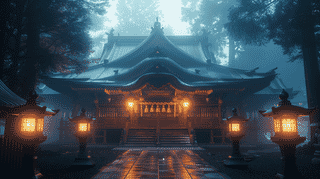
What Are the Enryakuji Temple Jogyodo and Hokkedo?
The Enryakuji Temple Jogyodo and Hokkedo (延暦寺常行堂及び法華堂, Jōgyō-dō and Hokke-dō) are a pair of identical Buddhist halls in the Saitō precinct of Mount Hiei, Sakamoto Honmachi, Otsu City, Shiga Prefecture; built in 1595 in the Momoyama period, they have been an Important Cultural Property since their designation in 1955.
Facing them, the Jōgyō-dō stands on the left and the Hokke-dō on the right. A roofed corridor, included in the designation as an appended structure, bridges the gap between them, and the path runs straight underneath it. Seen from the front, the corridor looks like a carrying pole with a hall hanging from each end, which is why the pair is better known as Ninai-dō, the "shouldered halls". The temple adds a livelier version: the warrior monk Benkei is said to have ducked under the corridor and hoisted both buildings on his shoulders.
When Oda Nobunaga burned Mount Hiei in 1571, almost every building was lost. After Toyotomi Hideyoshi allowed the temple to rebuild in 1584, the Agency for Cultural Affairs notes, the Jōgyō-dō and Hokke-dō were among the very first structures to go back up. The Enryakuji Temple Jogyodo and Hokkedo therefore mark the opening phase of the mountain's recovery.
Two Halls, One Design
The national database records both halls in the same words: five bays by five bays, single-storeyed, with a pyramidal hōgyō-zukuri roof, a one-bay kōhai porch at the front and a roof of tochi shingles. Each is a square box whose four roof slopes meet at a single point. The Agency's own description calls them exactly alike, and standing between them you can see that the pitch of the roofs and the depth of the eaves match.
The walls are fitted with hinged lattice shutters called shitomido and plain board doors, all in the native Japanese manner rather than the Chinese-derived Zen style. The grid of the shutters gives each face a steady, repeating rhythm. Overhead, the tochi roof of thick overlapping boards weathers to a soft grey against the cedars.
What happens inside explains why there are two. The Tendai school teaches four forms of meditative practice, the shishu zanmai, and these halls house two of them. The Jōgyō-dō enshrines Amida Nyorai and is used for jōgyō zanmai, in which the practitioner walks continuously around the image while chanting the Buddha's name. The Hokke-dō enshrines the bodhisattva Fugen and is used for hokke zanmai, a practice centred on the Lotus Sutra. Because the halls are still in use for this training, their interiors are closed to the public.
The value of the Enryakuji Temple Jogyodo and Hokkedo, designated an Important Cultural Property in 1955, lies in that continuity. The paired layout goes back to the Heian period; the Momoyama rebuilding reproduced it, and the halls still serve the purpose they were built for. They were dismantled and reassembled during a full repair in 1967.
What to Look For
Saitō is organised on a flight of stone steps. The twin halls sit at the top; below them is the precinct's main hall, the Tenpōrin-dō, better known as the Shaka-dō. As you reach the last step, the two identical buildings appear to left and right with the corridor spanning the space between.
Walk under the corridor. Looking up at its floor framing, you get a direct sense of the halls being joined by a single bridge. Turn around on the far side and compare the two roofs and porches; they line up almost as a mirror image.
For the full "carrying pole" effect, step back down the stairs and look up. From below, halls and corridor merge into one long, low composition, and the nickname makes immediate sense.
Visiting: Seeing Two Closed Halls
The halls stand at the heart of the Saitō precinct, at the top of the stone steps above the Tenpōrin-dō (Shaka-dō). Both are in use for meditation practice, so their interiors are closed; you can see the exteriors and walk through the passage beneath the corridor. Keep your voice down; this is an active training site.
The best places to take in both halls and the corridor at once are just past the passage, looking back, and at the foot of the steps, looking up. The temple does not publish a photography policy, so follow any signs on site.
Viewing is limited to Saitō opening hours with the combined Tōdō, Saitō and Yokawa ticket. Directions to Saitō and hours and fees for the temple as a whole are on the Enryakuji page.
- 📍 Plan Your Visit to Shiga
- Find tours, activities & transport passes near Enryakuji Temple Jogyodo and Hokkedo
- [ Hikone Castle & Lake Biwa Cruise Experiences ]
Q&A
- Why are the Enryakuji Temple Jogyodo and Hokkedo called Ninai-do?
- The corridor joining the two identical halls looks like a carrying pole with a load at each end. The temple also tells of the monk Benkei lifting both halls on his shoulders by the corridor.
- Can you go inside the Enryakuji Temple Jogyodo and Hokkedo?
- No. Both halls are used for Tendai meditation practice and their interiors are closed. You can view the exteriors and walk under the connecting corridor.
- What is the difference between the Jogyodo and the Hokkedo at Enryakuji?
- The Jōgyō-dō enshrines Amida and is used for walking meditation with chanting; the Hokke-dō enshrines Fugen and is used for practice based on the Lotus Sutra. The buildings themselves are the same design.
- When were the Enryakuji Temple Jogyodo and Hokkedo built?
- In 1595. They were among the first buildings rebuilt after the burning of Mount Hiei in 1571.
- Where are the Enryakuji Temple Jogyodo and Hokkedo within Saito?
- At the centre of Saitō, at the top of the stone steps above the Shaka-dō. The Sōrintō is on the hill to the north, and the Ruri-dō is further north on a detached site.
Basic Information
| Name | Enryakuji Temple Jogyodo and Hokkedo (延暦寺常行堂及び法華堂) |
|---|---|
| Location | Sakamoto Honmachi, Otsu City, Shiga Prefecture (Saitō precinct, Mount Hiei) |
| Designation | Important Cultural Property (building) |
| Year Designated | Designated 1955/6/22 (Showa 30) |
| Quantity | 2 buildings (with 1 connecting corridor as an appended structure) |
| Dimensions | Each 5 by 5 bays, single storey, hōgyō-zukuri roof, 1-bay kōhai porch, tochi shingles |
| Owner | Enryakuji Temple |
| Public Access | Exteriors viewable during Saitō opening hours with the combined ticket; interiors closed |
References
- Database of National Cultural Properties: Enryakuji Jogyodo and Hokkedo, Jogyodo (Agency for Cultural Affairs)
- https://kunishitei.bunka.go.jp/bsys/maindetails/102/1326
- Database of National Cultural Properties: Enryakuji Jogyodo and Hokkedo, Hokkedo (Agency for Cultural Affairs)
- https://kunishitei.bunka.go.jp/bsys/maindetails/102/1327
- Database of National Cultural Properties: Enryakuji, detailed commentary (Agency for Cultural Affairs)
- https://kunishitei.bunka.go.jp/bsys/maindetails/102/00004892
- Cultural Heritage Online: World Heritage nomination, Historic Monuments of Ancient Kyoto, E Enryakuji
- https://online.bunka.go.jp/suisensyo/kyoto/MAINTEXT/3b-E-j.html
- Enryakuji Jogyodo (Otsu City Cultural Properties Protection Division)
- https://www.city.otsu.lg.jp/bz/a/03/15/60714.html
- Enryakuji Hokkedo (Otsu City Cultural Properties Protection Division)
- https://www.city.otsu.lg.jp/bz/a/03/15/60698.html
- Saitō precinct (Hieizan Enryakuji official site)
- https://www.hieizan.or.jp/grounds/saitou.html
- Opening hours and fees (Hieizan Enryakuji official site)
- https://www.hieizan.or.jp/tickets/
- Access (Hieizan Enryakuji official site)
- https://www.hieizan.or.jp/access/
Last verified: 2026.09.25
Cultural Treasures in the Same Area
All are within walking distance in the same area, so we recommend visiting them together.
- Enryakuji Temple's Jōgyōdō and Hokkedō Jogyodo 0.00 km
- Enryakuji Temple's Jōgyōdō and Hokkedō Hokkedo 0.03 km