What Is the Enryakuji Temple Rurido Hall?
The Enryakuji Temple Rurido Hall (延暦寺瑠璃堂, Ruri-dō) is a small late-Muromachi-period Buddhist hall standing north of the Saitō precinct on Mount Hiei, in Sakamoto Honmachi, Otsu City, Shiga Prefecture; it was designated in 1912 and is now an Important Cultural Property. Its name comes from its principal image, Yakushi Ruri Kōnyorai, the Buddha of Healing whose paradise is described as made of lapis lazuli (ruri).
In 1571 Oda Nobunaga's army burned almost every building on Mount Hiei. Enryakuji describes the Enryakuji Temple Rurido Hall as the only building on the mountain to escape, and the government's World Heritage nomination for the Historic Monuments of Ancient Kyoto likewise lists the Ruri-dō and a sōrin (the metal spire later mounted on the Sōrintō pillar) as the survivors. Nearly everything else you see on Hiei today was rebuilt in the decades that followed; this hall is older than the fire.
The Agency for Cultural Affairs places it on a detached plot to the north of Saitō. No record gives the year of construction. Both the Agency and the temple date it to the late Muromachi period, roughly the late fifteenth to sixteenth century, on the evidence of its style.
Form and Significance
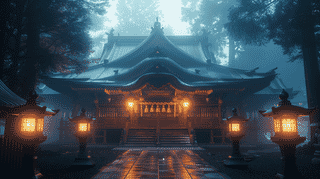
The national database records the Enryakuji Temple Rurido Hall as three bays by three bays, single-storeyed, with a hip-and-gable irimoya-zukuri roof covered in hiwada-buki, cypress bark laid in fine overlapping layers.
The temple points out that the hall shows features of the Zen style, which it calls unusual on Mount Hiei. A Zen-style hall surviving from before 1571 offers a rare glimpse of what medieval Hiei actually looked like. Compare it with the twin Jōgyō-dō and Hokke-dō in central Saitō, with their rows of lattice shutters in the native Japanese manner, and the difference in lineage is easy to read.
The hall has been taken apart and rebuilt twice in modern times, in 1917 and again in 1939, according to the World Heritage nomination. Those repairs are why a building of this age still stands in good order.
Its importance is chiefly a matter of date. If the temple's account holds, this is the only building still standing on the mountain that connects Hiei's architecture to the period before the fire. It was protected in 1912 as a Specially Protected Building under the Ancient Shrines and Temples Preservation Law and became an Important Cultural Property under the postwar heritage law.
What to Look For
The Enryakuji Temple Rurido Hall stands alone among tall cedars at the end of a forest path north of the Saitō halls. Far fewer people come here than to the centre of Saitō, and the setting is quiet.
Start with the roof. Cypress bark is laid in thin, closely packed layers, so the cut edge of the eaves shows as fine stripes. Next to the chunky tochi shingles of the Jōgyō-dō and Hokke-dō, the bark roof looks smoother and its gable lines softer.
Then stand back in front of the hall. Only three bays across, it carries a roof that spreads well beyond its walls. Keep in mind that it has stood on this mountain since before the fire, and the contrast with the Edo-period halls around Saitō becomes clearer.
Visiting: The Path from Saitō
The interior is closed. You can view the exterior during Saitō opening hours with the combined Tōdō, Saitō and Yokawa ticket.
The hall lies about 500 metres north, in a straight line, of the Jōgyō-dō and Hokke-dō. The route is an unpaved mountain path that crosses a road partway, so wear sturdy shoes and watch for cars. Allow 10 to 15 minutes each way. The temple publishes no photography policy; follow any signs on site.
Directions to Saitō and hours and fees for the temple as a whole are on the Enryakuji page.
- 📍 Plan Your Visit to Shiga
- Find tours, activities & transport passes near Enryakuji Temple Rurido Hall
- [ Hikone Castle & Lake Biwa Cruise Experiences ]
Q&A
- Did the Enryakuji Temple Rurido Hall survive Oda Nobunaga's attack in 1571?
- Yes. Enryakuji describes it as the only building on the mountain to escape the fire, and the World Heritage nomination lists it, with a metal spire, as the survivors.
- How old is the Enryakuji Temple Rurido Hall?
- No construction date is recorded. The Agency for Cultural Affairs dates it to the late Muromachi period on stylistic grounds.
- Can you go inside the Ruri-do at Enryakuji?
- No, the interior is closed. The exterior can be seen during Saitō opening hours with the combined ticket.
- How do I get to the Enryakuji Temple Rurido Hall?
- Walk north on the mountain path from the Jōgyō-dō and Hokke-dō in Saitō. It is about 500 metres in a straight line; allow 10 to 15 minutes each way, and take care where the path crosses a road.
- Who is enshrined in the Ruri-do on Mount Hiei?
- Yakushi Nyorai, the Buddha of Healing, in the form known as Yakushi Ruri Kōnyorai. The hall takes its name from him.
Basic Information
| Name | Enryakuji Temple Rurido Hall (延暦寺瑠璃堂) |
|---|---|
| Location | Sakamoto Honmachi, Otsu City, Shiga Prefecture (north of the Saitō precinct, Mount Hiei) |
| Designation | Important Cultural Property (building) |
| Year Designated | Designated 1912/2/8 (Meiji 45) |
| Quantity | 1 building |
| Dimensions | 3 by 3 bays, single storey, irimoya-zukuri roof, cypress-bark roofing |
| Owner | Enryakuji Temple |
| Public Access | Exterior viewable during Saitō opening hours with the combined ticket; interior closed |
References
- Database of National Cultural Properties: Enryakuji Rurido (Agency for Cultural Affairs)
- https://kunishitei.bunka.go.jp/bsys/maindetails/102/1324
- Database of National Cultural Properties: Enryakuji, detailed commentary (Agency for Cultural Affairs)
- https://kunishitei.bunka.go.jp/bsys/maindetails/102/00004892
- Cultural Heritage Online: World Heritage nomination, Historic Monuments of Ancient Kyoto, E Enryakuji
- https://online.bunka.go.jp/suisensyo/kyoto/MAINTEXT/3b-E-j.html
- Saitō precinct (Hieizan Enryakuji official site)
- https://www.hieizan.or.jp/grounds/saitou.html
- Opening hours and fees (Hieizan Enryakuji official site)
- https://www.hieizan.or.jp/tickets/
- Access (Hieizan Enryakuji official site)
- https://www.hieizan.or.jp/access/
Last verified: 2026.09.25