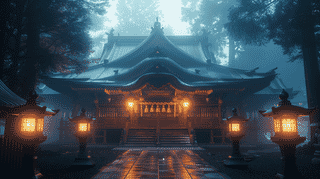
What Is the Enryakuji Temple Tenporindo?
The Enryakuji Temple Tenporindo (延暦寺転法輪堂, Tenpōrin-dō) is the main hall of the Saitō precinct on Mount Hiei, Sakamoto Honmachi, Otsu City, Shiga Prefecture; built in 1347 in the early Muromachi period, it was designated in 1900 and is now an Important Cultural Property. It is better known as the Shaka-dō, after its principal image, Shakyamuni.
The hall did not start life on Mount Hiei. After the fire of 1571, as the temple was rebuilt under Toyotomi Hideyoshi, it was dismantled at Onjō-ji (Mii-dera) and re-erected here in 1595. Sources differ on what it was at Onjō-ji: the Agency for Cultural Affairs calls it the former Miroku Hall, while Enryakuji describes it as Onjō-ji's main hall (kondō).
Because the building itself dates from 1347, both Enryakuji and Otsu City call it the oldest surviving building of the temple. Bringing an old hall up from another temple to fill the gap left by the fire is itself a telling episode in the mountain's recovery.
Form and Significance
The national record describes the Enryakuji Temple Tenporindo as seven bays by seven, single-storeyed, with an irimoya roof of copper shaped like tochi shingles. From a distance the roof reads as thick wooden boards; up close it is metal formed to imitate them.
Otsu City describes the hall as purely native Japanese in style, following the standard plan of a Tendai main hall. There is no admixture of Zen-style detail, which makes it a clear example of a fourteenth-century main hall. The World Heritage nomination records that it was dismantled and reassembled in a full repair in 1958.
Its value is twofold: as an early, textbook example of a native-style Tendai main hall, and as physical evidence of how Mount Hiei rebuilt after 1571 by borrowing buildings from elsewhere.
What to Look For
The hall sits at the foot of Saitō's stone steps, with the twin Jōgyō-dō and Hokke-dō at the top. Look down from the upper landing and you take in the full sweep of the seven-bay roof.
Closer in, look up at the eaves. The copper has been formed to copy the stepped edges of board roofing. Count the bays across the front to see how the seven-bay width is held together by the calm proportions of the native style.
The Saitō bell tower stands on the slope to the south and the Sōrintō on the hill to the north, so from here you can see how the core of Saitō is laid out.
Visiting: The Main Hall of Saitō
The Enryakuji Temple Tenporindo is at the centre of Saitō and can be visited during Saitō opening hours with the combined Tōdō, Saitō and Yokawa ticket. The temple's Saitō page marks the Jōgyō-dō, Hokke-dō and Ruri-dō as closed inside but carries no such note for the Tenpōrin-dō.
Entry may be restricted during services. The temple publishes no photography policy, so follow signs and staff inside. Directions to Saitō and hours and fees for the temple as a whole are on the Enryakuji page.
- 📍 Plan Your Visit to Shiga
- Find tours, activities & transport passes near Enryakuji Temple Tenporindo
- [ Hikone Castle & Lake Biwa Cruise Experiences ]
Q&A
- Are the Enryakuji Temple Tenporindo and the Shaka-do the same building?
- Yes. Its formal name is Tenpōrin-dō; it is called the Shaka-dō after its principal image, Shakyamuni.
- When was the Enryakuji Temple Tenporindo built?
- In 1347, which makes it the oldest surviving building of Enryakuji. It was moved from Onjō-ji to its present site in 1595.
- Why was the Tenporindo moved from Onjo-ji to Enryakuji?
- Saitō's halls were lost in the fire of 1571, and during the rebuilding under Hideyoshi a hall from Onjō-ji was brought up to serve as Saitō's main hall. The Agency calls it the former Miroku Hall; the temple calls it Onjō-ji's main hall.
- What is the roof of the Enryakuji Temple Tenporindo made of?
- Copper sheet formed to look like tochi wooden shingles.
- Can I visit the Shaka-do at Enryakuji?
- Yes, during Saitō opening hours with the combined Tōdō, Saitō and Yokawa ticket.
Basic Information
| Name | Enryakuji Temple Tenporindo (延暦寺転法輪堂, Shaka-dō) |
|---|---|
| Location | Sakamoto Honmachi, Otsu City, Shiga Prefecture (Saitō precinct, Mount Hiei) |
| Designation | Important Cultural Property (building) |
| Year Designated | Designated 1900/4/7 (Meiji 33) |
| Quantity | 1 building |
| Dimensions | 7 by 7 bays, single storey, irimoya roof, copper roofing shaped like tochi shingles |
| Owner | Enryakuji Temple |
| Public Access | Open during Saitō opening hours with the combined ticket |
References
- Database of National Cultural Properties: Enryakuji Tenporindo (Agency for Cultural Affairs)
- https://kunishitei.bunka.go.jp/bsys/maindetails/102/1322
- Database of National Cultural Properties: Enryakuji, detailed commentary (Agency for Cultural Affairs)
- https://kunishitei.bunka.go.jp/bsys/maindetails/102/00004892
- Enryakuji Tenporindo (Otsu City Cultural Properties Protection Division)
- https://www.city.otsu.lg.jp/bz/a/03/15/60694.html
- Cultural Heritage Online: World Heritage nomination, Historic Monuments of Ancient Kyoto, E Enryakuji
- https://online.bunka.go.jp/suisensyo/kyoto/MAINTEXT/3b-E-j.html
- Saitō precinct (Hieizan Enryakuji official site)
- https://www.hieizan.or.jp/grounds/saitou.html
Last verified: 2026.09.25