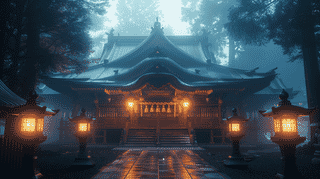
What Is the Enryakuji Temple Konpon Chudo Corridor?
The Enryakuji Temple Konpon Chudo Corridor (延暦寺根本中堂廻廊, the kairō of the Konpon Chūdō) is the roofed cloister that encloses the forecourt of Enryakuji's head hall in the Tōdō precinct of Mount Hiei, Sakamoto Honmachi, Otsu City, Shiga Prefecture; built in 1640, it was designated in 1899 and is now an Important Cultural Property.
The Konpon Chūdō faces east, and in front of it lies an enclosed courtyard. The corridor folds around that courtyard, meeting the hall at its front corners, so that building and yard read as a single sacred compound. Enryakuji traces the arrangement back to 980, when the abbot Ryōgen had a valley filled in, enlarged the hall to its present eleven-bay width, and added the cloister and a middle gate for the first time.
Everything burned in 1571, when Oda Nobunaga's army torched Mount Hiei. Reconstruction came under the third Tokugawa shogun, Iemitsu, at the urging of the monk Tenkai. The Agency for Cultural Affairs dates both hall and corridor to 1640, while the temple gives 1642 as the year the hall was completed; the two figures most likely mark different points in the same building campaign.
How the Corridor Is Built
The national heritage record describes the Enryakuji Temple Konpon Chudo Corridor as 41 bays long along its folded run and 2 bays deep, single-storeyed, with a ryōsage roof that slopes both ways, kara-hafu gables on the inner and outer eaves at the front, a kara-hafu carriage porch projecting from each side, and a roof of tochi shingles.
Those curved gables do the architectural work. At the centre of the front, a kara-hafu rises from the eaves on both faces of the corridor, marking the formal entrance. The two side porches break up what would otherwise be a long, even run of posts and roof.
The roof is the detail to know. According to the temple's restoration notes, each tochi board is 2.4 centimetres thick and 30 centimetres long, and the boards are laid in courses offset by 8.5 centimetres. The main hall itself was switched from tochi shingles to copper sheeting in 1798; the corridor never was, which is why the two roofs look so different today.
The colour scheme follows rules as well. Posts and everything below the head-tie beams are finished in chan-nuri, a red pigment bound in oil (here a mix of perilla oil, tung oil and pine resin), while the bracket sets above are painted in a brighter vermilion called ni-nuri, and doors are black lacquer. Research during the current restoration showed that the original finish was doshu-nuri, a treatment the shogunate permitted only on specially favoured buildings. The materials are now hard to obtain, so the restorers kept chan-nuri but matched the original hue.
The corridor matters as the frame of the National Treasure hall it surrounds. The layout of hall and enclosed forecourt goes back to the Heian period, and the 1640 rebuilding restated it at full scale; the head hall's standing within the Tendai world is expressed as much by this enclosure as by the hall itself.
What to Look For During the Great Restoration
Since 2016 the Konpon Chūdō and its corridor have been under a conservation project planned to run about fifteen years: reroofing the hall in copper and the corridor in tochi shingles, and repainting and cleaning the painted decoration. The work goes on inside a huge temporary shed, and the temple keeps the buildings open to worshippers throughout.
That shed brings a rare chance. A viewing stage built in the courtyard lets you climb to the height of the hall's eaves and look straight down onto the roof of the Enryakuji Temple Konpon Chudo Corridor. From up there you can follow the tochi boards stepping back course after course and see the crown of the front kara-hafu from above. The temple says the stage will stay open until around December 2026, when dismantling begins.
Back on the ground, compare the chan-nuri on the posts with the vermilion around the brackets; after repainting, the contrast with the black-lacquered doors is sharp.
On the higher ground east of the corridor stands the Monju-rō gate. Climb its steps and turn around, and you can see how the corridor's front entrance and the Konpon Chūdō line up on one axis.
Visiting During the Restoration
The corridor stands at the centre of the Tōdō precinct, enclosing the forecourt of the Konpon Chūdō. Both are currently inside the restoration shed, but the temple keeps them open to worshippers, and the courtyard viewing stage is scheduled to stay open until around December 2026.
Enryakuji also runs free guided visits to the restoration site, starting from the Konpon Chūdō entrance. In 2026 they are scheduled for October 10 and the Saturdays of November, and the temple says this is the last year they will be held because the shed is coming down. Check the official site for dates.
The temple does not publish a photography policy, so follow instructions on site around the corridor and the works. Viewing is limited to Tōdō opening hours with the combined Tōdō, Saitō and Yokawa ticket; directions, hours and fees for the temple as a whole are on the Enryakuji page.
- 📍 Plan Your Visit to Shiga
- Find tours, activities & transport passes near Enryakuji Temple Konpon Chudo Corridor
- [ Hikone Castle & Lake Biwa Cruise Experiences ]
Q&A
- When was the Enryakuji Temple Konpon Chudo Corridor built?
- The Agency for Cultural Affairs dates it to 1640, the same year as the hall; the temple gives 1642 for the hall's completion. A corridor first surrounded the forecourt in 980.
- Can I see the Enryakuji Temple Konpon Chudo Corridor during the restoration?
- Yes. The buildings stay open, and a viewing stage in the courtyard lets you look down on the corridor roof until around December 2026.
- Why is the corridor roof at Konpon Chudo made of wood when the hall roof is copper?
- The hall was reroofed in copper in 1798, but the corridor kept its tochi shingles, thick wooden boards laid in overlapping courses.
- Are there tours of the Enryakuji Temple Konpon Chudo Corridor restoration?
- Yes. Enryakuji runs free site visits starting at the Konpon Chūdō entrance; in 2026 they are scheduled for October 10 and the Saturdays of November, and this is said to be the final year.
- How does the Enryakuji Temple Konpon Chudo Corridor relate to the Monju-ro gate?
- The Monju-rō stands on higher ground east of the corridor. From in front of it you can see the corridor entrance and the Konpon Chūdō lined up on one axis.
Basic Information
| Name | Enryakuji Temple Konpon Chudo Corridor (延暦寺根本中堂廻廊) |
|---|---|
| Location | Sakamoto Honmachi, Otsu City, Shiga Prefecture (Tōdō precinct, Mount Hiei) |
| Designation | Important Cultural Property (building) |
| Year Designated | Designated 1899/4/5 (Meiji 32) |
| Quantity | 1 building |
| Dimensions | 41 bays along its folded run, 2 bays deep, single storey, ryōsage roof, kara-hafu on front inner and outer eaves, kara-hafu carriage porch on each side, tochi shingles |
| Owner | Enryakuji Temple |
| Public Access | Open during Tōdō opening hours with the combined ticket; under conservation work |
References
- Database of National Cultural Properties: Enryakuji Konpon Chudo Corridor (Agency for Cultural Affairs)
- https://kunishitei.bunka.go.jp/bsys/maindetails/102/1321
- Cultural Heritage Online: World Heritage nomination, Historic Monuments of Ancient Kyoto, E Enryakuji
- https://online.bunka.go.jp/suisensyo/kyoto/MAINTEXT/3b-E-j.html
- Great Restoration of the Konpon Chudo (Hieizan Enryakuji official site)
- https://www.hieizan.or.jp/renovation/overview.html
- Outline of the restoration work (Hieizan Enryakuji official site)
- https://www.hieizan.or.jp/renovation/process.html
- Restoration site tours (Hieizan Enryakuji official site)
- https://www.hieizan.or.jp/experience/renovation.html
- Tōdō precinct (Hieizan Enryakuji official site)
- https://www.hieizan.or.jp/grounds/toudou.html
- Opening hours and fees (Hieizan Enryakuji official site)
- https://www.hieizan.or.jp/tickets/
- Access (Hieizan Enryakuji official site)
- https://www.hieizan.or.jp/access/
Last verified: 2026.09.25