
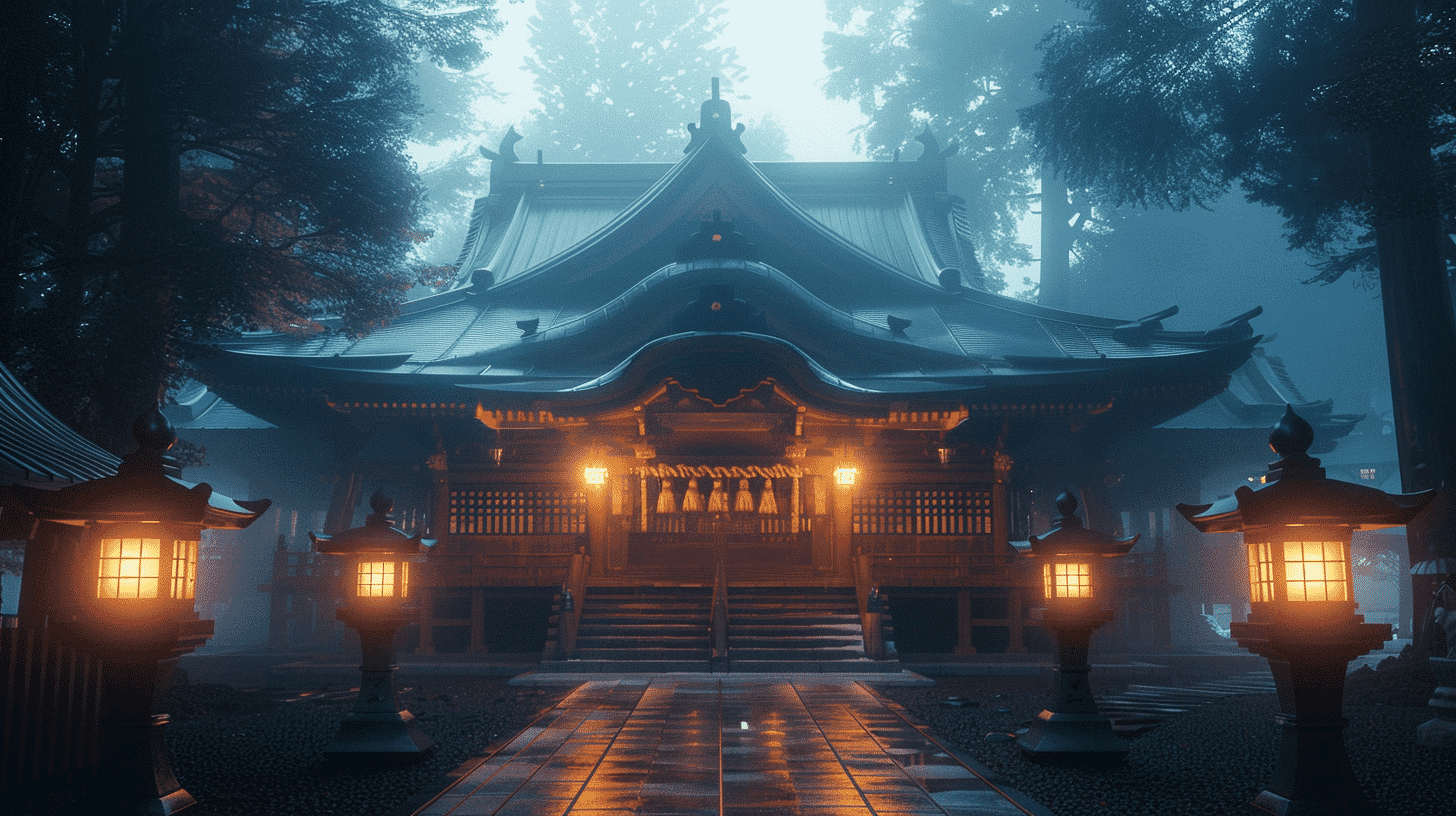
Rebuilt in 1640, National Treasure since 1953
Enryakuji Konpon Chudo (延暦寺根本中堂) is an early Edo Buddhist hall at Sakamoto Honmachi, Otsu City, Shiga Prefecture, within Enryakuji on Mount Hiei, designated a National Treasure in 1953, on 31 March. In 1899, on 5 April, it had been listed as a specially protected structure under the old preservation law. The quantity is one building, with an altar platform and three shrine housings as attached property.
Its form is recorded as eleven bays along the front, six bays deep, single storey, hip-and-gable, roofed in sheet copper over ribs. The Agency for Cultural Affairs gives the year as 1640. Some accounts give completion as 1642, so the start and the finish of the rebuilding may be recorded differently.
The Agency's commentary is brief. The Konpon Chudo was built with the founding of Enryakuji, but the present building is a rebuilding of 1640. It is an imposing hall, its outer sanctuary boarded as a worship space while the inner sanctuary is left as bare earth. This preserves the basic form of esoteric Buddhist architecture and is an important survival in cultural history.
An Inner Sanctuary Three Metres Lower
The contrast the Agency draws, boarded outer sanctuary against earthen inner sanctuary, is the heart of the building.
The interior divides, from the entrance inward, into outer sanctuary, middle sanctuary and inner sanctuary. The outer and middle are boarded; the inner is a stone-paved earth floor. That floor lies about three metres below the middle sanctuary. Worshippers stand in the middle sanctuary while the principal image is enshrined a level below.
The drop brings the eyes of the enshrined image and of the worshipper standing above to the same height. The Tendai school explains this as an expression of the identity of Buddha and ordinary being.
When the Agency finds that the hall preserves the basic form of esoteric architecture, it means this earthen inner sanctuary. A boarded worship space with an earthen sanctuary beyond is the basic plan of an esoteric hall.
The World Heritage commentary gives the depth in detail: eleven bays across the front, and on the side four bays of inner sanctuary, one of middle sanctuary serving as the worship space, and one of outer sanctuary, six in all. Three shrine housings stand in the inner sanctuary under a finely coffered ceiling of high formal rank.
Plan from Heian, Detail from Early Edo
The building is an early Edo rebuilding, but its form is older than that.
The Agency's World Heritage commentary records that the Konpon Chudo was founded in 887 as a single building eleven bays across the front and four bays deep with an outer aisle; rebuilt in 938; widened with a corridor and middle gate added in 980; rebuilt again in 1435, 1499 and 1589; and, after collapsing in 1631, rebuilt in 1640 in its present form.
It then judges that this form and scale are thought to go back to the Heian period, while the framing and the details show the temper of the early Edo period in a full command of the native manner. The plan and the scale are old; the assembly and the detail are new.
Behind the rebuilding lies the burning of Mount Hiei by Oda Nobunaga in 1571. The present hall was raised after that, by order of Tokugawa Iemitsu.
The Heisei Restoration
The Konpon Chudo and its corridor, an Important Cultural Property, have been under major conservation work since October 2016, the first since the repairs of 1951 to 1955, some sixty years earlier.
The work was planned for ten years at about five billion yen. Investigation then revealed how the building had looked when Tokugawa Iemitsu rebuilt it and how it was altered in the mid Edo period, and it was decided to restore parts of that. The programme now runs fifteen years at about 7.3 billion yen.
The work centres on the sheet copper roofing of the hall, the shingled roofing of the corridor, and the painting and coloring throughout. Restoring part of the original appearance is what extended the schedule.
Worship continues during the work. The whole building stands under a temporary shelter, and a specially built stage allows visitors to look down on the roof. Enryakuji states that this will be possible until about January 2027.
Visiting
The Konpon Chudo stands at the centre of the Todo district, below the steps that lead down from the Monju-ro gate on the rise to the east, facing east across the forecourt enclosed by its corridor. It is currently inside the restoration shed, but worship continues throughout the work.
Photography inside the hall is prohibited. Visitors do not enter the inner sanctuary but look down into it from the middle sanctuary. The unextinguished lamp burns within the inner sanctuary.
Visits are made during Todo opening hours with a pilgrimage ticket. Directions, hours and fees for the temple as a whole are on the Enryakuji page.
Q&A
- When was the Konpon Chudo built and designated?
- The Agency for Cultural Affairs dates the present building to a rebuilding of 1640. It was listed as a specially protected structure on 5 April 1899 and designated a National Treasure in 1953, on 31 March. It counts as one building, with an altar platform and three shrine housings as attached property.
- Why is the inner sanctuary lower?
- Its stone-paved earth floor lies about three metres below the middle sanctuary, so the eyes of the enshrined image and of the worshipper standing above come to the same height. The Tendai school explains this as the identity of Buddha and ordinary being. The Agency finds the boarded outer and earthen inner sanctuaries preserve the basic form of esoteric architecture.
- Is the form of the building Edo-period?
- The Agency judges that the form and scale are thought to go back to the Heian period, while the framing and details show the early Edo temper in a full command of the native manner. The width of eleven bays descends from the founding of 887, so the plan is old and the assembly new.
- How long will the restoration last?
- It began in October 2016 and was planned for ten years, but investigation revealed the appearance of the original rebuilding and of mid-Edo alterations, and it was decided to restore parts of these, extending the work to fifteen years at about 7.3 billion yen. Worship continues, and a stage allows a view down on the roof until about January 2027.
- Can the Konpon Chudo be visited?
- Yes, during Todo opening hours with a pilgrimage ticket, and worship continues during the restoration. Photography inside is prohibited, and visitors look down into the inner sanctuary from the middle sanctuary rather than entering it.
Basic Information
| Name | Enryakuji Konpon Chudo (延暦寺根本中堂) |
|---|---|
| Location | 4220 Sakamoto Honmachi, Otsu City, Shiga Prefecture (Enryakuji, Mount Hiei) |
| Designation | National Treasure (structure); the corridor is an Important Cultural Property; component of the World Heritage site Historic Monuments of Ancient Kyoto |
| Year Designated | 1899 (5 April), specially protected structure; 1953 (31 March), National Treasure |
| Quantity | 1 building; altar platform and 3 shrine housings as attached property |
| Dimensions | 11 bays along the front, 6 bays deep, single storey, hip-and-gable, sheet copper over ribs. Interior divided into outer, middle and inner sanctuaries; the outer and middle boarded, the inner a stone-paved earth floor about 3 metres lower. Rebuilt 1640 |
| Owner | Enryakuji |
| Public Access | In the Todo district of Enryakuji; pilgrimage ticket required. No photography inside. Under conservation work, with a stage allowing a view of the roof |
References
- Cultural Heritage Online, World Heritage: Enryakuji
- https://online.bunka.go.jp/special_content/component/28
- Hieizan Enryakuji: the restoration of the Konpon Chudo
- https://www.hieizan.or.jp/renovation/overview.html
- Hieizan Enryakuji official site
- https://www.hieizan.or.jp/
- Shiga Prefecture tourism: Hieizan Enryakuji
- https://www.biwako-visitors.jp/spot/detail/348
Last verified: 2026.09.25
