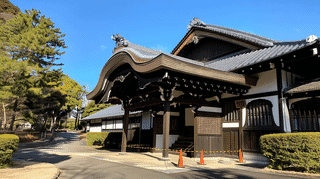
Sojiji Temple: A Soto Zen Head Temple That Moved From Noto to Yokohama
Sojiji Temple (總持寺, also written Sōji-ji) is a head temple of the Soto school of Zen at 2-1-1 Tsurumi, Tsurumi-ku, Yokohama, founded on the Noto Peninsula in 1321 and relocated to its present site in 1911. Eighteen of its structures, most of them timber halls built in the Taisho and early Showa eras, are listed as Registered Tangible Cultural Properties.
Soto Zen has two head temples. Eiheiji in Fukui honours Dogen, who brought the school's teaching from China; Sojiji honours Keizan Jokin (瑩山紹瑾), the monk who spread it across the provinces. Keizan took over a Shingon-affiliated Kannon hall at Kushihi in Noto, turned it into a Zen monastery and named it Sojiji. The temple's mountain name, Shogakusan, preserves the name of that older hall.
In 1898 a fire destroyed most of the Noto buildings. Rather than rebuild in a remote corner of the Sea of Japan coast, the order petitioned to move the head temple closer to Tokyo. Abbot Ishikawa Sodo, who took office in 1905, pushed the plan through: ground was broken at Tsurumi in 1907, and the formal ceremony transferring the founder's seat was held on 5 November 1911. The original site survives as Sojiji Soin.
How Sojiji Temple Was Built Up, One Hall at a Time
The Tsurumi precinct did not arrive fully formed. According to the temple's own digital archive, the first years saw little more than two buildings dismantled and brought from Soonji, a temple in Tsuruoka, Yamagata: its main hall (now the Hokodo) and a residence called Choryushitsu (now the Koshokutsu), plus temporary quarters for monks. The Buddha Hall, Shiundai and Koshakudai followed through the Taisho era, and after damage in the 1923 Great Kanto Earthquake the layout seen today settled only in the Showa period.
The eighteen listed structures track that sequence closely:
- two late-Edo buildings of the Ansei era, moved here in 1911: the Hokodo and the Koshokutsu
- the Karishinden and the corridor linking the Hokodo and Koshokutsu, both from around the time of the move
- a cluster from about 1915: the Buddha Hall (Daiyuhoden), Shiundai, Shoryo, Bell and Drum Tower, Bell Tower, and the Hyakken Corridor and Gates, plus the Taihokan, a 1915 reception hall moved onto the grounds in 1957
- the Sanshokan gate and Koshakudai (1920), the Hikari Kannon Pedestal (1923) and the Mukai Karamon (1925)
- the Daisodo and Goreiden (1937) and the Sanpoden (1942)
Sixteen were registered on 12 July 2005; the Karishinden and the connecting corridor were added on 7 August 2023. The registration criteria are telling. Four structures, the Buddha Hall, the Hyakken Corridor, the Mukai Karamon and the Sanshokan, were judged to contribute to the historic landscape; the Bell Tower was cited as difficult to reproduce; the rest were listed as models of design. In other words, the survey separated the buildings that give Sojiji Temple its overall shape from those prized for their detailing.
Finding Your Way Around Sojiji Temple
The grounds of Sojiji Temple cover roughly 150,000 tsubo, close to 50 hectares, and slope noticeably toward the south. Coming from the station you pass first through the Sanshokan, the outer gate, and follow the approach west. Beyond the reinforced-concrete Sanmon (not a listed structure), the Koshakudai, which houses the main reception desk, stands on the right, with the Taihokan guest hall and the Shiundai audience hall further north.
Straight ahead is the Mukai Karamon, and behind it the Hyakken Corridor runs east to west. North of the corridor, raised on a stone platform and facing south, is the Buddha Hall; the Goreiden sits behind it and the modern Founders' Hall (大祖堂, not listed) to its east. West of the Buddha Hall, the Hokodo faces east and connects by a covered passage to the Koshokutsu, while the Karishinden adjoins the Hokodo at the rear.
The training buildings lie southwest of the Buddha Hall: the Shoryo faces east with the Daisodo to its south, and the Bell and Drum Tower stands between the Hokodo and the Shoryo. Heading downhill to the south brings you to the Bell Tower and the Sanpoden, and to the granite pedestal of the Hikari Kannon in the southwest.
A comfortable loop runs from the Sanshokan past the Koshakudai, along the Mukai Karamon and the corridor, round the west side of the Buddha Hall, and finally down to the southern group. Expect slopes and stone steps on the last stretch.
Getting to Sojiji Temple and Visiting Conditions
The official website gives the walk as about 5 minutes from the west exit of JR Tsurumi Station (Keihin-Tohoku Line) and about 7 minutes from either Keikyu Tsurumi or Kagetsu-Sojiji Station on the Keikyu Line. Drivers are directed to the Shioiri exit of the Shuto Expressway Yokohane Line (about 15 minutes, from the Tokyo side) or the Namamugi exit (about 10 minutes, from the Yokohama side). The temple has its own car park, which may be closed over the New Year period and on ceremony days.
Anyone may walk the grounds of Sojiji Temple freely. The main reception desk in the Koshakudai (tel. 045-581-6021) handles tour bookings, memorial services and cemetery enquiries, and the same building has a shop and a rest area.
To see inside the halls you join a guided tour of the buildings, which takes about an hour. When the temple's visitor page was checked in September 2026, the only tour on offer included a vegetarian meal: two sessions a day, starting at 11:00 a.m. and 2:00 p.m., for groups of 3 to 20, at 3,500 yen per person, booked at least two weeks ahead. Bookings are suspended in some months and on ceremony days, so confirm the current arrangements on the official site or with the reception desk before you go.
Details on which buildings open their interiors, and where each is best viewed from, are on the pages for the individual structures.
References
- About Sojiji (Japanese) - Sotoshu Daihonzan Sojiji
- https://www.sojiji.jp/about/
- Visiting Information (Japanese) - Sotoshu Daihonzan Sojiji
- https://www.sojiji.jp/visit/
- Access (Japanese) - Sotoshu Daihonzan Sojiji
- https://www.sojiji.jp/access/
- Precinct Map (Japanese) - Sotoshu Daihonzan Sojiji
- https://www.sojiji.jp/map/
- History of Sojiji Through Its Collections - Sojiji Digital Archive
- https://adeac.jp/sojiji/top/timeline/index.html
- Sojiji Butsuden (Daiyuhoden) - Database of National Cultural Properties, Agency for Cultural Affairs
- https://kunishitei.bunka.go.jp/bsys/maindetails/101/00004717
- Sojiji Karishinden - Database of National Cultural Properties, Agency for Cultural Affairs
- https://kunishitei.bunka.go.jp/bsys/maindetails/101/00014577
- Daihonzan Sojiji - Yokohama Official Visitors' Guide
- https://www.welcome.city.yokohama.jp/spot/details.php?bbid=197
Last verified: 2026.09.16
Basic Information
| Name | Sojiji Temple |
|---|---|
| Location | 2-1-1 Tsurumi, Tsurumi-ku, Yokohama City, Kanagawa Prefecture |
| Owner | Religious Corporation Daihonzan Sojiji Temple |
| Designation | Registered Tangible Cultural Properties (18) |
| Coordinates | 35.50616, 139.67054 |