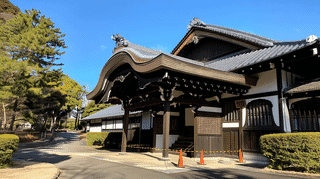
What Is the Sojiji Goreiden?
The Sojiji Goreiden (總持寺御霊殿, Goreiden) is a memorial hall for emperors at Sojiji Temple in Tsurumi-ku, Yokohama, built in 1937 and registered as a Registered Tangible Cultural Property in 2005.
It stands behind the Buddha Hall and enshrines a statue of Emperor Go-Daigo. The single-storey timber building has a copper roof and covers 78 square meters. According to the temple, alongside Go-Daigo's image and memorial tablet it holds tablets for Emperors Go-Murakami, Go-Nara, Go-Momozono, Go-Yozei, Go-Komyo, Meiji, Taisho and Showa.
The link goes back to Go-Daigo's edict naming Sojiji a leading Soto training monastery. The temple says later emperors continued to treat it as a place of imperial prayer, and the Sojiji Goreiden gives that relationship architectural form.
Why the Goreiden Was Registered
The Sojiji Goreiden was listed as a model of design. Although it stands in a Zen monastery, it is laid out like a Shinto shrine: from south to north, a worship hall, an offering hall and an inner sanctuary in a single line, with bracket sets (Kumimono) and frog-leg struts (Kaerumata) between them.
The inner sanctuary has a hip-and-gable roof (Irimoya-zukuri) with a mokoshi skirt roof, and the worship hall is roughly three bays square. What the Agency for Cultural Affairs picks out is the front of the worship hall: a wide veranda with posts carrying an extended roof, and a one-bay porch (Kōhai) added beyond that. The layering produces a distinctive variation on the Gongen-zukuri shrine plan.
Gongen-zukuri links worship hall and sanctuary through an intermediate chamber and is associated with mausoleum shrines, so choosing it for a hall honouring imperial spirits was a deliberate statement by its 1937 designers.
What to Look For at the Goreiden
At the front of the worship hall, the veranda, its extended roof and the porch step forward one after another; the number of layers is clearest from the side.
Walk alongside to see the roofs run from worship hall to offering hall to sanctuary. The skirt roof on the sanctuary borrows from temple architecture, which is what makes the Sojiji Goreiden a hybrid.
Look too for the carved struts between the brackets, and for the copper roof, which stands out in colour and texture among the tiled buildings around it.
Visiting the Sojiji Goreiden
The Sojiji Goreiden sits north of the Buddha Hall. Its exterior can be seen from the paths around the central halls, though the surrounding buildings limit clear views.
Entry to the interior is by the guided building tour booked at the main reception desk. This is a hall for imperial memorials, so keep your voice down and ask your guide before taking photos. Directions and booking details are on the Sojiji Temple page.
- 📍 Plan Your Visit to Kanagawa
- Find tours, activities & transport passes near Sojiji Goreiden
- [ Kamakura Buddha Hakone Onsen & Yokohama Tours ]
Q&A
- What is enshrined in the Sojiji Goreiden?
- According to the temple, a statue and memorial tablet of Emperor Go-Daigo, together with tablets for Emperors Go-Murakami, Go-Nara, Go-Momozono, Go-Yozei, Go-Komyo, Meiji, Taisho and Showa.
- Why does the Sojiji Goreiden honour Emperor Go-Daigo?
- Go-Daigo issued the edict that ranked Sojiji as a leading Soto training monastery, and the temple says later emperors treated it as a temple of imperial prayer.
- Does the Sojiji Goreiden look like a shrine?
- Yes. It has a worship hall, offering hall and inner sanctuary in a row, which the Agency for Cultural Affairs describes as a distinctive gongen-zukuri-style plan.
- When was the Sojiji Goreiden built and registered?
- It was built in 1937 and registered on 12 July 2005.
- Can I visit the Sojiji Goreiden?
- You can see the exterior from the grounds. The interior is shown on the guided building tour, which requires advance booking.
Basic Information
| Name | Sojiji Goreiden (總持寺御霊殿) |
|---|---|
| Location | 2-1-1 Tsurumi, Tsurumi-ku, Yokohama City, Kanagawa Prefecture |
| Designation | Registered Tangible Cultural Property (Structure) |
| Year Designated | 2005 (Heisei 17) |
| Quantity | 1 building |
| Dimensions | Timber, single-storey, copper roof; building area 78 square meters |
| Owner | Religious Corporation Daihonzan Sojiji |
| Public Access | Exterior viewable from the grounds; interior by guided tour booked in advance |
References
- Sojiji Goreiden - Database of National Cultural Properties, Agency for Cultural Affairs
- https://kunishitei.bunka.go.jp/bsys/maindetails/101/00004716
- Goreiden (Japanese) - Sotoshu Daihonzan Sojiji
- https://www.sojiji.jp/map/goreiden/
- Mukai Karamon (Japanese) - Sotoshu Daihonzan Sojiji
- https://www.sojiji.jp/map/mukaikaramon/
- Visiting Information (Japanese) - Sotoshu Daihonzan Sojiji
- https://www.sojiji.jp/visit/
Last verified: 2026.09.16