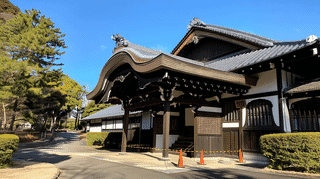
What Is the Sojiji Hyakken Corridor and Gates?
The Sojiji Hyakken Corridor and Gates (總持寺百間廊下及び門, Hyakken Rōka) is a long covered walkway with three gates at Sojiji Temple in Tsurumi-ku, Yokohama, built around 1915 and registered as a Registered Tangible Cultural Property in 2005.
It runs dead straight on an east-west line just south of the Buddha Hall. The national database gives its length as 142 meters, its depth as 3.6 meters and its building area as 514 square meters; the temple quotes 164 meters, probably measuring a longer stretch. Either way it falls short of the "hundred ken" in its name: taking 1 ken as about 1.8 meters, 100 ken would be about 182 meters. The name is a boast, not a survey.
The temple describes the corridor as the link between the halls on its east and west sides and as the line dividing the outer precinct from the inner one. In practice it is the spine that ties the post-1911 layout together.
Why the Hyakken Corridor Was Registered
The Sojiji Hyakken Corridor and Gates was listed for its contribution to the historic landscape. The Agency for Cultural Affairs points to the way it frames the space in front of the Buddha Hall: walking north up the approach, your eye is stopped by the corridor's long, low roof, and the Buddha Hall rises behind it.
The construction is plain on purpose. Square posts carry simple boat-shaped bearing blocks, tie beams (Kōryō) link post to post, and glass doors fill the bays. That restraint lets a structure more than 140 meters long read as a single clean line.
Each of the three gates is one bay by one bay, with a gabled (Kirizuma-zukuri) roof of pantiles (Sangawara-buki). The temple names them, east to west, Kinkeimon (Golden Rooster Gate, for morning), Chujakumon (for midday) and Gyokutomon (Jade Hare Gate, for night). They serve as side entrances.
What to Look For Along the Corridor
From one end, the posts and beams repeat into the distance like a perspective drawing, and light through the glass doors falls on the boards in regular bands.
The floor doubles as a place of daily cleaning practice for the monks, and the polish shows. From outside, watch how each gate roof lifts slightly above the corridor roof, breaking the rhythm at three points.
Walk east to west and you move from morning to night by the names of the gates. The Sojiji Hyakken Corridor and Gates is simple in form, but its naming gives a plain passage a sense of passing time.
Visiting the Sojiji Hyakken Corridor and Gates
The exterior of the Sojiji Hyakken Corridor and Gates, including the three gates, is visible from the open grounds. The roof line runs behind the walls either side of the Mukai Karamon, so the area just past the Sanmon gives a good sense of its reach.
Walking inside the corridor is part of the guided building tour booked at the main reception desk. Because it is also a working space for the monks, follow your guide, stay clear during cleaning, and ask before taking photos. Directions and booking details are on the Sojiji Temple page.
- 📍 Plan Your Visit to Kanagawa
- Find tours, activities & transport passes near Sojiji Hyakken Corridor and Gates
- [ Kamakura Buddha Hakone Onsen & Yokohama Tours ]
Q&A
- How long is the Sojiji Hyakken Corridor?
- The national database gives 142 meters; the temple cites 164 meters. The name "hundred ken" (about 182 meters) is a figure of speech rather than a measurement.
- What are the three gates of the Sojiji Hyakken Corridor called?
- From east to west the temple calls them Kinkeimon (morning), Chujakumon (midday) and Gyokutomon (night). Each is a one-bay gabled gate.
- Can visitors walk through the Sojiji Hyakken Corridor?
- You can see it from the grounds freely, but walking inside is part of the guided building tour, which needs advance booking. Check current conditions on the official site.
- When was the Sojiji Hyakken Corridor and Gates registered?
- It was built around 1915 and registered on 12 July 2005 as a structure contributing to the historic landscape.
- What is the role of the Sojiji Hyakken Corridor in the temple layout?
- It links the halls to its east and west and marks the boundary between the outer and inner precinct, screening the space in front of the Buddha Hall.
Basic Information
| Name | Sojiji Hyakken Corridor and Gates (總持寺百間廊下及び門) |
|---|---|
| Location | 2-1-1 Tsurumi, Tsurumi-ku, Yokohama City, Kanagawa Prefecture |
| Designation | Registered Tangible Cultural Property (Structure) |
| Year Designated | 2005 (Heisei 17) |
| Quantity | 1 building (with 3 gates) |
| Dimensions | Length 142 meters, depth 3.6 meters, building area 514 square meters |
| Owner | Religious Corporation Daihonzan Sojiji |
| Public Access | Exterior viewable from the grounds; interior walk by guided tour booked in advance |
References
- Sojiji Hyakken Corridor and Gates - Database of National Cultural Properties, Agency for Cultural Affairs
- https://kunishitei.bunka.go.jp/bsys/maindetails/101/00004723
- Hyakken Roka (Japanese) - Sotoshu Daihonzan Sojiji
- https://www.sojiji.jp/map/hyakkanroka/
- Visiting Information (Japanese) - Sotoshu Daihonzan Sojiji
- https://www.sojiji.jp/visit/
Last verified: 2026.09.16