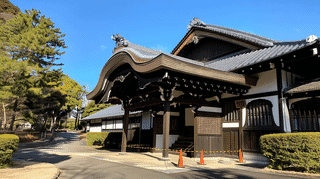
What Is the Sojiji Mukai Karamon?
The Sojiji Mukai Karamon (總持寺向唐門) is a ceremonial gate at Sojiji Temple in Tsurumi-ku, Yokohama, built in 1925 and registered as a Registered Tangible Cultural Property in 2005. It was formerly known as the Chokushimon, the gate for imperial envoys.
It stands south of the Buddha Hall, directly in front of the Hyakken Corridor. The gate is a four-legged type (Shikyakumon) with a gabled roof of layered cypress bark (Hiwadabuki) and a cusped karahafu gable (karahafu) on both front and back. It is 6.2 meters wide, and earthen walls totalling 63 meters extend to either side.
The temple explains the old name through its imperial ties: Emperor Go-Daigo issued an edict ranking Sojiji as a leading Soto training monastery, and later emperors treated it as a temple of imperial prayer.
Why the Mukai Karamon Was Registered
The Sojiji Mukai Karamon was listed for its contribution to the historic landscape. The Agency for Cultural Affairs notes that the gate, about 6 meters across, and its long flanking walls together give the approach to the Buddha Hall its weighty, formal character. Looking up the approach, the gate fills the centre of view, with the corridor and the Buddha Hall layered behind it.
Its carving was a second reason. The head-tie beams and the carved beam ends are cut deep, and the openwork floral panels on the sides and the carvings between the bracket sets are finely made.
Cypress-bark roofing suits the flowing curves of a karahafu far better than tile. Choosing it here, in the mid-1920s, marks this as the highest-ranking gate on the grounds.
What to Look For at the Mukai Karamon
Face the gate and the karahafu reads first: a bow that swells at the centre and sweeps down at the sides. The bark eaves are thick and soft-edged next to the tiled roofs around it.
Then move to the side to see the openwork panels. The carved beam ends show their depth best from an angle.
Take in the walls as well. It is their length, as much as the gate, that sets the space before the Buddha Hall apart.
Visiting the Sojiji Mukai Karamon
The Sojiji Mukai Karamon faces you as you come through the Sanmon, and its exterior can be viewed freely from the grounds. Its doors are normally closed.
According to the temple, the gate is opened for the installation of a new chief abbot, at New Year, for the Mitama Matsuri in July and on the anniversary of the relocation in November. If you want to see it open, check the event calendar on the official site first; passage may be limited to ceremony participants, so follow staff directions. Directions are on the Sojiji Temple page.
- 📍 Plan Your Visit to Kanagawa
- Find tours, activities & transport passes near Sojiji Mukai Karamon
- [ Kamakura Buddha Hakone Onsen & Yokohama Tours ]
Q&A
- When is the Sojiji Mukai Karamon open?
- It is usually closed. The temple opens it for the installation of a chief abbot, at New Year, for the July Mitama Matsuri and on the November relocation anniversary.
- Why was the Sojiji Mukai Karamon called the Chokushimon?
- Because Sojiji received an edict from Emperor Go-Daigo and was later treated as a temple of imperial prayer, the gate kept the name for receiving imperial envoys.
- What is the roof of the Sojiji Mukai Karamon made of?
- Layered cypress bark, known as hiwadabuki. The gabled roof has a karahafu gable on front and back.
- When was the Sojiji Mukai Karamon built and registered?
- It was built in 1925 and registered on 12 July 2005.
- What details should I look for at the Sojiji Mukai Karamon?
- The curved karahafu gables, the deeply carved beam ends and head-tie beams, and the openwork side panels, along with the 63 meters of flanking walls.
Basic Information
| Name | Sojiji Mukai Karamon (總持寺向唐門) |
|---|---|
| Location | 2-1-1 Tsurumi, Tsurumi-ku, Yokohama City, Kanagawa Prefecture |
| Designation | Registered Tangible Cultural Property (Structure) |
| Year Designated | 2005 (Heisei 17) |
| Quantity | 1 building |
| Dimensions | Frontage 6.2 meters, with flanking walls of 63 meters |
| Owner | Religious Corporation Daihonzan Sojiji |
| Public Access | Exterior viewable from the grounds; doors opened only on ceremonial occasions |
References
- Sojiji Mukai Karamon - Database of National Cultural Properties, Agency for Cultural Affairs
- https://kunishitei.bunka.go.jp/bsys/maindetails/101/00004724
- Mukai Karamon (Japanese) - Sotoshu Daihonzan Sojiji
- https://www.sojiji.jp/map/mukaikaramon/
- Visiting Information (Japanese) - Sotoshu Daihonzan Sojiji
- https://www.sojiji.jp/visit/
Last verified: 2026.09.16