What Is the Sojiji Sanpoden?
The Sojiji Sanpoden (總持寺三宝殿, Sanpōden) is a shrine hall at Sojiji Temple in Tsurumi-ku, Yokohama, built in 1942 and registered as a Registered Tangible Cultural Property in 2005.
It stands on a low platform south of the central halls, a single-storey timber building with a tiled roof and a building area of 79 square meters. It is the most recent of the temple's eighteen registered structures.
Sanpo means the Three Treasures: the Buddha, the teaching and the monastic community. Sojiji has long honoured Sanbo Daikojin, a fierce protector of the Three Treasures, as guardian of the head temple, and the original Noto site, Sojiji Soin, still describes the deity that way. The name of the Sojiji Sanpoden is said to reflect that devotion.
Why the Sanpoden Was Registered
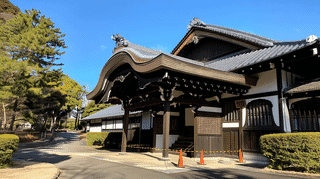
The Sojiji Sanpoden was listed as a model of design. Its hip-and-gable roof (Irimoya-zukuri) of pantiles (Sangawara-buki) is turned so that a gable end faces the front (Tsumairi).
According to the Agency for Cultural Affairs, the interior consists of a front room of about 12 mats and, at the back, a room of about 24 mats where the deity is enshrined. A veranda runs round three sides of them. At the front, round posts define an open-sided space with a ceiling shaped like an upturned boat hull, and a one-bay porch (Kōhai) projects beyond that.
Front room, open space, porch: the building deepens step by step toward the sanctuary, which the Agency calls a distinctive plan for a shrine hall. That such care went into a guardian shrine in a temple precinct in 1942, in the middle of the war, is worth noting.
What to Look For at the Sanpoden
From the front, the porch projects under the end-on roof, and behind it the open, column-lined space leads the eye inward, growing dimmer and quieter as it goes.
In the open section, look up at the boat-hull ceiling, high in the middle and falling to the sides, which gives this in-between space a gentle, sheltering feel.
The low platform lifts the Sojiji Sanpoden just clear of the ground and, with the veranda, gives it the formal bearing of a shrine.
Visiting the Sojiji Sanpoden
The Sojiji Sanpoden lies south of the central halls. Its exterior and the open front section can be seen from the grounds. Getting there involves slopes and stone steps, so wear comfortable shoes.
Treat the inner sanctuary as closed and pay your respects quietly from the front. Check the official site or the reception desk for prayer services and events. Directions are on the Sojiji Temple page.
- 📍 Plan Your Visit to Kanagawa
- Find tours, activities & transport passes near Sojiji Sanpoden
- [ Kamakura Buddha Hakone Onsen & Yokohama Tours ]
Q&A
- What is enshrined in the Sojiji Sanpoden?
- A deity is enshrined in the innermost room. Sojiji honours Sanbo Daikojin as guardian of the head temple, and the hall's name is said to reflect that.
- What is distinctive about the Sojiji Sanpoden's design?
- An end-on hip-and-gable roof over a front room and a rear sanctuary, with verandas on three sides, an open front space with a boat-hull ceiling, and a one-bay porch.
- When was the Sojiji Sanpoden built?
- In 1942, making it the most recent of the temple's registered structures.
- When was the Sojiji Sanpoden registered?
- It was registered on 12 July 2005 as a model of design.
- Where is the Sojiji Sanpoden?
- On a low platform south of the central halls, reached by slopes and steps.
Basic Information
| Name | Sojiji Sanpoden (總持寺三宝殿) |
|---|---|
| Location | 2-1-1 Tsurumi, Tsurumi-ku, Yokohama City, Kanagawa Prefecture |
| Designation | Registered Tangible Cultural Property (Structure) |
| Year Designated | 2005 (Heisei 17) |
| Quantity | 1 building |
| Dimensions | Timber, single-storey; building area 79 square meters |
| Owner | Religious Corporation Daihonzan Sojiji |
| Public Access | Exterior and open front section viewable from the grounds |
References
- Sojiji Sanpoden - Database of National Cultural Properties, Agency for Cultural Affairs
- https://kunishitei.bunka.go.jp/bsys/maindetails/101/00004726
- Daihonzan Sojiji Soin (Japanese)
- https://noto-soin.jp/
- Precinct Map (Japanese) - Sotoshu Daihonzan Sojiji
- https://www.sojiji.jp/map/
- Visiting Information (Japanese) - Sotoshu Daihonzan Sojiji
- https://www.sojiji.jp/visit/
Last verified: 2026.09.16