What Is the Sojiji Buddha Hall (Daiyuhoden)?
The Sojiji Buddha Hall (總持寺仏殿, Butsuden, also called the Daiyuhoden 大雄宝殿) is the central worship hall of Sojiji Temple in Tsurumi-ku, Yokohama, built in 1915 and registered as a Registered Tangible Cultural Property in 2005.
It stands on a dressed-stone platform at the heart of the monastery, facing south, with a building area of 475 square meters. In a Zen temple the buddha hall houses the principal image, and here that is a carved wooden seated Shakyamuni. According to the temple, his right hand is raised in the gesture of fearlessness and his left lowered in the gesture of granting wishes. Two of the Buddha's disciples, Kasho (Mahakasyapa) and Anan (Ananda), flank him, and side altars hold Bodhidharma and Daigen Shuri Bosatsu, a guardian figure common in Soto temples.
The hall went up only four years after the head temple moved to Tsurumi, which makes it one of the first permanent buildings of the new precinct. The temple archive records that in 1925, at the 600th memorial of the founder Keizan, a plaque inscribed "Josai" and granted by Emperor Taisho was installed on its altar.
Why the Daiyuhoden Was Registered
The Sojiji Buddha Hall was listed for its contribution to the historic landscape. It sits on the main axis of the precinct, north of the Mukai Karamon gate and the Hyakken Corridor, and is the building the rest of the layout is arranged around.
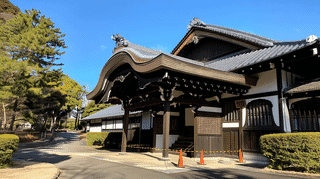
From outside it looks two-storied, but it is a single-storey hall wrapped in a lean-to skirt roof called a mokoshi. The core is three bays square and carries a hip-and-gable (Irimoya-zukuri) roof of formal clay tiles (Hongawarabuki). Its eaves rest on three-stepped bracket sets (Mitesaki) with slanting tail rafters, the most elaborate bracketing used in Japanese temple building.
What the Agency for Cultural Affairs singles out as inventive is the plan. The bays of the mokoshi are narrower than those of the core, and two free-standing columns in the centre divide the interior into a front and a rear zone. The design follows the Zenshūyō buddha-hall type while rethinking how the worship space works.
What to Look For at the Daiyuhoden
Stand back and look up. The two eave lines step outward one above the other, and between them the bracket sets project in three tiers. The tail rafters poking out at an angle are easier to read from a little distance.
Then look down at the platform. Its neatly cut stone courses lift the Sojiji Buddha Hall above its neighbours, so the building's rank is expressed in height as well as ornament.
If you get inside, notice where the two central columns fall. They set the distance between worshipper and altar, and that is where the design's originality shows.
Visiting the Sojiji Buddha Hall
The exterior of the Sojiji Buddha Hall can be seen from the open grounds. It faces south, so the facade is best lit around midday. Because the corridor and gate screen its front, you will mostly see it at an angle from the east or west side.
Entry to the interior is by the temple's guided building tour, booked at the main reception desk; dates and group-size rules change, so check ahead. Follow your guide on photography inside. Directions and booking details are on the Sojiji Temple page.
- 📍 Plan Your Visit to Kanagawa
- Find tours, activities & transport passes near Sojiji Buddha Hall (Daiyuhoden)
- [ Kamakura Buddha Hakone Onsen & Yokohama Tours ]
Q&A
- Can I see the Sojiji Buddha Hall without a reservation?
- Yes, from outside. The exterior is visible from the grounds at any time the temple is open. The interior is shown only on the guided building tour, which must be booked in advance.
- What image is enshrined in the Sojiji Buddha Hall?
- A carved wooden seated Shakyamuni Buddha, attended by the disciples Kasho and Anan. Side altars hold Bodhidharma and Daigen Shuri Bosatsu.
- Is the Sojiji Buddha Hall a two-storey building?
- No. The lower roof is a mokoshi, a decorative skirt roof. The hall itself has one storey and a core three bays square.
- When was the Sojiji Buddha Hall built and registered?
- It was completed in 1915 and registered as a Registered Tangible Cultural Property on 12 July 2005, under the criterion of contributing to the historic landscape.
- What does the name Daiyuhoden mean for the Sojiji Buddha Hall?
- Daiyu, "great hero", is an epithet of the Buddha, so Daiyuhoden means the treasure hall of the Buddha. Zen temples often use it as a formal name for the buddha hall.
Basic Information
| Name | Sojiji Buddha Hall (Daiyuhoden) (總持寺仏殿(大雄宝殿)) |
|---|---|
| Location | 2-1-1 Tsurumi, Tsurumi-ku, Yokohama City, Kanagawa Prefecture |
| Designation | Registered Tangible Cultural Property (Structure) |
| Year Designated | 2005 (Heisei 17) |
| Quantity | 1 building |
| Dimensions | Building area 475 square meters |
| Owner | Religious Corporation Daihonzan Sojiji |
| Public Access | Exterior viewable from the grounds; interior by guided tour booked in advance |
References
- Sojiji Butsuden (Daiyuhoden) - Database of National Cultural Properties, Agency for Cultural Affairs
- https://kunishitei.bunka.go.jp/bsys/maindetails/101/00004717
- Butsuden (Japanese) - Sotoshu Daihonzan Sojiji
- https://www.sojiji.jp/map/butuden/
- History of Sojiji Through Its Collections - Sojiji Digital Archive
- https://adeac.jp/sojiji/top/timeline/index.html
- Visiting Information (Japanese) - Sotoshu Daihonzan Sojiji
- https://www.sojiji.jp/visit/
Last verified: 2026.09.16