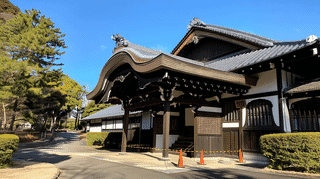
What Is the Sojiji Koshokutsu?
The Sojiji Koshokutsu (總持寺虎嘯窟, Koshōkutsu) is the private residence of the chief abbot of Sojiji Temple in Tsurumi-ku, Yokohama, a late-Edo building of 1854 to 1859 that was moved here in 1911 and registered as a Registered Tangible Cultural Property in 2005.
It stands west of the Buddha Hall, facing south: a single-storey timber house with a tiled roof and a building area of 137 square meters. According to the temple's digital archive, it came from Soonji in Tsuruoka, Yamagata, along with the Hokodo, and was first known as the Choryushitsu, the Leaping Dragon Room.
Where the Shiundai is the abbot's public audience hall, the Sojiji Koshokutsu is his inner, domestic space. The name can be read as "cave of the roaring tiger", a counterpart to the dragon of its earlier name.
Why the Koshokutsu Was Registered
The Sojiji Koshokutsu was listed as a model of design. It has a hipped roof (Yosemune-zukuri) of pantiles (Sangawara-buki) with an open eave canopy carried on posts alone.
The Agency for Cultural Affairs praises the care of its interior. Two reception rooms of 15 and 17.5 mats sit side by side, wrapped on the east, south and west by broad tatami-floored verandas. Each room has an alcove and shelves, a narrow band of wall above the rails that lifts the ceiling visually, carved transoms (Ranma) and painted wooden doors. It is small, but it has the full Shoin-zukuri repertoire.
A late-Edo shoin-type house moved from Yamagata to Yokohama at the end of Meiji and lived in by the head temple's abbots ever since, the Sojiji Koshokutsu shows both how timber houses could be taken apart and rebuilt and the quality of late-Edo interior work.
What to Look For at the Koshokutsu
Outside, the open canopy throws a deep shadow across the south front, and the edge of that shadow shifts with the seasons.
Inside, the highlights are the upper wall band and the transoms. The carved transoms and painted doors are the parts that show late-Edo craftsmanship.
A covered corridor links the house to the Hokodo. An abbot here would have walked it to the main hall, and that closeness says something about daily life in the young precinct.
Visiting the Sojiji Koshokutsu
The Sojiji Koshokutsu is the chief abbot's residence, and the temple's visitor information does not list its interior as open. It lies in a private area, so even exterior views are limited for ordinary visitors.
From around the Hokodo you can glimpse part of its roof beyond the connecting corridor. Do not enter restricted areas; ask the main reception desk if you hope to see more. Directions are on the Sojiji Temple page.
- 📍 Plan Your Visit to Kanagawa
- Find tours, activities & transport passes near Sojiji Koshokutsu
- [ Kamakura Buddha Hakone Onsen & Yokohama Tours ]
Q&A
- What is the Sojiji Koshokutsu?
- It is the chief abbot's residence, a shoin-style house with 15-mat and 17.5-mat rooms, alcoves, shelves and carved transoms.
- Where did the Sojiji Koshokutsu come from?
- The temple archive says it was moved from Soonji in Tsuruoka, Yamagata, together with the Hokodo, and was first called the Choryushitsu.
- Can I visit the Sojiji Koshokutsu?
- The temple's visitor information does not list it as open. It is in a private area, and exterior views are limited.
- When was the Sojiji Koshokutsu built and registered?
- It was built between 1854 and 1859, moved here in 1911, and registered on 12 July 2005.
- How is the Sojiji Koshokutsu related to the Hokodo?
- Both came from Soonji, and they are joined by the Koshokutsu Connecting Corridor.
Basic Information
| Name | Sojiji Koshokutsu (總持寺虎嘯窟) |
|---|---|
| Location | 2-1-1 Tsurumi, Tsurumi-ku, Yokohama City, Kanagawa Prefecture |
| Designation | Registered Tangible Cultural Property (Structure) |
| Year Designated | 2005 (Heisei 17) |
| Quantity | 1 building |
| Dimensions | Timber, single-storey; building area 137 square meters |
| Owner | Religious Corporation Daihonzan Sojiji |
| Public Access | Chief abbot's residence; no published interior access |
References
- Sojiji Koshokutsu - Database of National Cultural Properties, Agency for Cultural Affairs
- https://kunishitei.bunka.go.jp/bsys/maindetails/101/00004718
- History of Sojiji Through Its Collections - Sojiji Digital Archive
- https://adeac.jp/sojiji/top/timeline/index.html
- Visiting Information (Japanese) - Sotoshu Daihonzan Sojiji
- https://www.sojiji.jp/visit/
Last verified: 2026.09.16