
Edo
Oita · 江戸Browse Oita’s cultural heritage from the Edo period (1603 – 1868). Filter by type and keyword, with concise stories, maps, and travel tips.

The main hall of Usa Jingu in Oita was raised between 1855 and 1861. Two gabled buildings front and back with a gutter between typify the Hachiman style.
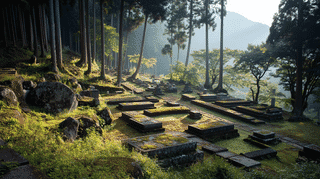
Discover Shimofuji Christian Cemetery in Usuki, a nationally designated historic site and Japan's first complete Christian burial ground from the 16th century. Explore the hidden history of Kirishitan faith, European burial traditions, and the remarkable legacy of early Japanese Christians.

The Miura Baien Manuscripts, designated as an Important Cultural Property of Japan, comprise 30 categories of autograph manuscripts (212 volumes) and four personal artifacts belonging to the Edo-period philosopher Miura Baien (1723–1789). Preserved in Kunisaki City, Oita Prefecture, these documents record his original philosophical system known as Jōrigaku (Study of Natural Order), which anticipated Western dialectical philosophy. The collection is displayed at the Miura Baien Museum alongside his former residence, a National Historic Site.
The Main Hall of Ganjo-in Temple, known as Aizen-do, stands on the hillside of Mount Hachiman in Taketa, Oita Prefecture, as the city's oldest surviving wooden structure. Built in 1635 by Hida master carpenters under the patronage of Lord Nakagawa Hisamori, this nationally designated Important Cultural Property features sophisticated Zen-style bracket complexes, fan-shaped rafters, and distinctive demon carvings at its eaves. Enshrining Aizen Myoo, the deity of love, it is celebrated as one of Oita's most popular romantic power spots.
Discover the Former Yahata Family Residence (Kyū Yahata-ke Jūtaku), an Important Cultural Property in Hita, Oita Prefecture. This rare 18th-century kudo-zukuri farmhouse preserves the traditional split-roof architecture of rural Kyushu.
The Gyōtoku Family Residence in Yoake, Hita City, Ōita Prefecture, is a nationally designated Important Cultural Property dating from the late Edo period. Once home to generations of official physicians serving the Kurume Domain, the residence features the distinctive L-shaped magari-ya roofline of western Ōita and a spacious earthen-floor layout typical of grand village headman dwellings. Visitors can explore the house, its borrowed-scenery garden, and a medical heritage museum free of charge.
Kōkan Bridge is a magnificent single-arch stone bridge completed in 1824, spanning the gorge of the Mie River between Usuki City and Bungo-Ōno City in Oita Prefecture. Boasting the longest stone arch span in Japan at the time of its construction, this Important Cultural Property represents the origin of large-scale stone arch bridge engineering in Kyushu. Discover the story of three merchants who sacrificed their fortunes to build it and the enduring beauty of Aso welded tuff masonry.
Designated an Important Cultural Property in 1975, this thatched farmhouse at Niogi is the oldest house in Oita City, with an upward-hinged shutter and adzed posts.
Hosokawa Tadaoki raised this two-storey gate at Komo Shrine in Nakatsu, Oita, in 1622. Skirt roofs balance its tall frame. An Important Cultural Property since 1988.
This small hall at Senpukuji in Kunisaki, Oita shelters the stone grave of the monk who founded the temple in 1375. Rebuilt in 1636, it is 4.01 metres wide.
Chofukuji Hondo at Hita, built in 1669, is Kyushu's oldest Shin Buddhist main hall: carved dragon transoms, original lotus paintings, and where Hirose Tanso taught.
The west gate of Mikasayama Kasuga Shrine in Bungotakada, Oita, is a late Edo yakuimon just 1.9 metres wide, its timber painted red. Registered in 2011.
The late Edo main hall of Mikasayama Kasuga Shrine in Bungotakada, Oita, is a three-bay gabled sanctuary of bare zelkova housing four deities. Registered in 2011.
Jodoji Genkan oyobi Watariroka links Jodo-ji's main hall to its priests' quarters in Oita City. Its raised corridor reputedly reuses doors from a Funai lord's barge.
Jodoji Hondo, the 1849 main hall of Jodo-ji in Oita City, is a Registered Tangible Cultural Property: seven bays wide, with carved brackets above the altar posts.
The stone bridge and channel wall before the gate of the Higashi Betsuin in Usa. A late-Edo girder bridge, 9.5 m wide with nine cambered girders, framing the front.
The sutra repository of the Higashi Betsuin in Usa, completed in 1799, the compound's oldest building. Inside turns an octagonal revolving case in a fine storehouse.
The drum tower of the Higashi Betsuin in Usa, a late-Edo two-storey structure housing a drum. With cusped windows east and west, it accents the temple skyline.
The earthen wall and stone base on the north edge of the Higashi Betsuin in Usa. A late-Edo plaster wall on random-coursed andesite, shaping the historic streetscape.
An 1864 tiled yakuimon gate at Miemachi in Bungo-Ono, Oita, registered in 2002. Its opening spans 1.7 metres and its low-pitched roof lifts sharply at the eaves.