
National Treasures of Hiroshima
広 島 県 の 国 宝Hiroshima’s national treasures — properties designated kokuhō for their exceptional value to the nation.
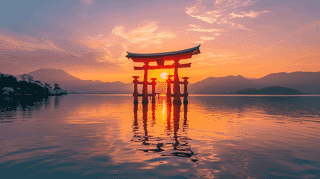
Itsukushima Shrine in Hiroshima rests on a rebuilding of 1241, its main sanctuary alone from 1571. Six of its twelve buildings are National Treasures.
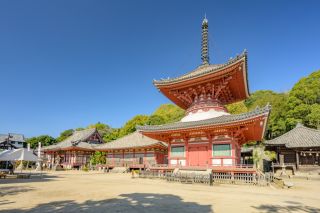
Jodoji Temple Tahoto Pagoda in Onomichi was rebuilt in 1329 after a fire. Praised for its balance and original details, it held hand-copied sutras in its spire.
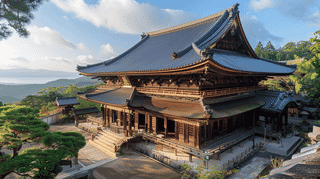
Jodoji Temple Main Hall in Onomichi, built in 1327 after a fire, is an eclectic-style hall rated among the oldest on the Seto Inland Sea. What to see inside.
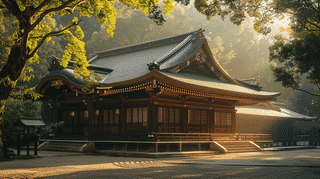
A late Muromachi-period hall in Hiroshima Prefecture. It once stood in Yamaguchi as the Buddha hall of a Zen temple, and was later moved over to here.
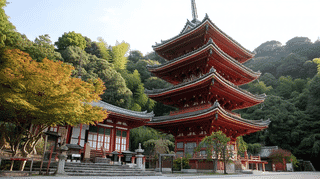
An early Muromachi-period pagoda in Hiroshima Prefecture. The image standing within it was renamed after an investigation carried out there in the 1990s.
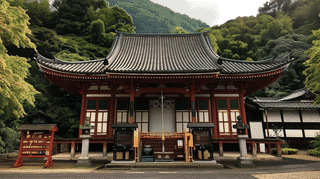
A late Kamakura-period hall in Hiroshima Prefecture. It and the temple's own pagoda took the two steps of the listing here in quite the opposite order.
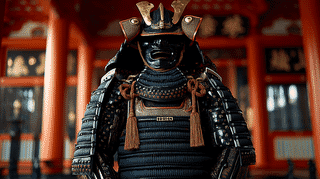
A Nanbokucho-period suit owned by Itsukushima Shrine in Hiroshima Prefecture. A National Treasure of the very same name also stands at Kasuga Taisha too.
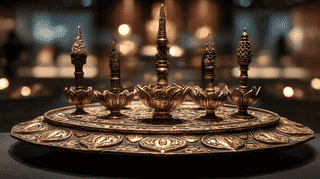
A Kamakura-period set owned by Itsukushima Shrine in Hiroshima Prefecture. Its own three vajras all lie within just nine millimetres of each other here.
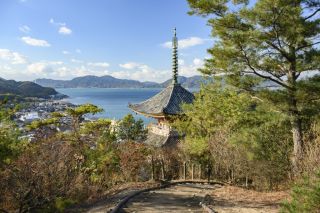
Kojoji Temple Three-Storied Pagoda on Ikuchijima dates from 1432: a Zen pagoda with strong karayo details and mostly original timber. National Treasure since 1958.

A late Kamakura great armor with helmet and shoulder guards at Itsukushima Shrine, Hiroshima, a National Treasure since 1951, elegant in form and colour.
A National Treasure at Itsukushima Shrine, Miyajima: a late-Heian court costume set with ornamental swords, a quiver and vermilion sword boxes dated to 1183.
A National Treasure on silk dated 1153, the twenty-armed Fugen Enmei at Onomichi's Jiko-ji bears a rare dated inscription, a benchmark for late Heian painting.
A rare Heian-period great armor at Itsukushima Shrine, laced with cherry-stenciled yellow leather over wide plates and tied by tradition to Minamoto no Tametomo.
A late Heian great armor at Itsukushima Shrine, laced in indigo so dark it reads as black. Helmet and sleeves survive, said to be the gift of Taira no Shigemori.
A Heian National Treasure at Itsukushima Shrine, the Kan Fugen-kyo in gold on indigo paper, brushed jointly by Taira no Kiyomori and his half-brother Yorimori.
A National Treasure at Itsukushima Shrine: a seven-scroll Lotus Sutra brushed in gold on indigo paper around 1170 by Taira no Kiyomori and his half-brother Yorimori.
A Heian painted cypress fan at Itsukushima Shrine, Hiroshima, a National Treasure since 1952, showing the poem-picture designs of the period.
A 13th-century tachi by Kunimune, a founder of Kamakura swordsmithing, with a flamboyant temper line of round-headed choji; a National Treasure in Fukuyama.
A Nanbokucho tachi by the first Samonji at the Fukuyama Museum of Art, once treasured by Okabe Kosetsusai, a National Treasure since 1951.
A Heian tachi by the Ko-Bizen smith Tomonari, its tang unshortened and signed, held by Itsukushima Shrine and linked by tradition to the Taira. National Treasure.
More from Hiroshima
Hiroshima’s registered properties across designations, with featured heritage and travel notes.
The complete kokuhō catalogue — browse by prefecture, period, and category.
Nationwide jūyō bunkazai — architecture, sculpture, painting, crafts, and documents.