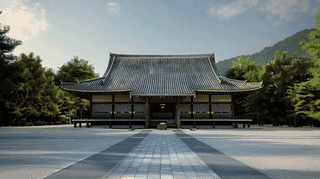
What Is Ninnaji Temple?
Ninnaji Temple (仁和寺, Ninna-ji) is the head temple of the Omuro school of Shingon Buddhism in Omuro-Ouchi, Ukyo Ward, Kyoto City, completed in 888 by Emperor Uda to fulfill the wish of his father, Emperor Koko, and rebuilt in its present form by 1646.
Koko vowed in 886 to build a temple he called Nishiyama Gogan-ji, but died the following year. Uda finished it and named it after the Ninna era. After abdicating in 897 he took the tonsure and became the temple's first abbot, and from then on the abbots, known as monzeki, came from the imperial family. Because the retired emperor kept his residence, his omuro, here, the temple was also called Omuro Gosho, the Omuro Palace.
The Onin War, which broke out in 1467, burned almost every building. The principal Amida triad and the sacred texts survived because they were moved to Shinko-in, one of the temple's sub-temples. Recovery began in 1634, when the 21st abbot, Prince Kakushin, petitioned the shogun Tokugawa Iemitsu, then visiting Kyoto, and won his support. The imperial palace happened to be under reconstruction, so its Shishinden became the Kondo and timber from the Seiryoden went into the Mieido, and the rebuilding was finished in 1646. The layout you walk today dates from that campaign.
The line of imperial abbots ended in 1867, when the 30th abbot, Prince Junnin, returned to lay life. In 1887 fire destroyed the palace in which the abbots had lived, and it was rebuilt over the Meiji and Taisho eras. In 1994 Ninnaji was inscribed on the World Heritage List as one of the Historic Monuments of Ancient Kyoto.
Cultural Properties at Ninnaji Temple
The buildings of Ninnaji fall under three different national systems.
The Kondo, or Golden Hall, is a National Treasure. It is the Shishinden of the imperial palace, built in the Keicho era and moved here in the Kan'ei era, and it was designated a National Treasure in 1953.
Fourteen buildings are designated together, under the single name Ninnaji, as an Important Cultural Property: the Nio-mon Gate, the Chumon Gate, the Five-Story Pagoda, the Kannon-do, the Mieido and its middle gate, the bell tower, the sutra repository, the three halls of the Kusho Myojin shrine, the Honbo Omotemon Gate, and the teahouses Ryokakutei and Hitotei. Most belong to the seventeenth-century rebuilding; the pagoda was raised in 1644.
Eight buildings are Registered Tangible Cultural Properties: seven structures of the palace compound rebuilt after the 1887 fire (the Shinden, the White Study Hall, the Black Study Hall, the Reimeiden, the Grand Entrance, the Imperial Envoy Gate and the Imperial Family Gate) and the Treasure Museum of 1927, all registered on October 28, 2011. Early Edo halls, a Meiji and Taisho palace, and an early Showa museum share one precinct, and that layering is what makes the architecture of Ninnaji Temple so rewarding. Each building has its own page covering its structure and details.
Walking Ninnaji Temple: From the Nio-mon to the Palace, the Chumon and the Kondo
The Nio-mon Gate faces straight onto the street, which is unusual in Kyoto. Just inside, on your left, are the ticket counter for the palace (the Ninnaji Palace Garden) and the Honbo Omotemon Gate, and farther along the wall stands the Imperial Envoy Gate. On your right, east of the approach, is the Treasure Museum.
The Palace Garden route leads from the Honbo Omotemon Gate along a stone path into the Grand Entrance, then by covered corridors through the White Study Hall, the Shinden, the Reimeiden and the Black Study Hall. The white-sand South Garden lies before the Shinden and the pond-centered North Garden behind it, with the Hitotei teahouse on its hill and the pagoda beyond. The temple suggests allowing about an hour.
Continue north along the approach to the Chumon Gate; past it, on your left, spreads the grove of Omuro cherries, a late-flowering variety that usually peaks in mid-April. At the far end stands the Kondo, with the pagoda, the Kannon-do, the Mieido, the sutra repository, the bell tower and the Kusho Myojin shrine arranged around it.
Ninnaji Temple Opening Hours and Admission
The temple grounds are normally free. During the Omuro cherry season in spring, the Omuro Flower Festival brings a special entry fee for the grounds (800 yen for adults, free for high school students and younger).
There are two paid areas. The Ninnaji Palace Garden, covering the palace buildings and the South and North Gardens, costs 800 yen for adults and is free for high school students and younger; groups of 15 or more pay 720 yen per adult. Between March and November it is open 9:00 a.m. until 5:00 p.m. (last entry 4:30 p.m.), and between December and February 9:00 a.m. until 4:30 p.m. (last entry 4:00 p.m.). The Treasure Museum opens only for limited periods in spring, summer and autumn, at 500 yen for adults and free for high school students and younger, with a combined ticket available during those periods.
Holders of a disability certificate are admitted free on presentation. Wheelchair users are asked to contact the temple in advance so staff can help where possible, and one indoor and one outdoor wheelchair are available to borrow.
Personal photography is allowed in the grounds but not inside worship halls or the Treasure Museum. Tripods are allowed outdoors only.
Getting to Ninnaji Temple
The nearest station is Omuro-Ninnaji on the Randen (Keifuku Electric Railroad) Kitano Line, about 3 minutes on foot; the Nio-mon Gate is in view as you leave the station.
On the JR Sagano Line, Hanazono Station is about 15 minutes away on foot (about 5 minutes by taxi), or change at Emmachi Station to city bus 26 for about 10 minutes. From Kyoto Station, city bus 26 takes about 40 minutes and the JR bus on the Takao-Keihoku line about 30 minutes. City buses 10 and 59 from Keihan Sanjo Station take about 40 minutes, bus 26 from Hankyu Omiya Station about 30 minutes, and bus 26 from Hankyu Saiin Station about 25 minutes.
By car it is about 40 minutes from either the Kyoto-minami or the Kyoto-higashi interchange of the Meishin Expressway. A 24-hour coin car park on the east side of the temple holds 98 cars and 12 buses. The roads around the temple jam during the cherry season, so the temple asks visitors to use public transport then.
Ninnaji Temple: Names and Spellings
The name is read Ninnaji. Because imperial princes served as its abbots, the temple is also known as Omuro Gosho or Kyu-Omuro Gosho, the former Omuro Palace. In English it appears as Ninnaji Temple and often as Ninna-ji. This site uses Ninnaji and Ninnaji Temple consistently, including on the pages for individual buildings.
References
- Ninnaji: About the Temple (Japanese)
- https://ninnaji.jp/about_outline/
- Ninnaji: Guide to the Precincts (Japanese)
- https://ninnaji.jp/precincts/
- Ninnaji: Admission and Access (Japanese)
- https://ninnaji.jp/visit/
- Ninnaji: Frequently Asked Questions (Japanese)
- https://ninnaji.jp/question/
- Agency for Cultural Affairs Database: Ninnaji Kondo
- https://kunishitei.bunka.go.jp/heritage/detail/102/1853
- Agency for Cultural Affairs Database: Ninnaji Shinden
- https://kunishitei.bunka.go.jp/bsys/maindetails/101/00009038
- Cultural Heritage Online: Historic Monuments of Ancient Kyoto, Ninnaji
- https://online.bunka.go.jp/special_content/component/30
- Japan Tourism Agency Multilingual Commentary Database: Nio-mon Gate
- https://www.mlit.go.jp/tagengo-db/R1-00346.html
- Japan Tourism Agency Multilingual Commentary Database: Omuro Cherry Trees
- https://www.mlit.go.jp/tagengo-db/R1-00358.html
- Kyoto City Tourism Association: Ninnaji (Japanese)
- https://ja.kyoto.travel/tourism/single01.php?category_id=7&tourism_id=439
Last verified: 2026.09.19
Basic Information
| Name | Ninnaji Temple |
|---|---|
| Location | 33-1 Omuro-Ouchi, Ukyo Ward, Kyoto City, Kyoto Prefecture |
| Owner | Religious Corporation Ninnaji |
| Designation | National Treasure (1) · Important Cultural Property (1) · Registered Tangible Cultural Properties (8) |
| Coordinates | 35.02925, 135.71348 |