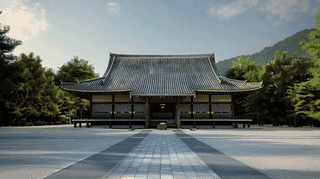
What Is Ninnaji Temple Reimeiden Hall?
Ninnaji Temple Reimeiden Hall (仁和寺霊明殿, Reimeiden) is a small Buddhist hall built in 1911 north of the Black Study Hall in the Ninnaji palace compound, Omuro-Ouchi, Ukyo Ward, Kyoto City, and it was registered as a Registered Tangible Cultural Property on October 28, 2011.
It was built to house a seated statue of Yakushi Nyorai, the Buddha of healing, which had been the principal image of Kita-in, one of Ninnaji's affiliated sub-temples. According to the temple's multilingual commentary, memorial tablets of the successive abbots of Ninnaji are enshrined here as well. A covered corridor links it to the Black Study Hall, and it faces south.
The architect was Kameoka Suekichi of the Kyoto Prefectural government. His Shinden was completed in 1914, which makes Ninnaji Temple Reimeiden Hall three years older and one of the first pieces he delivered for the rebuilt palace.
Why Ninnaji Temple Reimeiden Hall Is Registered
The criterion was serving as a model of design. The hall is three bays square, with a pyramidal (hogyo) roof of cypress bark (Hiwadabuki) and a one-bay entrance canopy (Kōhai) on the front. At 53 square metres it is about a fifth the size of the Shinden, which covers 257 square metres.
Inside is a single room. A three-bay altar platform (Shumidan) stands at the back, and the ceiling is a coved, finely latticed coffer, curving up at the edges with a smaller grid set inside each square, one of the most formal ceiling types in Japanese architecture. The Agency for Cultural Affairs reads the whole composition as a conscious nod to late Heian-period design.
Kameoka's own hand shows in the details. The frog-leg struts (Kaerumata) carry carved arabesques redrawn as crisp modern patterns, a motif he favored. Classical bones with an early twentieth-century graphic sense: that pairing is the point of Ninnaji Temple Reimeiden Hall. The temple's commentary likewise singles out the combination of bark roofing and repeated arabesque motifs as typical of Kameoka.
Highlights: The Roof Jewel, the Carved Struts and the Konoe Plaque
A sacred jewel crowns the pyramidal roof. As you walk north along the corridor toward the hall, look up first: the four bark-covered slopes meet at a single point, and the jewel on top gives the small building a vertical accent.
Above the front hangs a name plaque written by Konoe Fumimaro. Drop your eyes to the struts under the eaves and you will find the stylized arabesques. Kameoka used similar vines in the openwork of the Imperial Envoy Gate, so comparing the two reveals his habits.
The Yakushi statue itself is a hidden image, and the temple says it is unlikely ever to be shown at Ninnaji. According to the temple's commentary, the figure was long believed to have been brought from China by Kukai, but a study the temple permitted in 1986 showed that it was completed in 1103.
To the east of Ninnaji Temple Reimeiden Hall lies the pond of the North Garden. From here you see the water and the artificial hill from the garden's western edge, a different angle from the north veranda of the Shinden.
Visiting Ninnaji Temple Reimeiden Hall
Ninnaji Temple Reimeiden Hall is on the Ninnaji Palace Garden route: from the Shinden, head west and follow the corridor north until you stand in front of the hall.
This is still a working memorial hall, and some visitors stop to pray. The temple does not permit photography inside worship halls, so keep cameras away from the interior. The roof jewel and the carved struts can be viewed from the corridor.
Opening hours, admission and directions to the temple are covered on the Ninnaji Temple page.
- 📍 Plan Your Visit to Kyoto
- Find tours, activities & transport passes near Ninnaji Temple Reimeiden Hall
- [ Kinkakuji Fushimi Inari & Kimono Rental ]
Q&A
- When was Ninnaji Temple Reimeiden Hall built, and when was it registered?
- Built in 1911, it became a Registered Tangible Cultural Property on October 28, 2011, recognized as a model of design.
- What is enshrined in Ninnaji Temple Reimeiden Hall?
- A seated statue of Yakushi Nyorai, formerly the principal image of Kita-in, a Ninnaji sub-temple. According to the temple's commentary, memorial tablets of the successive abbots are also kept here.
- Can I see the statue in Ninnaji Temple Reimeiden Hall?
- No. The Yakushi statue is a hidden image, and the temple says it is unlikely to be shown. You can stand in front of the hall on the Ninnaji Palace Garden route.
- Who designed Ninnaji Temple Reimeiden Hall?
- Kameoka Suekichi of the Kyoto Prefectural government. He combined a three-bay pyramidal hall in a late Heian manner with struts carved in his favorite stylized arabesques.
- Whose calligraphy is on the plaque of Ninnaji Temple Reimeiden Hall?
- According to the temple, the name plaque above the front was written by Konoe Fumimaro.
Basic Information
| Name | Ninnaji Temple Reimeiden Hall (仁和寺霊明殿) |
|---|---|
| Location | 33-1 Omuro-Ouchi, Ukyo Ward, Kyoto City, Kyoto Prefecture |
| Designation | Registered Tangible Cultural Property (Building) |
| Year Designated | Registered October 28, 2011 |
| Quantity | 1 building |
| Dimensions | 3 bays square; building area 53 square metres (single-storey timber, pyramidal roof of cypress bark, 1-bay entrance canopy, connecting corridor) |
| Owner | Religious Corporation Ninnaji |
| Public Access | Inside the paid Ninnaji Palace Garden area; viewed from outside during regular visiting hours |
References
- Agency for Cultural Affairs Database: Ninnaji Reimeiden
- https://kunishitei.bunka.go.jp/bsys/maindetails/101/00009042
- Japan Tourism Agency Multilingual Commentary Database: Reimeiden
- https://www.mlit.go.jp/tagengo-db/R1-00371.html
- Ninnaji: Guide to the Precincts (Japanese)
- https://ninnaji.jp/precincts/
- Ninnaji: About the Temple (Japanese)
- https://ninnaji.jp/about_outline/
- Ninnaji: Frequently Asked Questions (Japanese)
- https://ninnaji.jp/question/
Last verified: 2026.09.19