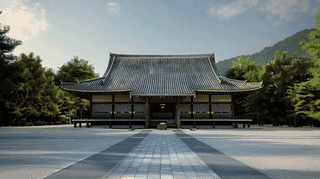
What Is Ninnaji Temple Imperial Family Gate?
Ninnaji Temple Imperial Family Gate (仁和寺皇族門, Kozokumon) is a slender gate built in 1914 midway along the wall that runs east from the Grand Entrance of the Ninnaji palace compound in Omuro-Ouchi, Ukyo Ward, Kyoto City, and it was registered as a Registered Tangible Cultural Property on October 28, 2011.
South of the palace buildings lies a forecourt crossed by a stone path from the Honbo Omotemon Gate to the Grand Entrance; north of it spreads the white-sand South Garden in front of the Shinden. Ninnaji Temple Imperial Family Gate is the opening in the wall between the two. The name marks it as a gate for members of the imperial family, but the temple's published materials say nothing about how it is used today.
The Agency for Cultural Affairs database gives the same date, 1914, for the Shinden and the Imperial Envoy Gate. The gate belongs to the later stage of the rebuilding that followed the fire of 1887.
Why Ninnaji Temple Imperial Family Gate Is Registered
The criterion was serving as a model of design. It is a four-legged gate (Shikyakumon) of the hira-karamon type, roofed in cypress bark (Hiwadabuki), with an opening 2.7 m wide.
In a hira-karamon, the curved karahafu gables are shown on the sides of the gate. The Imperial Envoy Gate turns its gables to the front and back instead, so the palace has two versions of the Chinese-style gate standing a short walk apart.
The Agency's description is precise about the structure. The main posts are round and the rear supporting posts square; the ridge beam rests on a frog-leg strut (Kaerumata) and a boat-shaped bracket set on the main tie beam. The rafters (Taruki) are spaced widely, and above the paneled doors sits an openwork transom (Ranma).
The Agency sums it up as a delicate gate with slender proportions. Set it beside the large, lavishly carved Imperial Envoy Gate and the two could hardly be more different, though both belong to the same palace.
Highlights: Open Rafters and a Pierced Transom
Look up under the eaves first. With the rafters set so far apart, the underside of the roof has an unhurried rhythm, and together with the thin members it explains why the whole gate looks so light.
Then look above the doors. The pierced transom lets light through and draws a bright band over the doorway. The ornament is modest, sized to a small gate, and nothing like the carving that covers the Imperial Envoy Gate.
Notice the posts, too. From the front you see the round main posts; step to the side and the supporting posts behind turn out to be square. Using round and square timbers in one gate is an old way of distinguishing members of different rank.
Stand on the stone path with your back to the carriage porch of the Grand Entrance and look north: Ninnaji Temple Imperial Family Gate sits in the middle of the wall. From inside, you can see its back across the white sand from the veranda of the Shinden.
Visiting Ninnaji Temple Imperial Family Gate
Ninnaji Temple Imperial Family Gate lies inside the paid Ninnaji Palace Garden area. Once past the ticket counter and the Honbo Omotemon Gate, you see it in the wall on your right, to the north, as you walk the stone path toward the Grand Entrance.
Because the gate stands outdoors, personal photography is allowed within the temple's rules. Tripods are permitted outside, but the stone path is the main visitor route, so pick a spot that keeps it clear.
Opening hours, admission and directions to the temple are covered on the Ninnaji Temple page.
- 📍 Plan Your Visit to Kyoto
- Find tours, activities & transport passes near Ninnaji Temple Imperial Family Gate
- [ Kinkakuji Fushimi Inari & Kimono Rental ]
Q&A
- When was Ninnaji Temple Imperial Family Gate built, and when was it registered?
- The gate dates from 1914 and has been a Registered Tangible Cultural Property since October 28, 2011.
- Where is Ninnaji Temple Imperial Family Gate?
- In the middle of the wall running east from the Grand Entrance. It divides the stone-paved forecourt from the South Garden in front of the Shinden.
- How does Ninnaji Temple Imperial Family Gate differ from the Imperial Envoy Gate?
- The Imperial Family Gate is a slender four-legged hira-karamon with a 2.7 m opening. The Imperial Envoy Gate is 5.2 m wide, turns its curved gables front and back, and is covered in openwork carving.
- Can Ninnaji Temple Imperial Family Gate be seen from outside the paid area?
- No. It stands inside the Ninnaji Palace Garden area and is seen from the forecourt beyond the Honbo Omotemon Gate; from inside, you can see its back across the South Garden from the veranda of the Shinden.
- What should I look for at Ninnaji Temple Imperial Family Gate?
- The widely spaced rafters under the eaves, the pierced transom above the paneled doors, and the contrast between the round main posts and the square supporting posts.
Basic Information
| Name | Ninnaji Temple Imperial Family Gate (仁和寺皇族門) |
|---|---|
| Location | 33-1 Omuro-Ouchi, Ukyo Ward, Kyoto City, Kyoto Prefecture |
| Designation | Registered Tangible Cultural Property (Building) |
| Year Designated | Registered October 28, 2011 |
| Quantity | 1 building |
| Dimensions | Opening 2.7 m wide (timber four-legged hira-karamon gate, cypress-bark roof) |
| Owner | Religious Corporation Ninnaji |
| Public Access | Inside the paid Ninnaji Palace Garden area; seen during regular visiting hours |
References
- Agency for Cultural Affairs Database: Ninnaji Kozokumon
- https://kunishitei.bunka.go.jp/bsys/maindetails/101/00009044
- Agency for Cultural Affairs Database: Ninnaji Chokushimon
- https://kunishitei.bunka.go.jp/bsys/maindetails/101/00009043
- Ninnaji: About the Temple (Japanese)
- https://ninnaji.jp/about_outline/
- Ninnaji: Frequently Asked Questions (Japanese)
- https://ninnaji.jp/question/
Last verified: 2026.09.19