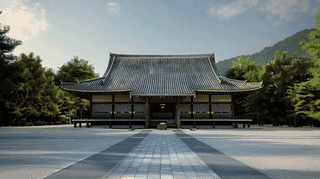
What Is Ninnaji Temple Grand Entrance?
Ninnaji Temple Grand Entrance (仁和寺大玄関, Ōgenkan) is the entrance building at the southern end of the palace compound of Ninnaji in Omuro-Ouchi, Ukyo Ward, Kyoto City; it dates from 1890 and was registered as a Registered Tangible Cultural Property on October 28, 2011.
A fire in 1887 destroyed most of the palace buildings at Ninnaji. The Grand Entrance was among the first things rebuilt, going up in 1890 alongside the White Study Hall, which served as a temporary Shinden. The new Shinden itself was not finished until 1914, so the compound took close to three decades to recover.
The building faces east and connects to the halls behind it by a covered corridor. Today it is where visitors to the Palace Garden step up into the buildings, and it houses the Ogenkan stamp office, where pilgrims collect the handwritten temple seal known as goshuin.
Why Ninnaji Temple Grand Entrance Is Registered
The criterion was serving as a model of design. The Agency for Cultural Affairs calls Ninnaji Temple Grand Entrance a large entrance hall that is at once dignified and lavish.
The main block is 12 m by 7.0 m under a hip-and-gable (irimoya) roof of pantiles (Sangawara-buki), with a building area of 127 square metres. From its east front projects a carriage porch close to 6.0 m wide, the kind of covered stop where palanquins and carriages once pulled up. The porch roof sweeps up into a cusped karahafu gable and is covered in cypress bark (Hiwadabuki).
The Agency's database sums up the roof as "tile, partly cypress bark," and that split is the key to the design. The body of the building wears durable tile; only the face that greets guests gets the softer, palace-style bark. From a distance the roofs read as one, but up close the change in texture is obvious.
The carving is the other point the Agency stresses. The frog-leg struts (Kaerumata) and the flared oigata brackets flanking the vase-shaped struts (Taiheizuka) are cut with care, a small signal of the rank expected of an imperial abbot's residence.
Highlights: Approaching the Carriage Porch
The best view of this building comes before you enter it. Walk through the Honbo Omotemon Gate and follow the diagonal stone path, and the cusped gable of the carriage porch grows ahead of you. From the path you can see the soft curve of the bark roof layered against the straight ridges of the tiled roof behind it.
Look for the carved struts and brackets around the porch. Because Ninnaji Temple Grand Entrance faces east, morning light on a clear day falls straight on the front and brings out the depth of the carving.
A wall runs east from the Grand Entrance, and midway along it stands the Imperial Family Gate (Kozokumon), which divides the forecourt from the South Garden in front of the Shinden. Facing the porch, you will see it in the wall on your right, to the north. Together the two buildings form the southern edge of the palace compound.
Visiting Ninnaji Temple Grand Entrance
Ninnaji Temple Grand Entrance is the doorway to the paid Ninnaji Palace Garden area. Once past the ticket counter and the Honbo Omotemon Gate, you see the carriage porch at the end of the stone path, and every visitor to the palace steps up into the buildings here.
The Ogenkan stamp office issues the Palace Garden goshuin. On days when the Palace Garden is closed, the stamp office and shop close as well and seals are handled at the office in front of the Kondo.
Personal photography is allowed in the grounds, though not inside worship halls, and the porch can be photographed from the stone path.
Opening hours, admission and directions to the temple are covered on the Ninnaji Temple page.
- 📍 Plan Your Visit to Kyoto
- Find tours, activities & transport passes near Ninnaji Temple Grand Entrance
- [ Kinkakuji Fushimi Inari & Kimono Rental ]
Q&A
- When was Ninnaji Temple Grand Entrance built, and when was it registered?
- It was built in 1890 and registered as a Registered Tangible Cultural Property on October 28, 2011. It was one of the first buildings rebuilt after the fire of 1887, together with the White Study Hall.
- What does the carriage porch of Ninnaji Temple Grand Entrance look like?
- A porch close to 6.0 m wide projects from the east front under a cusped gable roofed in cypress bark. The main block has a hip-and-gable tile roof, so only the front is finished in bark.
- Can I visit Ninnaji Temple Grand Entrance?
- Yes. It is the entrance to the Ninnaji Palace Garden, and every visitor steps up into the palace here. The carriage porch is best seen from the stone path leading from the Honbo Omotemon Gate.
- Can I get a goshuin stamp at Ninnaji Temple Grand Entrance?
- Yes, the Ogenkan stamp office issues the Palace Garden seal. When the Palace Garden is closed, the office closes too and seals are handled at the office in front of the Kondo.
- Which carvings should I look for at Ninnaji Temple Grand Entrance?
- The frog-leg struts and the flared brackets beside the vase-shaped struts, which the Agency for Cultural Affairs singles out. The building faces east, so the carving shows best in morning light from the stone path.
Basic Information
| Name | Ninnaji Temple Grand Entrance (仁和寺大玄関) |
|---|---|
| Location | 33-1 Omuro-Ouchi, Ukyo Ward, Kyoto City, Kyoto Prefecture |
| Designation | Registered Tangible Cultural Property (Building) |
| Year Designated | Registered October 28, 2011 |
| Quantity | 1 building |
| Dimensions | 12 m by 7.0 m; building area 127 square metres; carriage porch about 6.0 m wide (single-storey timber, hip-and-gable tile roof, porch with cusped gable in cypress bark, connecting corridor) |
| Owner | Religious Corporation Ninnaji |
| Public Access | At the entrance of the paid Ninnaji Palace Garden area; seen during regular visiting hours |
References
- Agency for Cultural Affairs Database: Ninnaji Ogenkan
- https://kunishitei.bunka.go.jp/bsys/maindetails/101/00009039
- Japan Tourism Agency Multilingual Commentary Database: Honbo-omotemon Gate
- https://www.mlit.go.jp/tagengo-db/R1-00352.html
- Ninnaji: Notice of Palace Garden Closure on September 30 (Japanese)
- https://ninnaji.jp/news/information-3/
- Ninnaji: About the Temple (Japanese)
- https://ninnaji.jp/about_outline/
- Ninnaji: Frequently Asked Questions (Japanese)
- https://ninnaji.jp/question/
Last verified: 2026.09.19