What Is Ninnaji Temple White Study Hall?
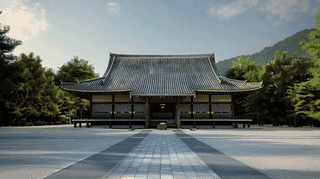
Ninnaji Temple White Study Hall (仁和寺白書院, Shiroshoin) is a reception hall built in 1890 between the Shinden and the Grand Entrance of the Ninnaji palace compound in Omuro-Ouchi, Ukyo Ward, Kyoto City, and it was registered as a Registered Tangible Cultural Property on October 28, 2011.
When fire destroyed the Shinden, the ceremonial heart of the palace, in 1887, the temple put up this building first as a temporary Shinden. Once the present Shinden was finished in 1914, it stepped aside and became known as the White Study Hall. The Agency for Cultural Affairs describes it as a study hall that keeps the dignity of a former Shinden, a nod to that history.
The hall faces east over the white sand of the South Garden. Directly opposite, in the garden's east wall, stands the Imperial Envoy Gate, set squarely in front of Ninnaji Temple White Study Hall.
Why Ninnaji Temple White Study Hall Is Registered
The criterion was serving as a model of design. The hall measures 15.8 m by 12.5 m, with a building area of 196 square metres, under a hip-and-gable (irimoya) roof of pantiles (Sangawara-buki).
Six rooms sit in two rows of three, one row facing the garden to the east and the other to the west. Along the front runs an open veranda with no doors at all, a soft threshold between the tatami rooms and the garden. The temple's multilingual commentary notes that the deep eaves shade the east and west walls and keep the interior cool in summer, and that the beams carrying the eaves run right through into the core of the building, so inside and outside feel continuous.
Between the front rooms are transoms (Ranma) shaped like bamboo nodes, and the main room has a display alcove (Tokonoma) and shelves. The design is restrained and follows the rules of a formal study hall, which suits a building that once had to stand in for the Shinden at ceremonies.
That role has not ended. The temple's commentary says the White Study Hall is still used for rites, together with the Shinden or in its place.
Highlights: Fukunaga Seihan's Pines and a Freshly Restored Hall
Inside, pine trees cover the sliding panels and wrap around the rooms. They were painted in 1937 by the Japanese-style painter Fukunaga Seihan. The same year Domoto Insho painted the panels of the Black Study Hall, so walking the route through both study halls lets you compare two painters working in 1937.
Ninnaji Temple White Study Hall went under restoration in December 2023, and the work was completed in 2026.
Sit on the veranda facing east and the cusped gable of the Imperial Envoy Gate lines up across the white sand. The gate stands directly in front of the White Study Hall, and the veranda is where that relationship makes sense. On a sunny morning, light bouncing off the sand reaches deep under the eaves.
Visiting Ninnaji Temple White Study Hall
Ninnaji Temple White Study Hall is the first building you enter on the Ninnaji Palace Garden route; the corridor from the Grand Entrance brings you out onto its veranda.
Personal photography is allowed in the grounds, but the temple does not permit it inside worship halls. Follow the signs on site before photographing the painted panels.
Opening hours, admission and directions to the temple are covered on the Ninnaji Temple page.
- 📍 Plan Your Visit to Kyoto
- Find tours, activities & transport passes near Ninnaji Temple White Study Hall
- [ Kinkakuji Fushimi Inari & Kimono Rental ]
Q&A
- When and why was Ninnaji Temple White Study Hall built?
- It was built in 1890 as a temporary Shinden after fire destroyed the original in 1887. After the present Shinden was completed in 1914 it became the White Study Hall. It was registered as a Registered Tangible Cultural Property on October 28, 2011.
- Who painted the sliding panels in Ninnaji Temple White Study Hall?
- The Japanese-style painter Fukunaga Seihan, in 1937. His pine trees run around the rooms on every side.
- Has the restoration of Ninnaji Temple White Study Hall finished?
- Yes. Work that began in December 2023 was completed in 2026.
- Where is Ninnaji Temple White Study Hall on the visitor route?
- It is the first building on the Ninnaji Palace Garden route. The corridor from the Grand Entrance leads onto its veranda, and from there the route continues to the Shinden.
- How is Ninnaji Temple White Study Hall related to the Imperial Envoy Gate?
- The Imperial Envoy Gate stands in the east wall of the South Garden, facing east, directly in front of the White Study Hall. From the veranda you look straight across the white sand at its cusped gable.
Basic Information
| Name | Ninnaji Temple White Study Hall (仁和寺白書院) |
|---|---|
| Location | 33-1 Omuro-Ouchi, Ukyo Ward, Kyoto City, Kyoto Prefecture |
| Designation | Registered Tangible Cultural Property (Building) |
| Year Designated | Registered October 28, 2011 |
| Quantity | 1 building |
| Dimensions | 15.8 m by 12.5 m; building area 196 square metres (single-storey timber, hip-and-gable tile roof) |
| Owner | Religious Corporation Ninnaji |
| Public Access | Inside the paid Ninnaji Palace Garden area; seen during regular visiting hours |
References
- Agency for Cultural Affairs Database: Ninnaji Shiroshoin
- https://kunishitei.bunka.go.jp/bsys/maindetails/101/00009040
- Cultural Heritage Online: Ninnaji Shiroshoin
- https://online.bunka.go.jp/heritages/detail/246140
- Japan Tourism Agency Multilingual Commentary Database: Shiroshoin
- https://www.mlit.go.jp/tagengo-db/R1-00370.html
- Ninnaji: Sanskrit-Script Exhibition for the Shiroshoin Restoration (Japanese)
- https://ninnaji.jp/news/event-33-2/
- Ninnaji: Guide to the Precincts (Japanese)
- https://ninnaji.jp/precincts/
- Ninnaji: Frequently Asked Questions (Japanese)
- https://ninnaji.jp/question/
Last verified: 2026.09.19