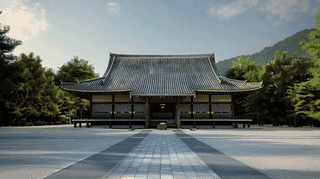
What Is Ninnaji Temple Imperial Envoy Gate?
Ninnaji Temple Imperial Envoy Gate (仁和寺勅使門, Chokushimon) is an ornate gate built in 1914 on the east side of the Ninnaji palace compound, facing east in front of the White Study Hall, in Omuro-Ouchi, Ukyo Ward, Kyoto City, and it was registered as a Registered Tangible Cultural Property on October 28, 2011.
A chokushimon is the gate reserved for an emperor's messenger. According to the temple's multilingual commentary, only the emperor or his envoys may pass through it, so it normally stays shut. A gate stood on this spot before, but it burned in the fire of 1887, and the present one replaced it.
The architect was Kameoka Suekichi of the Kyoto Prefectural government. Sources disagree by a year on the date: the Agency for Cultural Affairs database says 1914, while the temple's website and multilingual commentary give 1913. This article follows the Agency.
Why Ninnaji Temple Imperial Envoy Gate Is Registered
The criterion was serving as a model of design. It is a four-legged gate (Shikyakumon) whose roof has cusped karahafu gables at front and back and hip-and-gable (irimoya) ends at the sides, all covered in cypress bark (Hiwadabuki). The opening is 5.2 m wide, with short flanking walls on either side.
The Agency notes that the form is modeled on the Karamon (Chinese-style gate) of Hongwanji. Because the curved gable faces both ways, the gate presents a full front to each side. That makes sense for a gate seen both from the public approach outside and from the South Garden inside.
Ornament is what earned it attention. The walls and paneled doors are filled with openwork carving (Sukashibori) that turns flower lozenges, phoenixes and scrolling vines into flowing patterns. The temple lists phoenix tail feathers, peony scrolls, hosoge floral scrolls and geometric designs, and describes the result as traditional Japanese carpentry given Kameoka's own twist. The Agency calls it a large gate that shows off his feel for design.
Highlights: Reading the Openwork in Changing Light
Stand close to the doors and side panels. Openwork lets light through from behind, so the carving changes with the hour and your position. Because the gate faces east, a sunny morning lights the front and deepens the shadows in the relief; in the afternoon the light comes from behind, and brightness glows through the gaps.
Look for the phoenix tail feathers. Their long, trailing lines wind into the vine scrolls until it is hard to tell where bird ends and plant begins. The temple's commentary presents the phoenix as a symbol of resurrection and renewal, and it is tempting to connect that with a gate raised during the recovery from a fire.
Kameoka also carved stylized vines into the struts of the Reimeiden. Comparing them with the openwork of Ninnaji Temple Imperial Envoy Gate shows the same hand at work.
Visiting Ninnaji Temple Imperial Envoy Gate
The front (east face) of Ninnaji Temple Imperial Envoy Gate can be seen from outside the palace compound, on your left as you walk the main approach from the Nio-mon Gate toward the Chumon Gate. You do not need a Palace Garden ticket to study the front up close.
The back (west face) is seen across the South Garden from inside the paid Ninnaji Palace Garden area, and it lines up with the veranda of the White Study Hall.
The gate belongs to imperial messengers and normally stays closed. According to the temple's commentary, each October the festival procession of nearby Fukuoji Shrine passes through it.
As an outdoor structure it can be photographed freely for personal use within the temple's rules. Admission to the grounds and directions are covered on the Ninnaji Temple page.
- 📍 Plan Your Visit to Kyoto
- Find tours, activities & transport passes near Ninnaji Temple Imperial Envoy Gate
- [ Kinkakuji Fushimi Inari & Kimono Rental ]
Q&A
- When was Ninnaji Temple Imperial Envoy Gate built, and when was it registered?
- The Agency for Cultural Affairs database dates it to 1914, while the temple's website gives 1913. It was registered as a Registered Tangible Cultural Property on October 28, 2011.
- Can I see Ninnaji Temple Imperial Envoy Gate without paying admission?
- Yes. The front faces the main approach between the Nio-mon Gate and the Chumon Gate and can be seen from the grounds (a special entry fee applies to the grounds during the spring cherry festival). The back is seen from inside the paid Palace Garden.
- Is Ninnaji Temple Imperial Envoy Gate ever opened?
- It is reserved for the emperor or his envoys and normally stays closed. According to the temple's commentary, the procession of nearby Fukuoji Shrine passes through it each October.
- What do the carvings on Ninnaji Temple Imperial Envoy Gate show?
- Openwork patterns of flower lozenges, phoenixes and scrolling vines fill the walls and doors. The temple mentions phoenix tail feathers, peony scrolls, floral scrolls and geometric designs.
- Who designed Ninnaji Temple Imperial Envoy Gate?
- Kameoka Suekichi of the Kyoto Prefectural government. The Agency for Cultural Affairs describes it as modeled on the Karamon of Hongwanji and as a showcase of his design sense.
Basic Information
| Name | Ninnaji Temple Imperial Envoy Gate (仁和寺勅使門) |
|---|---|
| Location | 33-1 Omuro-Ouchi, Ukyo Ward, Kyoto City, Kyoto Prefecture |
| Designation | Registered Tangible Cultural Property (Building) |
| Year Designated | Registered October 28, 2011 |
| Quantity | 1 building |
| Dimensions | Opening 5.2 m wide (timber four-legged gate, cusped gables front and back, hip-and-gable sides, cypress-bark roof, flanking walls) |
| Owner | Religious Corporation Ninnaji |
| Public Access | Front seen from the temple approach; back seen from the paid Ninnaji Palace Garden area |
References
- Agency for Cultural Affairs Database: Ninnaji Chokushimon
- https://kunishitei.bunka.go.jp/bsys/maindetails/101/00009043
- Japan Tourism Agency Multilingual Commentary Database: Chokushimon
- https://www.mlit.go.jp/tagengo-db/R1-00372.html
- Ninnaji: Guide to the Precincts (Japanese)
- https://ninnaji.jp/precincts/
- Ninnaji: Admission and Access (Japanese)
- https://ninnaji.jp/visit/
- Ninnaji: Frequently Asked Questions (Japanese)
- https://ninnaji.jp/question/
Last verified: 2026.09.19