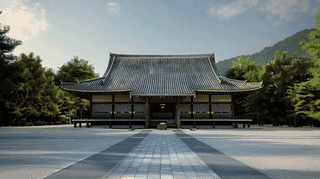
What Is the Important Cultural Property Ninnaji Temple?
The Important Cultural Property named Ninnaji Temple (仁和寺) is a set of 14 buildings, mostly of the early Edo period and including the Nio-mon Gate, the Five-Story Pagoda and the Mieido, in the grounds of Ninnaji in Omuro-Ouchi, Ukyo Ward, Kyoto City, designated in stages starting with the pagoda in 1900 and completed in 1973.
In the Agency for Cultural Affairs database, the 14 are recorded as the individual buildings of a single designation that carries the temple's own name. They are the Nio-mon Gate, the Chumon Gate, the Five-Story Pagoda, the Kannon-do, the Mieido, the Mieido middle gate, the bell tower, the sutra repository, the three halls of the Kusho Myojin shrine, the Honbo Omotemon Gate, and the teahouses Ryokakutei and Hitotei. The Kondo, the main hall, is a separate designation and is not among them.
Most of these buildings date from the early Edo rebuilding of a temple burned in the Onin War. The Agency dates the majority to 1641 through 1645 and the pagoda and bell tower to 1644. Three are exceptions: the Honbo Omotemon Gate is dated to the Keicho era, the Ryokakutei to the mid-Edo period and the Hitotei to the late Edo period.
How the 14 Buildings of Ninnaji Temple Were Designated
The pagoda came first, on April 7, 1900. The Mieido followed in 1908, the Nio-mon Gate in 1931, and the two teahouses in 1937. On June 2, 1973, nine more were added: the Kannon-do, the Chumon Gate, the bell tower, the sutra repository, the Mieido middle gate, the three Kusho Myojin halls and the Honbo Omotemon Gate, bringing the total to 14.
For that 1973 addition the Agency noted that all nine belonged to the Kan'ei-era rebuilding, were of good quality and formed an essential part of the temple complex. It singled out the Kannon-do for its old-fashioned plan mixed with newer details, the Chumon for its traditional eight-legged gate design, the bell tower as a large, purely Japanese-style tower with a skirted lower story, and the sutra repository for its Zen-style details and the octagonal revolving sutra case inside.
Of the Honbo Omotemon Gate, the Agency records the tradition that it was the kitchen gate of the imperial palace, moved here, and describes its thick timbers and bold design. The temple's multilingual commentary adds that it survived the fire of 1887.
Highlights of the 14 Buildings of Ninnaji Temple
Gates: the Nio-mon, the Chumon, the Mieido Middle Gate and the Honbo Omotemon
The Nio-mon Gate is a two-story gate five bays wide with three openings, under a hip-and-gable (irimoya) roof of heavy tile (Hongawarabuki). According to the temple it stands 18.7 m high, with the fierce guardian kings on either side of the front and lion-dogs at the back. The temple points out that while the contemporary gates of Chion-in and Nanzen-ji use the Zen style, this one keeps to the Japanese style inherited from the Heian period.
The Chumon Gate is an eight-legged gate three bays wide with a single opening, under a gabled (kirizuma) tile roof; the temple says it houses the guardians of the west and east. The Mieido middle gate is a small hira-karamon roofed in cypress bark (Hiwadabuki), and the Honbo Omotemon Gate is a tiled yakuimon whose heavy timbers stand out even from a distance.
Pagoda and Halls: the Five-Story Pagoda, Kannon-do, Mieido, Sutra Repository and Bell Tower
The Five-Story Pagoda was raised in 1644, three bays square with tiled roofs. According to the temple its body is 32.7 m tall and its total height 36.18 m, and the tiers change little in width from top to bottom. On the west side of the first tier hangs a plaque with the Sanskrit seed syllable of Dainichi Nyorai.
The Kannon-do is 5 bays by 5 bays under a tiled hip-and-gable roof with an entrance canopy (Kōhai). Its principal image is the Thousand-Armed Kannon; the temple says the interior is normally closed and is still used for transmitting the temple's ritual lineage.
The Mieido is 5 bays by 5 bays with a pyramidal (hogyo) roof of cypress bark. According to the temple it was built in the Kan'ei era with parts of the Seiryoden, a hall of the imperial palace, even reusing its shutter fittings, and it enshrines statues of Kobo Daishi, the retired Emperor Uda and the second abbot, Prince Shoshin.
The sutra repository is 3 bays by 3 bays with a pyramidal roof and Zen-style details. Inside, an octagonal revolving case holds 96 boxes on each face, 768 in all, containing the Tenkai edition of the Buddhist canon. The bell tower is 3 bays by 2 bays with a skirted lower story and a hip-and-gable roof; the temple notes that the upper story is ringed by a vermilion railing and the bell is boarded in, so it cannot be seen from outside.
Shrine and Teahouses: Kusho Myojin, Ryokakutei and Hitotei
The Kusho Myojin shrine guards the temple. Its central hall is a one-bay nagare-zukuri shrine and the side halls are four-bay nagare-zukuri with shelf fronts, all roofed in cypress bark. According to the temple the central hall enshrines the three Hachiman deities and the side halls eight more, nine in all.
The Ryokakutei and the Hitotei are teahouses within the palace compound. The Ryokakutei has a tearoom of two and a half mats plus a daime mat, with a larger room and a preparation room, under a shingle roof that is hip-and-gable on the south and hipped on the north. The temple says it was moved from the town in front of the gate, and its commentary adds the tradition that it stood at the home of the painter Ogata Korin. The Hitotei, a thatched hip-and-gable building with a four-and-a-half-mat tearoom, a service room and a corridor, is said to have been a favorite of Emperor Kokaku and has a noble's entrance instead of the usual crawl-through door.
Visiting the 14 Buildings of Ninnaji Temple
Most of the 14 can be seen from the temple grounds. The Nio-mon Gate, the Chumon Gate, the pagoda, the Kannon-do, the Mieido and its middle gate, the sutra repository, the bell tower and the Kusho Myojin shrine stand along and around the approach from the Nio-mon to the Kondo, and none of them requires a Ninnaji Palace Garden ticket. The Honbo Omotemon Gate, entrance to the Palace Garden, is on your left just inside the Nio-mon.
The Kannon-do interior is normally closed, and visitors cannot climb the Nio-mon Gate or the pagoda. The sutra repository and some other halls are opened inside during occasional special openings.
The Ryokakutei and the Hitotei lie deep in the palace compound and are normally closed. According to the temple's commentary, groups can visit by advance reservation. The Hitotei sits on the hill of the North Garden, so you can glimpse it across the garden from the Palace Garden route.
Personal photography is allowed in the grounds, but not inside worship halls. Admission to the grounds and directions are covered on the Ninnaji Temple page.
- 📍 Plan Your Visit to Kyoto
- Find tours, activities & transport passes near Ninnaji Temple
- [ Kinkakuji Fushimi Inari & Kimono Rental ]
Q&A
- How many buildings does the Important Cultural Property Ninnaji Temple include?
- Fourteen: the Nio-mon Gate, the Chumon Gate, the Five-Story Pagoda, the Kannon-do, the Mieido, the Mieido middle gate, the bell tower, the sutra repository, the three Kusho Myojin halls, the Honbo Omotemon Gate, the Ryokakutei and the Hitotei. The Kondo is a separate designation.
- When were the 14 buildings of Ninnaji Temple designated?
- The pagoda came first in 1900, followed by the Mieido in 1908, the Nio-mon Gate in 1931, the Ryokakutei and Hitotei in 1937, and nine buildings including the Kannon-do in 1973.
- When was the Five-Story Pagoda of Ninnaji Temple built, and how tall is it?
- It was raised in 1644. According to the temple, its body is 32.7 m tall and its total height is 36.18 m.
- Can I visit the Ryokakutei and Hitotei teahouses at Ninnaji Temple?
- They are normally closed. According to the temple's commentary, groups can visit by advance reservation, and the Hitotei can be glimpsed across the North Garden from the Palace Garden route.
- Which of the 14 buildings of Ninnaji Temple can I see without a Palace Garden ticket?
- The Nio-mon Gate, the Chumon Gate, the pagoda, the Kannon-do, the Mieido and its middle gate, the sutra repository, the bell tower and the Kusho Myojin shrine can all be seen from the grounds. A special entry fee applies to the grounds during the spring cherry festival.
Basic Information
| Name | Ninnaji Temple (仁和寺) |
|---|---|
| Location | Omuro-Ouchi, Ukyo Ward, Kyoto City, Kyoto Prefecture |
| Designation | Important Cultural Property (Building) |
| Year Designated | April 7, 1900 (pagoda); August 1, 1908 (Mieido); January 19, 1931 (Nio-mon Gate); July 29, 1937 (Ryokakutei, Hitotei); June 2, 1973 (9 buildings including the Kannon-do) |
| Quantity | 14 buildings |
| Dimensions | Pagoda total height 36.18 m; Nio-mon Gate height 18.7 m (both temple figures). Plans of each building in the text |
| Owner | Ninnaji Temple |
| Public Access | Most visible from the temple grounds; Ryokakutei and Hitotei normally closed |
References
- Agency for Cultural Affairs Database: Ninnaji Five-Story Pagoda
- https://kunishitei.bunka.go.jp/heritage/detail/102/1854
- Agency for Cultural Affairs Database: Ninnaji Kannon-do
- https://kunishitei.bunka.go.jp/heritage/detail/102/1855
- Agency for Cultural Affairs Database: Ninnaji Nio-mon Gate
- https://kunishitei.bunka.go.jp/heritage/detail/102/1857
- Agency for Cultural Affairs Database: Ninnaji Mieido
- https://kunishitei.bunka.go.jp/heritage/detail/102/1860
- Agency for Cultural Affairs Database: Ninnaji Honbo Omotemon Gate
- https://kunishitei.bunka.go.jp/heritage/detail/102/1865
- Agency for Cultural Affairs Database: Ninnaji Ryokakutei
- https://kunishitei.bunka.go.jp/heritage/detail/102/1866
- Agency for Cultural Affairs Database: Ninnaji Hitotei
- https://kunishitei.bunka.go.jp/heritage/detail/102/1867
- Japan Tourism Agency Multilingual Commentary Database: Honbo-omotemon Gate
- https://www.mlit.go.jp/tagengo-db/R1-00352.html
- Japan Tourism Agency Multilingual Commentary Database: Ryokakutei
- https://www.mlit.go.jp/tagengo-db/R1-00353.html
- Japan Tourism Agency Multilingual Commentary Database: Hitotei
- https://www.mlit.go.jp/tagengo-db/R1-00354.html
- Ninnaji: Guide to the Precincts (Japanese)
- https://ninnaji.jp/precincts/
- Ninnaji: Frequently Asked Questions (Japanese)
- https://ninnaji.jp/question/
Last verified: 2026.09.19
Cultural Treasures in the Same Area
All are within walking distance in the same area, so we recommend visiting them together.
- Ninna-Ji Temple Five-storied pagoda 0.00 km
- Ninna-Ji Temple Kusho Myojin Main Hall (Right Hall) 0.06 km
- Ninna-Ji Temple Kusho Myojin Main Hall (Central Hall) 0.06 km
- Ninna-Ji Temple Kusho Myojin Main Hall (Left Hall) 0.07 km
- Ninna-Ji Temple Middle gate 0.08 km
- Ninna-Ji Temple scripture repository 0.08 km
- Ninna-Ji Temple Kannon Hall 0.10 km
- Ninna-Ji Temple Hitotei 0.13 km
- Ninna-Ji Temple Bell Tower 0.13 km
- Ninna-Ji Temple Middle gate of Miedo Hall 0.16 km
- Ninna-Ji Temple Liaoqiao Pavilion 0.17 km
- Ninna-Ji Temple Miedo Hall 0.18 km
- Ninna-Ji Temple Main temple front gate 0.22 km
- Ninna-Ji Temple Niomon 0.23 km