
What Is Ninnaji Temple Golden Hall?
Ninnaji Temple Golden Hall (仁和寺金堂, Kondo) is a Momoyama-period Buddhist hall at the far end of the approach beyond the Chumon Gate in the grounds of Ninnaji, Omuro-Ouchi, Ukyo Ward, Kyoto City; it was designated an Important Cultural Property in 1900 and a National Treasure in 1953.
It is the main hall of Ninnaji and houses the principal image, an Amida triad. According to the temple, statues of the Four Heavenly Kings and of Bonten stand inside as well, and the walls carry brightly colored paintings of the Pure Land and of Kannon.
The building began life as the Shishinden, the ceremonial throne hall of the imperial palace. The Agency for Cultural Affairs records that a Shishinden built in 1611 was moved to Ninnaji and re-erected in 1643. The Shishinden was where accessions and other great state rites took place; when the palace was rebuilt in the early Edo period, the old hall was given to Ninnaji and became the centerpiece of the temple's revival.
The Agency's own records give two dates for the original construction: its commentary says 1611, while the date field of its database says 1613. This article records both rather than choosing one.
Why Ninnaji Temple Golden Hall Is a National Treasure
The Agency values Ninnaji Temple Golden Hall as the only surviving Shishinden of the early modern period. The temple describes it as the oldest surviving Shishinden, but the Agency's wording claims uniqueness within that period rather than making a comparison of age.
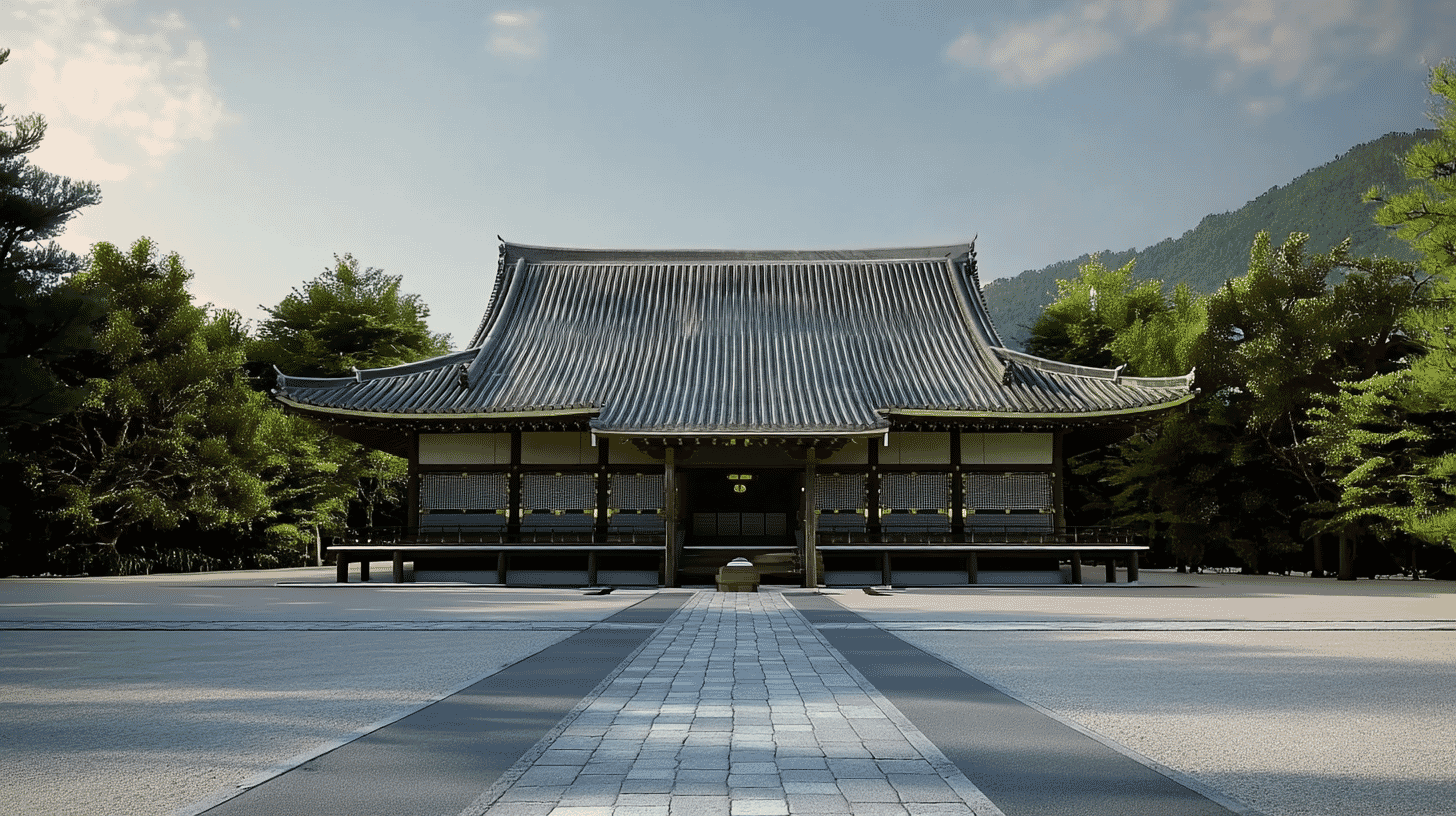
The hall is 7 bays by 5 bays and single-storey, under a hip-and-gable (irimoya) roof of heavy tile (Hongawarabuki), with a one-bay entrance canopy (Kōhai) on the front. Cultural Heritage Online describes it as a large building ringed on all four sides by hinged lattice shutters, a precious example of Momoyama palace architecture.
Moving from palace to temple changed the building a little. The same commentary notes that the original cypress-bark roof was replaced with tile. The entrance canopy, which shelters worshippers standing before the hall, appears to have been provided for its new role as a temple's main hall. What you see is the frame of a throne hall dressed for Buddhist worship.
Repairs continued into modern times; Cultural Heritage Online lists work on Ninnaji Temple Golden Hall in 1914.
Highlights: A Broad Facade, Lattice Shutters and a Sage on the Roof
Walk through the Chumon Gate and up the approach, and the Golden Hall stretches across the far end. The seven-bay front and the great hip-and-gable roof spread horizontally in a way that betrays its origin as a palace throne hall. Pause partway along the approach to watch the roofline and the entrance canopy line up.
Circle the building and you will see shitomido between the posts: lattice-faced wooden shutters that swing up and hook open, a fitting long used in palace architecture. Of everything on this Buddhist hall, they are the clearest trace of the palace it once was.
Look closely at the roof too. According to the temple, one of the tiles on Ninnaji Temple Golden Hall shows a figure riding a turtle: the Taoist sage Huang An, who by legend saw several times a turtle that surfaces only once in thousands of years. The tile stands for eternity.
The temple offers two explanations for the name Kondo, literally "golden hall": one traces it to an old word for the Buddha, "golden person," the other to the gilded decoration inside.
Visiting Ninnaji Temple Golden Hall
Ninnaji Temple Golden Hall stands inside the Chumon Gate toward the north of the grounds, and you can walk right up to its exterior. No Palace Garden ticket is needed.
The interior is open only during special openings that the temple schedules from time to time; normally you worship from in front of the hall. Check the temple's notices for any special opening.
Personal photography is allowed in the grounds, but not inside worship halls.
Admission to the grounds and directions are covered on the Ninnaji Temple page.
- 📍 Plan Your Visit to Kyoto
- Find tours, activities & transport passes near Ninnaji Temple Golden Hall
- [ Kinkakuji Fushimi Inari & Kimono Rental ]
Q&A
- When was Ninnaji Temple Golden Hall designated a National Treasure?
- On November 14, 1953. It had been designated an Important Cultural Property earlier, on April 7, 1900.
- What was Ninnaji Temple Golden Hall originally?
- The Shishinden, the throne hall of the imperial palace. According to the Agency for Cultural Affairs, a Shishinden built in 1611 was moved here in 1643, and it is the only Shishinden of the early modern period still standing.
- Can I go inside Ninnaji Temple Golden Hall?
- Only during special openings. At other times you worship from in front of the hall, and the exterior can be seen up close from the grounds.
- What is enshrined in Ninnaji Temple Golden Hall?
- The principal image is an Amida triad. According to the temple, statues of the Four Heavenly Kings and Bonten also stand inside, and the walls are painted with the Pure Land and Kannon in bright colors.
- What is the tile of a figure on a turtle on the roof of Ninnaji Temple Golden Hall?
- It shows the sage Huang An. According to the temple, he saw several times a turtle that surfaces only once in thousands of years, and the tile is placed there as a symbol of eternity.
Basic Information
| Name | Ninnaji Temple Golden Hall (仁和寺金堂) |
|---|---|
| Location | Omuro-Ouchi, Ukyo Ward, Kyoto City, Kyoto Prefecture |
| Designation | National Treasure (Building) |
| Year Designated | Important Cultural Property April 7, 1900; National Treasure November 14, 1953 |
| Quantity | 1 building |
| Dimensions | 7 bays by 5 bays (single storey, hip-and-gable roof, 1-bay entrance canopy, tiled) |
| Owner | Ninnaji Temple |
| Public Access | Exterior visible from the temple grounds; interior only during special openings |
References
- Agency for Cultural Affairs Database: Ninnaji Kondo
- https://kunishitei.bunka.go.jp/heritage/detail/102/1853
- Cultural Heritage Online: Historic Monuments of Ancient Kyoto, Ninnaji
- https://online.bunka.go.jp/special_content/component/30
- Japan Tourism Agency Multilingual Commentary Database: Kondo
- https://www.mlit.go.jp/tagengo-db/R1-00344.html
- Ninnaji: Guide to the Precincts (Japanese)
- https://ninnaji.jp/precincts/
- Ninnaji: Frequently Asked Questions (Japanese)
- https://ninnaji.jp/question/
Last verified: 2026.09.19
