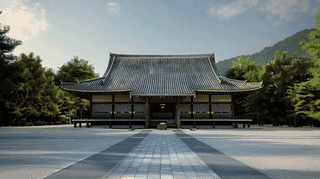
What Is Ninnaji Temple Treasure Museum?
Ninnaji Temple Treasure Museum (仁和寺霊宝館, Reihokan) is a museum building completed in 1927 near the center of the grounds of Ninnaji in Omuro-Ouchi, Ukyo Ward, Kyoto City, and it was registered as a Registered Tangible Cultural Property on October 28, 2011.
Ninnaji holds a large collection of Buddhist statues, paintings, sutras and documents, headed by the Amida triad said to be the temple's original principal image. The Reihokan was built to store and display them; the temple's multilingual commentary names housing the art and statuary handed down since the founding as one of its purposes.
Unlike the timber halls of the palace compound, Ninnaji Temple Treasure Museum is built of reinforced concrete. For a temple that had lost its palace to fire in 1887, protecting the collection from flames was the museum's first job, and the choice of structure follows directly from that.
Why Ninnaji Temple Treasure Museum Is Registered
The criterion was serving as a model of design. The museum is a 2-storey reinforced concrete building with a pantile (Sangawara-buki) roof and a building area of 376 square metres. It is arranged around a central court, like a hollow square, with a gabled (kirizuma) porch projecting from the middle of the south front.
What the Agency for Cultural Affairs singles out is the treatment of the outer walls. Azekura storehouses, the log-built treasuries in which temples and shrines have kept their valuables since ancient times, stack timbers of triangular section to form their walls. The Reihokan reproduces those horizontal ridges in concrete.
It also shows rafters (Taruki) and curved tie beams (Kōryō) on the outside, translating the parts of a wooden temple building into a new material. The Agency calls it a fine example of Japanese-style expression in concrete. Borrowing the look of the traditional treasure storehouse for a modern treasure house was a clever idea.
Highlights: The Ridged Walls and the Guardians at the Door
Stand in front of the south porch and look along the walls at an angle. The storehouse ridges cast stronger shadows seen obliquely than head-on, and that is when they read most like stacked timber. The rafter ends under the eaves are easiest to follow from the same angle.
On the entrance doors are copper-sheet figures of Jikokuten and Komokuten, painted in color. According to the temple's commentary, they were made to complete the set of Four Heavenly Kings attending the Amida inside, which lacked these two, and they are thought to be the work of Kataoka Yasushi, an architect and designer. Jikokuten, guardian of the east, holds a sword; Komokuten, guardian of the west, holds a brush and a scroll.
Exhibitions change theme every season, and the temple says everything except the Buddhist statues is rotated.
Visiting Ninnaji Temple Treasure Museum
Ninnaji Temple Treasure Museum is not open year-round; it opens for limited periods three times a year, in spring, summer and autumn. Dates and closing days vary from season to season, so check the temple's notices. Admission is 500 yen for adults and free for high school students and younger (as of September 2026).
During opening periods a combined ticket with the Ninnaji Palace Garden is available. Photography inside the museum is prohibited.
The museum stands on the east side of the main approach, on your right as you walk from the Nio-mon Gate toward the Chumon Gate, across the path from the Palace Garden. Even when it is closed you can see the exterior from the grounds.
Admission to the grounds as a whole and directions are covered on the Ninnaji Temple page.
- 📍 Plan Your Visit to Kyoto
- Find tours, activities & transport passes near Ninnaji Temple Treasure Museum
- [ Kinkakuji Fushimi Inari & Kimono Rental ]
Q&A
- When was Ninnaji Temple Treasure Museum built, and when was it registered?
- It was completed in 1927 and registered as a Registered Tangible Cultural Property on October 28, 2011, as a building that serves as a model of design.
- When is Ninnaji Temple Treasure Museum open?
- Only for limited periods in spring, summer and autumn. Dates and closing days vary each season, so check the temple's notices.
- How much does Ninnaji Temple Treasure Museum cost, and can I take photos?
- Admission is 500 yen for adults and free for high school students and younger (as of September 2026). A combined ticket with the Palace Garden is sold during opening periods. Photography inside is prohibited.
- What is special about the building of Ninnaji Temple Treasure Museum?
- Its concrete walls copy the stacked-timber ridges of an azekura storehouse, and it shows rafters and curved beams on the outside. The Agency for Cultural Affairs calls it a fine example of Japanese-style design in concrete.
- What are the figures on the door of Ninnaji Temple Treasure Museum?
- Painted copper-sheet images of Jikokuten and Komokuten, two of the Four Heavenly Kings. According to the temple, they were added to complete the Amida's guardians and are thought to be by Kataoka Yasushi.
Basic Information
| Name | Ninnaji Temple Treasure Museum (仁和寺霊宝館) |
|---|---|
| Location | 33-1 Omuro-Ouchi, Ukyo Ward, Kyoto City, Kyoto Prefecture |
| Designation | Registered Tangible Cultural Property (Building) |
| Year Designated | Registered October 28, 2011 |
| Quantity | 1 building |
| Dimensions | Building area 376 square metres (2-storey reinforced concrete, pantile roof, hollow-square plan, gabled porch on the south front) |
| Owner | Religious Corporation Ninnaji |
| Public Access | Open for limited seasons in spring, summer and autumn (admission charged); exterior visible from the temple grounds |
References
- Agency for Cultural Affairs Database: Ninnaji Reihokan
- https://kunishitei.bunka.go.jp/bsys/maindetails/101/00009045
- Japan Tourism Agency Multilingual Commentary Database: The Four Heavenly Kings at the Reihokan
- https://www.mlit.go.jp/tagengo-db/R1-00381.html
- Ninnaji: Guide to the Precincts (Japanese)
- https://ninnaji.jp/precincts/
- Ninnaji: About the Temple (Japanese)
- https://ninnaji.jp/about_outline/
- Ninnaji: Admission and Access (Japanese)
- https://ninnaji.jp/visit/
- Ninnaji: Frequently Asked Questions (Japanese)
- https://ninnaji.jp/question/
Last verified: 2026.09.19