
Nara
Tokyo · 奈良Browse Tokyo’s cultural heritage from the Nara period (710 – 794). Filter by type and keyword, with concise stories, maps, and travel tips.
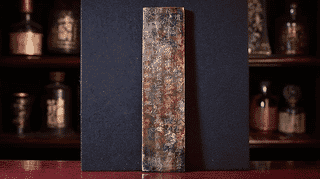
A copper epitaph found at Matsuokayama in Kashiwara, Osaka, now at the Mitsui Memorial Museum. Its inscription dates the burial to 668. National Treasure since 1961.
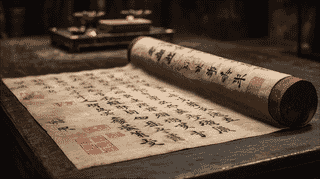
A Tang-dynasty copy of a letter by Wang Xizhi, kept in Tokyo. Nothing at all in his own hand survives, and so the copy itself is now the treasure here.
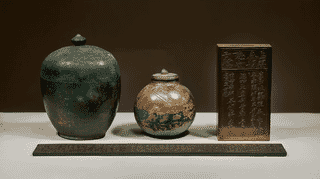
Archaeological material at the Tokyo National Museum in Tokyo. Its containers nest three deep here: a box, a jar, and a glass jar set inside that one.

A Southern Song tea bowl in Tokyo, known as the Inaba Tenmoku. Another bowl of the very same name here was listed on exactly the same day as this one.

A Southern Song-period silk painting of a quail bearing the "Zakkashitsu-in" connoisseurship seal of Shogun Ashikaga Yoshinori, this Important Cultural Property descends from the celebrated Higashiyama lineage of Chinese paintings cherished by the Ashikaga shogunal house, and is privately preserved in Tokyo as a quiet witness to Japan's medieval engagement with classical Chinese art.
Discover the Pigeon on a Peach Branch (Momohato-zu), a Japanese National Treasure attributed to Emperor Huizong of the Northern Song Dynasty. This exquisite silk painting from 1107 showcases the boneless (mokkotsu) technique, Slender Gold calligraphy, and a provenance tracing back to Shogun Ashikaga Yoshimitsu.
Discover the National Treasure bone repository vessel excavated from Miyajidake Shrine — a stunning Nara-period triple-layered cinerary urn of earthenware, bronze, and blown glass housed at the Tokyo National Museum, revealing ancient Japan's cremation practices and Silk Road connections.
Volume 78 of the Yogacarabhumi, copied in 767 for the monk Gyoshin's vow to transcribe 2,700 scrolls, finished by his disciples after he died. A twelve-metre scroll.
Calligraphy by the Southern Song Chan master Xutang Zhiyu on wax-coated paper, an Important Cultural Property prized as a tea-room scroll, privately held in Tokyo.
Discover the Tekagami (292 Leaves), a registered work of art at Tokyo National Museum. Compiled in 1861 by Edo Shogunate official painter Sumiyoshi Hirotsura, this rare album contains 292 fragments of Japan's finest ancient calligraphy spanning a thousand years from Nara to Edo periods.
Discover the National Treasure "Autumn Pasture with Cattle" (Akino Bokugyu-zu), a masterpiece of Southern Song Chinese painting attributed to court artist Yan Ciping. Housed at the Sen-oku Hakukokan Museum in Roppongi, Tokyo, this exquisite silk scroll once belonged to the Ashikaga Shogun's famed Higashiyama Collection.
A Tang manuscript of the Book of Han, chapter 57 on poet Yang Xiong, at Kyoto National Museum. Taboo strokes and 948 reading marks trace ten centuries of study.
This Tang-dynasty scroll at the Kyoto National Museum preserves 172 lines of the Shishuo Xinshu, the world's oldest surviving manuscript of the Chinese classic.
In 741 the monk Genbo commissioned 1,000 copies of this Kannon sutra. A lone scroll survives: a National Treasure of Nara calligraphy at the Kyoto National Museum.
A National Treasure album at the Kyoto National Museum, holding 240-plus calligraphy fragments from the 8th to 16th centuries, once used to authenticate old writing.
A Southern Song celadon vase of shimokabura form, a Japanese National Treasure with a smooth, crackle-free pale-blue glaze. Its kiln is still debated by scholars.
The National Treasure Nukatadera Garan narabini Jōrizu, held by the National Museum of Japanese History in Sakura, Chiba, is a rare large-scale map painted in the late Nara period (8th century) on four joined panels of hemp cloth. Depicting the jōri land-grid of Heguri District in Yamato Province and the detailed precinct of Nukatadera at its lower center, the map is an irreplaceable primary source on ancient Japanese land administration and Buddhist architecture.
A National Treasure near Tokyo: a Southern Song printing of the Hanshu in 61 fascicles, holding the earliest reliable Chinese record of Japan, the Wa people.
A complete Southern Song printing of the Book of the Later Han, kept in Sakura, whose account of the eastern peoples names Queen Himiko and an embassy of 57 CE.
A National Treasure near Tokyo: the Song-dynasty Shiji printed by Huang Shanfu, the oldest complete copy of the three-commentary edition, all 130 chapters intact.