
Shōwa
Tokyo · 昭和Browse Tokyo’s cultural heritage from the Shōwa period (1926 – 1989). Filter by type and keyword, with concise stories, maps, and travel tips.
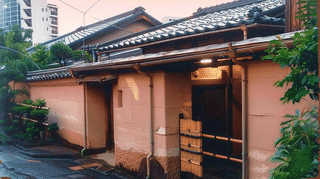
The front gate of Ohashi Saryo, a tea house at Toranomon, Tokyo, Japan. Framed in logs in the tea-house manner under a tiled roof, it is valued for its plain calm.
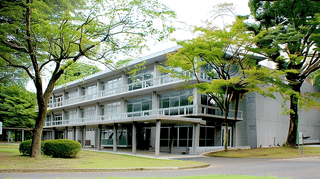
A Showa-period auditorium and student hall at ICU, Mitaka, Tokyo, Japan. Designed by the Vories office, it sets broad glass and early aluminium sashes round a court.
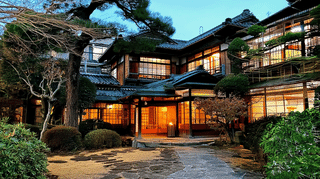
A Showa-period timber main house in Shirokanedai, Tokyo, Japan. Its own tatami rooms over there all run westward there in three quite offset sets now.

Held at The National Museum of Modern Art, Tokyo, this 1953 hanging scroll by Yasuda Yukihiko (1884–1978) depicts Konohana-no-Sakuyabime—the goddess of Mount Fuji and cherry blossoms from the Kojiki and Nihon Shoki. Designated a Registered Work of Art in 2019, it is recognized as one of the artist's representative masterworks of modern Nihonga.
Completed in 1933 at Shirokanedai, Tokyo, the Former Residence of Prince Asaka was designated an Important Cultural Property in 2015. Lalique glass survives inside.
The Kiyosu Bridge of 1928 over the Sumida in Tokyo, a self-anchored chain suspension bridge of the post-earthquake rebuilding, was modelled on a bridge at Cologne.
The only building Le Corbusier designed in Japan, opened in 1959. Its pilotis, central hall and spiral ramp embody his concept of a Museum of Unlimited Growth.
Completed in 1933 and extended by a second architect until 1965, this Nihombashi store was Japan's first department store designated an Important Cultural Property.
Completed in 1937 in Ueno Park, Tokyo, and designated an Important Cultural Property in 2001, this tile-roofed concrete building is the Tokyo National Museum Honkan.
The Mitsui Main Building in Nihonbashi, Tokyo, rebuilt in 1929 to designs by Trowbridge and Livingston of New York, lines its streets with a giant Corinthian order.
A 1927 steel and concrete department store in Nihonbashi, Tokyo, an Important Cultural Property since 2016, with a classical facade and an Art Deco atrium.
Meiji Seimeikan in Marunouchi, completed 1934, was the first Showa-era building listed as an Important Cultural Property. Its Corinthian colonnade faces the moat.
Built for the 1964 Tokyo Olympics and made an Important Cultural Property in 2021, Yoyogi National Stadium hangs its roof from cables slung between two 40m masts.
Berry Hall of Aoyama Gakuin in Shibuya, Tokyo, built in 1931 on the central rotary, is a Neo-Gothic hall with a chapel wing, buttresses and pointed arches.
An early Showa house in Shinjuku, Tokyo, with a Japanese wing of rare woods and a Western wing of French tiles, rustication and scratch tile. Registered in 2013.
The Igusa Kindergarten Building in Suginami, Tokyo, is a 1933 timber schoolhouse with an L-shaped plan around its hall. Registered in 2017, it is still in daily use.
The Ikegami Family Residence in Setagaya, Tokyo, is a 1932 Western-style house with Spanish tiles, a sunroom and Art Deco rooms. Registered in 2006; a private home.
Registered in 2018, Isago Family Nagaya is a five-unit timber row house of c.1932 on the Kishimojin approach in Zoshigaya, Tokyo, with an ochre metal-banded front.
Registered in 2010, Iseya Shop and Residence is a small 1927 timber shop-house in Nihonzutsumi, Tokyo, still a tempura shop, its gable facing a vanished embankment.
Issuiryo on a back street of Kagurazaka, Tokyo, a carpenters' dormitory of about 1951, shows chisel and adze work on its lattices and beams in the postwar townscape.