
Yayoi
弥生Browse Japan’s cultural heritage from the Yayoi period (300 BCE – 300 CE). Filter by prefecture, type, and keyword, with concise stories, maps, and travel tips.
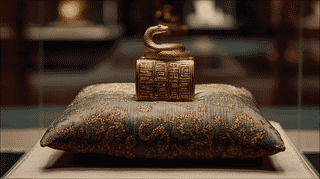
A solid gold seal of the Yayoi period at the Fukuoka City Museum, found on Shikanoshima in 1784. Its five characters set out the diplomatic ranking of the Han.

Thirty-nine Yayoi bronze bells found in 1996 at the Kamo Iwakura site in Shimane, the largest single find in Japan. They became National Treasures in 2008.
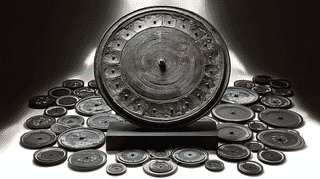
Yayoi-period finds in Fukuoka Prefecture, listed as a single lot. What came from the central burial is the property, and all of the rest an appendage.
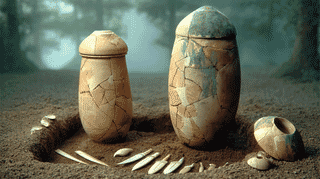
Yayoi-period archaeological finds from Chikushino, Fukuoka Prefecture, Japan. One single excavation there was split between two quite separate listings.
A Yayoi bronze bell excavated at Imukai in Fukui in 1868 and designated an Important Cultural Property in 1953. Now privately held in Aichi and not on view.
The Hilted Slender Bronze Sword (Yūhei Hosogata Dōken), excavated from the Ōyashiki Site in Nagato City, Yamaguchi Prefecture, is a rare middle Yayoi-period bronze artifact whose blade, hilt, and antenna-shaped pommel were cast as a single piece. One of only five such swords found in Japan—and the only one ever discovered on Honshu—it is designated an Important Cultural Property. Discover the story of its accidental 1901 unearthing, its mysterious link to the Yoshinogari Site, and the scenic Mukatsuku Peninsula that surrounds it.
Discover the Sakuragaoka Dōtaku, a National Treasure collection of 14 bronze bells and 7 bronze halberds from the Yayoi period, unearthed in Kobe. See rare pictorial bronze bells at Kobe City Museum.
Discover the Ryūsui-mon Dōtaku, National Treasure bronze bells adorned with flowing water patterns and pictorial scenes of Yayoi-period life, housed at Kobe City Museum in the heart of Kobe's historic foreign settlement.
Eight Yayoi-period tombs on a hilltop in northern Hiroshima preserve the transition to chiefly burial in unusual completeness, including three four-cornered protruding mounds. Designated a National Historic Site in October 2021.
Four Yayoi cemeteries in Karatsu, Saga, a Historic Site since 1966 and enlarged in 2014, showing early dolmens and the probable royal tomb of the land of Matsuro.
Excavated near Shibata in 1980-81, this Yayoi group centers on a 45.3 cm clay vessel shaped like a headless human torso that once held human bone. Designated 2013.
Discover the Lidded Bowl-Shaped Pottery with Stand, a designated cultural property from the Uriawari archaeological site in Osaka. Learn about its Yayoi-period origins, significance, and how to visit the Osaka Museum of History.
In 1984 an Izumo hillside yielded 358 bronze swords set on edge, with 16 spearheads and 6 bells beside them. The group became a National Treasure in 1998.
A pictorial Yayoi bronze bell at the Tokyo National Museum, said to come from old Sanuki, its six panels engraving deer hunts, herons, a granary and grain-pounders.
At the foot of Mount Miwa, the Makimuku Site preserves a 3rd-century building complex and 2,000 peach pits, central to the debate over Queen Himiko's Yamatai.
Perched on a 407-metre hilltop above the left bank of the Abukuma River in Shirakawa, Fukushima, the Tennouzan Site preserves a Yayoi-period village from around the 1st century CE. Its pottery became the type specimen for late Yayoi ceramics across southern Tohoku and Hokuriku, named Tennoyama-style. The site was designated a National Historic Site in 2021, and its excavated artifacts received National Important Cultural Property status in 2024. A new walking path leads visitors to the summit, while the nearby Shirakawa City Museum of History and Folklore displays original finds.
The Kamo Site in Kawanishi preserves one of the Kinki region's largest Yayoi villages, on a river terrace, known for a rare slope moat and a fenced timber hall.
A Late Yayoi hill settlement on northern Awaji, Hyogo, a Historic Site since 2021, with smithies and over 170 iron objects from two centuries of trade and ironworking.
Seven bronze dagger-axes found with fourteen bells on a Kobe hillside in 1964. Shaped like weapons yet never sharpened, they are a Yayoi National Treasure.