
Taishō
大正Browse Japan’s cultural heritage from the Taishō period (1912 – 1926). Filter by prefecture, type, and keyword, with concise stories, maps, and travel tips.
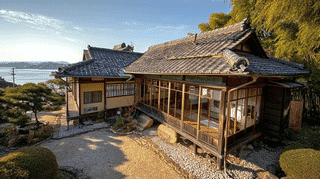
A detached building of 1916 on a hill in Gamagori, Aichi. A room stepping out to the southeast carries snow-viewing screens over Mikawa Bay. Registered in 2022.
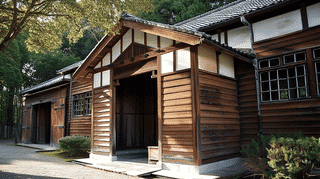
A martial arts hall of 1917 at Meiji Mura in Inuyama, Aichi, moved there from Kanazawa in 1970. A Western roof truss clears its floor of every column.
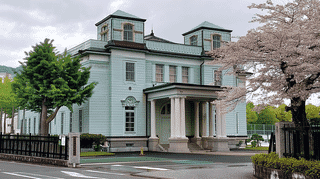
A timber auditorium of 1922 in Matsuyama, Ehime, built for a school run by the ministry. Its front carries a large porte-cochere of eight Tuscan columns.
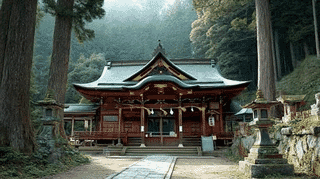
A shrine hall of 1919 in Maniwa, Okayama, just 12 square metres. Its walls are laid in two layers, with round posts outside and square ones set within.
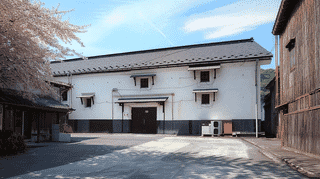
A large Taisho-period storehouse in Tome, Miyagi, fifteen bays long. Its roof frame imitates a Western truss, bolted and strapped together with iron straps.
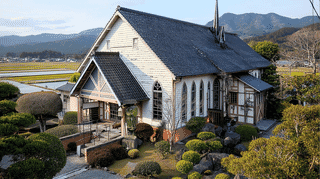
A temple main hall of 1926 in Yunomae, Kumamoto, Western throughout: mansard roof, pointed-arch windows, trussed roof. Said to be the head priest's son's design.
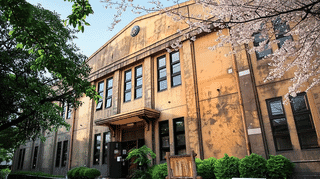
A Taisho-period school building in Soka, Saitama Prefecture, Japan. Its own roof over there was given over to use as a playground even so even now today.
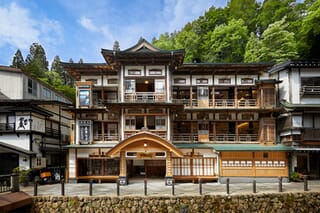
A three-storeyed Taisho timber building in the Ginzan hot-spring town, Yamagata, Japan. Its ground-floor bath faces the street; its river verandas shape the town.
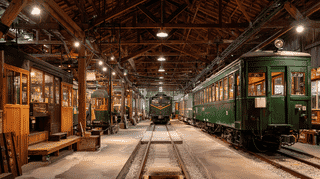
A Taisho-period timber locomotive shed in Joetsu, Niigata Prefecture, Japan. It runs about 40 whole metres from east to west over there even so today.
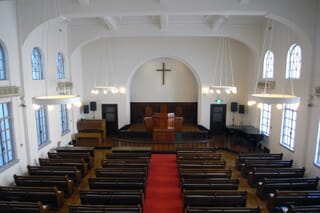
A church of 1925 facing Sakaisuji in central Osaka, Gothic in its pointed arches but deliberately flat across the front so it sits in the street. Listed in 2000.
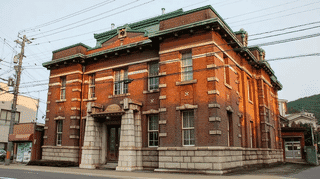
A Taisho-period office at a river mouth in Imizu, Toyama Prefecture, Japan. Built for a shipping firm and now a head office, it lays brown brick over timber.
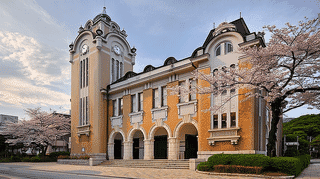
A public hall of 1924 at Fumotoyama in Koriyama, Fukushima, built to mark the city charter, with an arched colonnade and a corner tower. Listed in 2002.
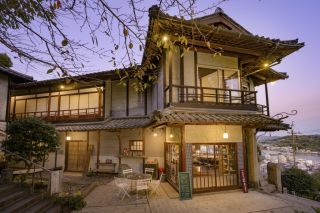
Former inn of about 1923 on Senkoji hill in Onomichi, Hiroshima, set on a high stone wall with a veranda over the Onomichi Channel; now used for lodging.

Tunnel of 1912 on the Watarase Keikoku Railway under the Gunma-Tochigi border, 362 metres long, the Ashio Railway's longest, with a brick arch and six refuges.
The Former Saionji Family Okitsu Villa 'Zagyoso,' preserved at the Museum Meiji-mura in Inuyama, Aichi Prefecture, was the seaside retreat of Prince Saionji Kinmochi, Japan's last elder statesman. Designated as an Important Cultural Property in 2017, the complex includes the main house, guard station, attendants' waiting area, and gate—showcasing exquisite sukiya-style craftsmanship and the political history of modern Japan.
A 1913 county public hall and products exhibition hall in Okazaki, Aichi: among the earliest surviving county public buildings, closed since 2010 for repairs.
The 1913 Church of St. Matthew at Toyohashi is a wooden Orthodox sanctuary attributed to Kawamura Izo, Aichi's oldest, named an Important Cultural Property in 2008.
Completed in 1922, this Nagoya courthouse is Japan's oldest surviving court of appeals. Free entry to its Neo-Baroque stairwell and restored 1922 conference room.
Granite gate pillars at Okazaki High School, Aichi, early Taisho. Western classical columns meet a Japanese rough stone finish, registered in 2017 and still in use.
Reinforced-concrete gate pillars raised around 1925 for a sericulture school in Nishio, Aichi. Their Secession-style geometry won national registration in 2017.