
Jōmon
縄文Browse Japan’s cultural heritage from the Jōmon period (14,000 – 300 BCE). Filter by prefecture, type, and keyword, with concise stories, maps, and travel tips.
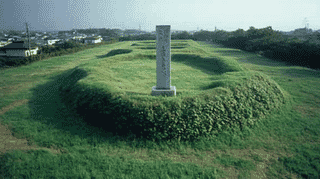
A late Jomon settlement in Iwatsuki Ward, Saitama City, where a ring of shells 150 metres across sits beside a waterlogged peat site. Designated in 1975.
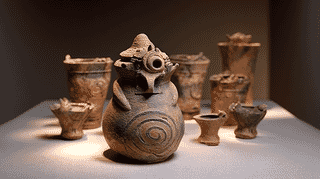
Jomon-period finds from Minami-Alps City in Yamanashi Prefecture. Their own quantity field there reads as just a single lot, with no number given at all.
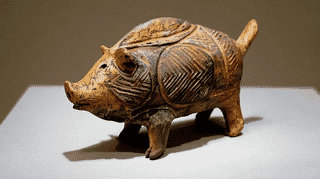
A Jomon-period boar-shaped clay object held in Hirosaki, Aomori Prefecture. The very same piece appears here in two quite separate records online too.
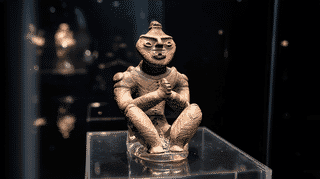
A late Jomon-period figurine in Aomori Prefecture, mended with the natural asphalt by the people of its own time after it had been broken into four parts.
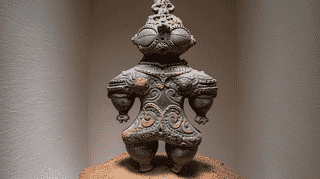
A Jomon-period clay figurine held in Tokyo. Its own name carries the find-spot in Miyagi Prefecture, while its own reading field there does not at all.

A Jomon-period figurine in Hokkaido Prefecture. Its own legs are set as if it were standing upright, yet the record says it will not stand at all here.
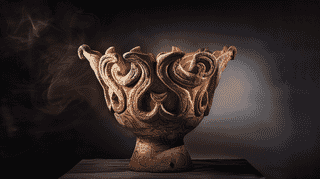
Fifty-seven Middle Jomon vessels from the Sasayama Site, led by flame-style pots, became Japan's first Jomon pottery National Treasure in 1999. Shown in Tokamachi.

The Ireibaru Site in Chatan Town, Okinawa, is a nationally designated historic site preserving roughly 7,000 years of continuous human life from the early Jomon period through the Gusuku era. Centered on the perpetually flowing Uchinukā spring, the waterlogged lowlands have yielded Okinawa's oldest wooden artifacts, the prefecture's first comb, jadeite from Niigata, and obsidian from Kyushu, attesting to wide-ranging exchange between the southern islands and mainland Japan. Opened to the public in 2025, the site park and the adjacent Chatan Town Museum offer a vivid hands-on encounter with prehistoric Okinawa.
Discovered on the floor of Pit Dwelling No. 1 at the Nukatsuka Site in Katano-machi, Takayama, this pair of shallow bowl-shaped Jomon vessels was designated a National Important Cultural Property in 1988. Their flat disk forms, intricate impressed patterns, and rings of small holes preserve evidence of cultural exchange between the Hida highlands and eastern Japan some five thousand years ago. Encounter them at the Hida Takayama Museum of History and Art.
A complete polished jadeite axe from the Kamegaoka Site in Aomori, now housed at Miyagi's Tōhoku History Museum. Designated an Important Cultural Property in 1973, this 9 cm masterpiece reveals Jōmon-era craftsmanship and the vast trade network that carried Itoigawa jadeite across ancient Japan.
On a wooded slope in Minakami, Gunma, two Jomon stone-paved dwelling floors survive as a National Historic Site, preserving their stone hearths and a buried jar.
Late to Final Jomon finds from the Ushiroya wetland site in Okegawa, Saitama, an Important Cultural Property since 2011, including lacquered combs and painted clay earrings.
A 45 cm Middle Jomon figurine from Funagata, Yamagata, known as the Jomon Goddess, a National Treasure since 2012 on display at the Yamagata Prefectural Museum.
In Mitsuke, Niigata, the Mimitori Site holds three Jomon villages layered on one hilltop, including a ring settlement with an 18-meter plaza and rare jade beads.
Spanning the city of Tokamachi and the town of Tsunan in Niigata Prefecture, the Honnoki and Tazawa Site Group is a National Historic Site preserving the dawn of the Jomon period. Composed of the Honnoki, Tazawa, and Jin Sites near the confluence of the Shinano and Kiyotsu Rivers, the group contains stone tools and pottery dating from around 15,000 to 12,500 years ago, offering an unusually clear record of how Ice Age communities transitioned from mobile Paleolithic hunting to riverside Jomon life.
At a Nagaoka museum, 1,402 Muroya Cave finds include rare Incipient Jomon pottery and Niigata's oldest burial, a woman laid to rest with a pot by her head.
Over a thousand stone spear points and Japan's oldest pottery from a Niigata river terrace: an Incipient Jomon find that named a famous debate on the Jomon's start.
The Motoyashiki Ruins finds, 1718 Jomon objects from a Niigata site now under a dam lake, were designated in 2015 and are shown at Jomon no Sato Asahi in Murakami.
Two ring-shaped shell mounds in Chiba form a figure eight, one of Japan's largest Jōmon settlements. Calcium-rich soil preserved human and dog bone for millennia.
Kōde shell mound finds in Matsudo: 266 nationally designated Early Jōmon objects, some 6,000 years old. Spouted cooking pots, cord-marked wares, slit stone earrings and a boar-tusk pendant, all held at the Matsudo City Museum.