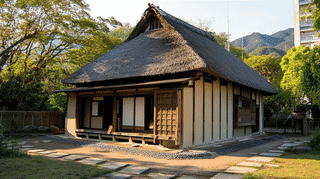
About the Oishi Family Residence Household Rice Storehouse and Waterwheel Shed
The Oishi Family Residence Household Rice Storehouse and Waterwheel Shed (大石家住宅飯米蔵及び水車小屋, Ōishi-ke Jūtaku Hanmaigura oyobi Suishagoya) is an earthen-walled storehouse with a waterwheel shed, built in 1884 southeast of the Unhulled Rice Storehouse on the Oishi estate in Yane, Tanto-cho, Toyooka City, Hyogo Prefecture, and registered as a Registered Tangible Cultural Property in 2011. Hanmai is rice kept for the household's own meals.
The storehouse itself is a two-storey Dozo-zukuri building 5.1 metres by 4.1 metres (Ketayuki × Harima), under a gabled (kirizuma) roof of pantiles set over the walls as an Okiyane, with its ridge running north to south. The Oishi Family Residence Household Rice Storehouse and Waterwheel Shed is registered as one building together with its timber waterwheel section and a wall, with a building area of 30 square metres. It was refitted in the early Showa period (1926–1945).
A waterwheel under the eaves
On the east side of the Oishi Family Residence Household Rice Storehouse and Waterwheel Shed is a lean-to canopy, and its north corner is partitioned off to house a waterwheel. Storehouse and waterwheel are combined in one structure. The Agency for Cultural Affairs does not say what the wheel drove, but writes that the building recalls the way daily life was lived in the modern era.
The storehouse stands on a base of irregular stones in random courses (Ranzumi) topped with two courses of dressed stone. The lower walls are clad in vertical boards, with Shikkui plaster above. It was registered as a Registered Tangible Cultural Property for its contribution to the historic landscape.
What to look for
Start at the base. Two courses of cut stone laid over the rough random stonework make a double footing, one step more careful than the plain random-stone base of the neighbouring Unhulled Rice Storehouse. With the vertical boarding above it, this small storehouse is well protected where it meets the ground.
Its position matters as well. The building stands southeast of the Unhulled Rice Storehouse, and the wall of the Unhulled Rice Storehouse East Gate, running from that storehouse's south face, joins the wall of the Oishi Family Residence Household Rice Storehouse and Waterwheel Shed. The store for husked grain and the store for everyday rice are linked by a single run of wall and gate.
Visiting the Oishi Family Residence Household Rice Storehouse and Waterwheel Shed
The Oishi Family Residence Household Rice Storehouse and Waterwheel Shed is part of a private home and is not open. The waterwheel sits in a partitioned corner under the canopy and is probably hard to see from outside the grounds.
Q&A
- What is the Oishi Family Residence Household Rice Storehouse and Waterwheel Shed?
- A two-storey earthen-walled storehouse for the family's everyday rice, combined with a waterwheel housed under a canopy on its east side.
- When was the Oishi Family Residence Household Rice Storehouse and Waterwheel Shed built?
- The Agency for Cultural Affairs dates it to 1884, with a refit in the early Showa period (1926–1945).
- What does "household rice" mean at the Oishi Family Residence Household Rice Storehouse and Waterwheel Shed?
- Rice set aside for the family's own meals (hanmai). The estate also has a Rice Storehouse and an Unhulled Rice Storehouse, each named for what it held.
- Why is the Oishi Family Residence Household Rice Storehouse and Waterwheel Shed a Registered Tangible Cultural Property?
- It was registered in 2011 for its contribution to the historic landscape. The Agency says it recalls how daily life was lived in the modern era.
- Can I see the waterwheel at the Oishi Family Residence Household Rice Storehouse and Waterwheel Shed?
- It is part of a private home and not open. The waterwheel sits in a partitioned corner under the canopy and is hard to see from outside.
Basic Information
| Name | Oishi Family Residence Household Rice Storehouse and Waterwheel Shed (大石家住宅飯米蔵及び水車小屋) |
|---|---|
| Location | 1076 Kanaya, Yane, Tanto-cho, Toyooka City, Hyogo Prefecture, and other lots |
| Designation | Registered Tangible Cultural Property (building) |
| Year Designated | Registered in 2011 |
| Quantity | 1 building |
| Dimensions | 5.1 m × 4.1 m (ketayuki × harima), building area 30 m² (with wall) |
| Owner | Private individual |
| Public Access | Not open to the public (part of a private home) |
References
- Agency for Cultural Affairs, Database of National Cultural Properties: 大石家住宅飯米蔵及び水車小屋
- https://kunishitei.bunka.go.jp/bsys/maindetails/101/00008529
- Agency for Cultural Affairs, Database of National Cultural Properties: 大石家住宅籾蔵東門
- https://kunishitei.bunka.go.jp/bsys/maindetails/101/00008532
Last verified: 2026.10.01