
Muromachi
Kyoto · 室町Browse Kyoto’s cultural heritage from the Muromachi period (1336 – 1573). Filter by type and keyword, with concise stories, maps, and travel tips.
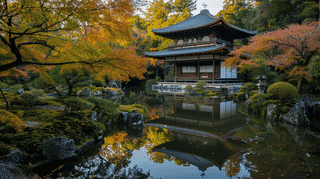
A pavilion of 1489 at Jishoji in Kyoto, its first storey a dwelling in the shoin manner and its second a Zen-style Buddhist hall. National Treasure since 1951.
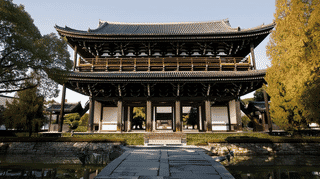
A two-storey gate of five bays at Tofukuji in Kyoto. Though it stands at a Zen temple, its structure follows the great Buddha manner instead of the Zen.
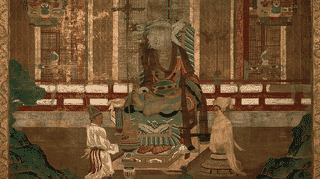
A Buddhist painting in sixteen scrolls owned by Seiryoji in Kyoto. The record gives its country as Song and its period as Northern Song, not as Japan.
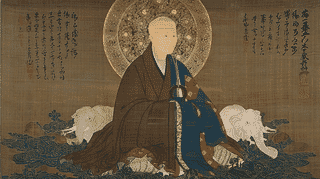
A Southern Song painting on one scroll at Tofukuji, Kyoto, showing the full figure. It came down in a single box with a second scroll of the same title.
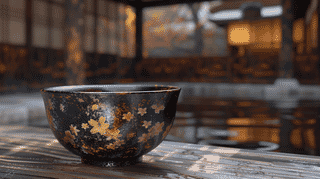
A Southern Song tea bowl held at Shokokuji in Kyoto Prefecture. On the inside, the pattern is formed exactly where the upper glaze was simply left off.
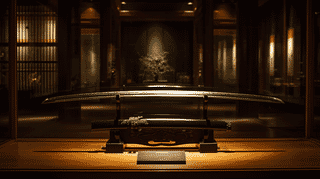
A Muromachi-period tachi at Kitano Tenmangu in Kyoto. Its title copies out the blade's own inscription, which can be read only as far as the year itself.
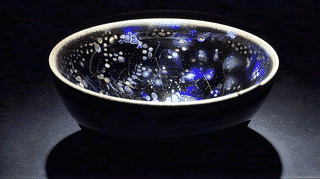
A tea bowl held at Ryukoin in Kyoto Prefecture. Yet another bowl of the very same name is recorded there under a different system of listing altogether.
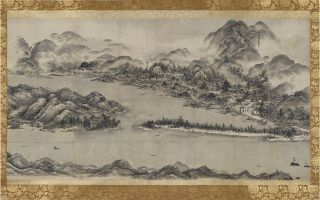
Sesshu's View of Amanohashidate, a National Treasure in Kyoto, maps the famed sandbar from a sky-high viewpoint that never existed. An unsigned sketch turned icon.

Discover the Persian Manuscript in Japan, a remarkable 13th-century document brought from Song-dynasty Quanzhou by the monk Keisei. This Important Cultural Property contains Persian poetry and reveals the vibrant maritime Silk Road connections between medieval Japan, China, and Persia.
Housed at the Kyoto National Museum, the Hanada-ito Odoshi Dōmaru is an Important Cultural Property of Muromachi-era armor laced with pale indigo cords and complete with its helmet and large shoulder guards. Its akoda-shaped helmet, intricate shakudō chrysanthemum fittings, and connection to the Nasu family — famed for the legendary archer Nasu no Yoichi — make it a rare window into medieval Japanese martial and craft heritage.
An Important Cultural Property of Japan held privately in Kyoto Prefecture. This hanging scroll is a Zen ink-trace (bokuseki) brushed in 1268 by the Southern Song Chan master Wu'er Kexuan (also known as Shiqiao Kexuan), giving a verse-poem to his disciple Ming, who served as the temple's head of guests. As a precisely dated late-Southern-Song original, it is a primary document of Sino-Japanese Zen exchange and an exemplar of the calligraphy that came to be revered as the highest form of hanging scroll in the Japanese tea ceremony.
This Important Cultural Property is an ink calligraphy (bokuseki) by Lingshi Ruzhi, a Yuan-dynasty Chan monk and direct disciple of the celebrated master Xutang Zhiyu. Written in 1330 as a gatha for the monk Zhèngtáng, this work connects the spiritual lineage of Rinzai Zen with Japan's tea ceremony culture and is privately held in Kyoto Prefecture.
Izumo Daijingu's main hall in Kameoka, Kyoto: a three-bay nagare-zukuri sanctuary of 1346 under a cypress-bark roof, an Important Cultural Property since 1906.
The main hall of Itsuki Shrine in Ayabe, Kyoto, a one-bay nagare-style hall of the mid-Muromachi period with unusual Zen-style details, was designated in 2024.
Ridge tags date this single-bay nagare-zukuri hall in Kameoka to 1338, with rebuilding in 1459. A rare surviving village shrine of its era, designated in 1941.
Before Enjoji's main hall in northern Kyoto stands a stone stupa carved in 1351, dated by the Southern Court calendar and signed by a monk called Gyoshu.
Carved in 1358 on a wooded slope west of Kameoka, this granite pagoda is recorded as the only medieval thirteen-storey stone tower left standing in Tanba.
Built in 1419 in the hills of Nantan, this one-bay shrine hall preserves rare roof detail and the twelve carpenter's templates designated alongside it.
Early Muromachi stone hokyointo stupa on a base at Kakushoin, the sub-temple by the gate of Daikakuji in Saga, Kyoto; the temple grounds are open to visitors.
Three-storey pagoda of 1442 at Gansenji in Kizugawa, Kyoto, about 18 metres tall, dated by an inscription found in 1943; the ground floor opens seasonally.