
Meiji
明治Browse Japan’s cultural heritage from the Meiji period (1868 – 1912). Filter by prefecture, type, and keyword, with concise stories, maps, and travel tips.
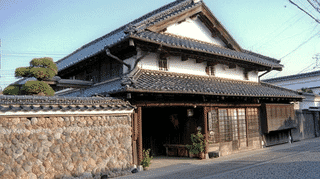
A Meiji storehouse on the north side of the Abuden Miso plot in Tochigi, its lean-to wall running on into a tuff boundary wall. Listed as heritage in 2004.

An 1885 storehouse on the north side of the Abuden Miso plot in Tochigi, three floors inside and two from without, built by the local master Mitomi Seibei.
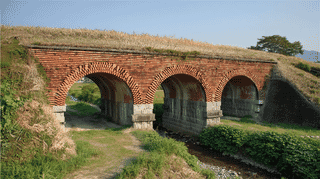
A Meiji-period brick railway bridge of three arches at Aka, Fukuoka Prefecture, Japan. Its downstream brickwork, toothed for a second track, has become ornament.
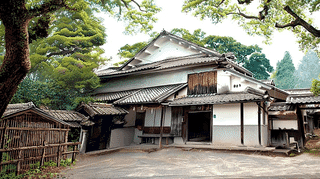
A Meiji-period main house in Ukiha, Fukuoka Prefecture, Japan. Its own roof over there takes one form east and quite another form west even so even now.
The 1904 main house of the Iwasa Residence at Toba in Akashi, Hyogo, plastered black with lean-tos on three sides. Listed as a heritage building in 2007.
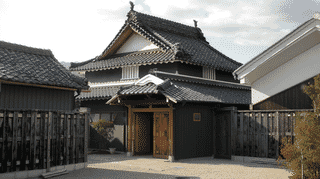
The 1904 storehouse of the Iwasa Residence at Toba in Akashi, Hyogo, two bays square in white plaster under formal tiles. Listed as a heritage building in 2007.
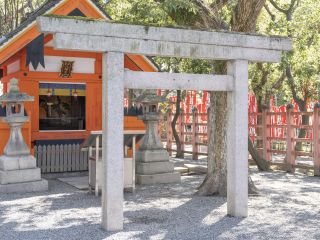
The Sumiyoshi Taisha Wakamiya Hachimangu Torii Gate is a small 1907 stone torii in Osaka with square pillars and straight lintels, a rare form in the grounds.
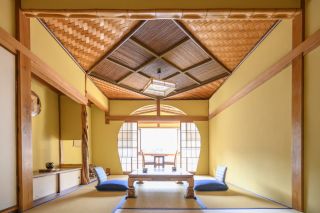
Kiya Ryokan is a nationally registered tangible cultural property in Misasa, Tottori Prefecture. Founded in 1868, this wooden inn preserves Meiji, Taisho, and Showa-era architecture alongside rare foot-emerging radium hot springs and a traditional ondoru bath.
Discover the Persian Manuscript in Japan, a remarkable 13th-century document brought from Song-dynasty Quanzhou by the monk Keisei. This Important Cultural Property contains Persian poetry and reveals the vibrant maritime Silk Road connections between medieval Japan, China, and Persia.
An Important Cultural Property of Japan held privately in Kyoto Prefecture. This hanging scroll is a Zen ink-trace (bokuseki) brushed in 1268 by the Southern Song Chan master Wu'er Kexuan (also known as Shiqiao Kexuan), giving a verse-poem to his disciple Ming, who served as the temple's head of guests. As a precisely dated late-Southern-Song original, it is a primary document of Sino-Japanese Zen exchange and an exemplar of the calligraphy that came to be revered as the highest form of hanging scroll in the Japanese tea ceremony.
A Southern Song-period silk painting of a quail bearing the "Zakkashitsu-in" connoisseurship seal of Shogun Ashikaga Yoshinori, this Important Cultural Property descends from the celebrated Higashiyama lineage of Chinese paintings cherished by the Ashikaga shogunal house, and is privately preserved in Tokyo as a quiet witness to Japan's medieval engagement with classical Chinese art.
Discover the Pigeon on a Peach Branch (Momohato-zu), a Japanese National Treasure attributed to Emperor Huizong of the Northern Song Dynasty. This exquisite silk painting from 1107 showcases the boneless (mokkotsu) technique, Slender Gold calligraphy, and a provenance tracing back to Shogun Ashikaga Yoshimitsu.
Held by the Diplomatic Archives of the Ministry of Foreign Affairs, Tsushin Zenran (320 volumes) and Zoku Tsushin Zenran (1,784 volumes) form Japan's first systematic compilation of diplomatic records. Covering the turbulent decade from 1859 to 1868, these approximately 2,000 volumes contain primary documents on Perry's arrival, the Namamugi Incident, and other pivotal Bakumatsu events. Designated an Important Cultural Property in 2016, related materials can be viewed free of charge at the Exhibition Room on the 5th floor of Mori JP Tower in Azabudai Hills, Tokyo.
Self-taught photographer Yokoyama Matsusaburo learned his craft to portray his mother. These 83 objects, kept by one Hakodate family, survive from early Meiji Japan.
Calligraphy by the Southern Song Chan master Xutang Zhiyu on wax-coated paper, an Important Cultural Property prized as a tea-room scroll, privately held in Tokyo.
The 1869 house of the Uchida Sashichi family, leading Utsumi shipowners, in Minamichita, Aichi: a rare Pacific-side shipowner's home, open at weekends.
The Oguri Residence in Handa, Aichi, a brewing dynasty's Meiji home, was named an Important Cultural Property in 2022 for its grand doma beamwork and tea rooms.
Discover the Former Ise Post Office (Uji-Yamada Post Office), a designated Important Cultural Property and the only surviving wooden post office from Japan's Meiji era. Now preserved at Museum Meiji-mura in Inuyama, Aichi, this 1909 half-timbered masterpiece features a striking V-shaped plan, conical dome, and a still-functioning postal service.
Built in Yamanashi in 1885 and moved to Meiji Mura in Aichi in 1964, this giyofu county office mixes Western trusses with Japanese roof framing under one roof.
Discover the Former Gofukuza Theater, an Important Cultural Property at Museum Meiji-Mura in Inuyama, Aichi. This Meiji-era kabuki playhouse features a revolving stage, naraku underpass, and traditional Edo-period theater architecture.